
India's Strategic Shift: A New Era of Military Power
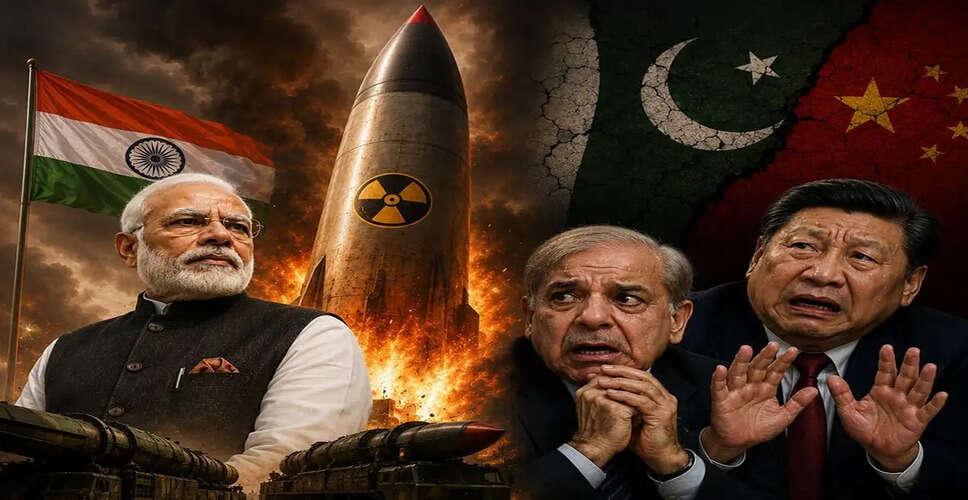

India's Emergence as a Military Power
India has taken a significant step on the global strategic map, creating ripples from Beijing to Islamabad. A recent report from a global strategic studies institute has highlighted that India has emerged as a superpower equipped with decisive deterrence capabilities. For the first time during peacetime, India has actively deployed 12 nuclear weapons, showcasing not just a numerical increase but also a shift in its strategic thinking, maritime strength, and national security policy.
Nuclear Arsenal and Strategic Implications
According to the report, India now possesses a total of 190 nuclear weapons, with 12 actively deployed. Previously, it was believed that India kept its nuclear arsenal and missiles separate, but now it has made it clear that any aggressive action from adversaries will be met with an immediate and devastating response. This shift comes at a time when China is rapidly expanding its nuclear stockpile and Pakistan continues to engage in nuclear threats.
Strengthening Maritime Deterrence
A crucial aspect of India's new strategic posture is its maritime deterrence capability. The Indian Navy's fleet of nuclear-powered ballistic missile submarines has achieved a level of strength considered among the most secure and lethal retaliatory capabilities in the world. By August 2024, submarines like INS Arighat and INS Aridaman will be fully operational, capable of lurking in the ocean depths for months while monitoring enemy movements and striking when necessary.
Reliable Second Strike Capability
This capability is referred to as a reliable second-strike capability in strategic terms. If an adversary were to launch a nuclear attack on India, the response would be so severe that it would be remembered for generations. This serves as the strongest shield for India's peace policy. While India maintains a no-first-use policy, it signifies not weakness but a controlled and responsible display of power.
Transformations in National Security Policy
Under Prime Minister Narendra Modi's leadership, India's national security policy has undergone unprecedented changes in recent years. Previously focused solely on border security, India's strategic scope has now expanded from the Indian Ocean to the Indo-Pacific. The Modi government has made it clear that a new India will not only defend its borders but will also crush any strategic conspiracies at their roots.
A Warning to China
This development serves as a warning to China. The report indicates that China now possesses 620 nuclear weapons and is rapidly expanding its nuclear arsenal. The construction of massive missile sites in northern China and the demonstration of new nuclear systems indicate Beijing's intent to shift the future balance of power in its favor. However, China must understand that today's India is not the India of 1962. The Indian Army, Navy, and Air Force are now equipped with modern technology, swift decision-making capabilities, and formidable retaliatory power.
Long-Range Nuclear Capability Development
India's development of long-range nuclear capabilities is also strategically aimed at China, which has consistently pursued policies of intrusion in the Indian Ocean, border tensions, and regional pressure. India has made it clear that any challenge to its sovereignty will not be limited to the borders.
Pakistan's Nuclear Blackmail Politics
For Pakistan, this situation is even more serious. Islamabad has long engaged in nuclear blackmail politics. Its strategy of harboring terrorism and scaring the world under the guise of nuclear threats is no longer sustainable. Following surgical strikes, airstrikes, and Operation Sindoor, India has conveyed a strategic message that any act of aggression from Pakistan will be met with a response harsher than its imagination. The new India knows how to tackle both terrorism and nuclear threats.
Global Nuclear Arms Race Concerns
On a global scale, the new arms race concerning nuclear weapons is raising concerns. There are over 12,000 nuclear weapons worldwide, with Russia and the United States remaining the largest nuclear powers. Russia possesses approximately 4,400 and the U.S. around 3,700 usable nuclear weapons. However, the most pressing concern is the weakening of nuclear control systems, with arms control agreements breaking down and superpowers re-entering the arms race.
India's Role in Global Stability
In this context, India's emergence is not just about military expansion but also about the necessity for global balance. India is a responsible democratic power that advocates for stability and balance rather than aggressive expansionism. This is why the world views India's nuclear capabilities not as a threat but as a stabilizing force.
Advancements in Defense Production
The Modi government has rapidly advanced in defense production, missile technology, space surveillance, maritime security, and nuclear deterrence capabilities, elevating India to new strategic heights. Today, India is not just preparing for war but is compelling adversaries to think twice before initiating conflict.
Preparedness Against Aggression
Beijing and Islamabad must understand that India is now prepared on all fronts. If China does not cease its expansionist policies and Pakistan does not shut down its terrorism factories, the new India will not stop at mere warnings. India's strength is now present in the depths of the oceans and the heights of the skies. This is the India that seeks peace, but if war is thrust upon it, it possesses the capability to deliver a historic response.