
India's Strategic Partnership with Taiwan: A Path to Technological Growth
Strengthening Ties with Taiwan
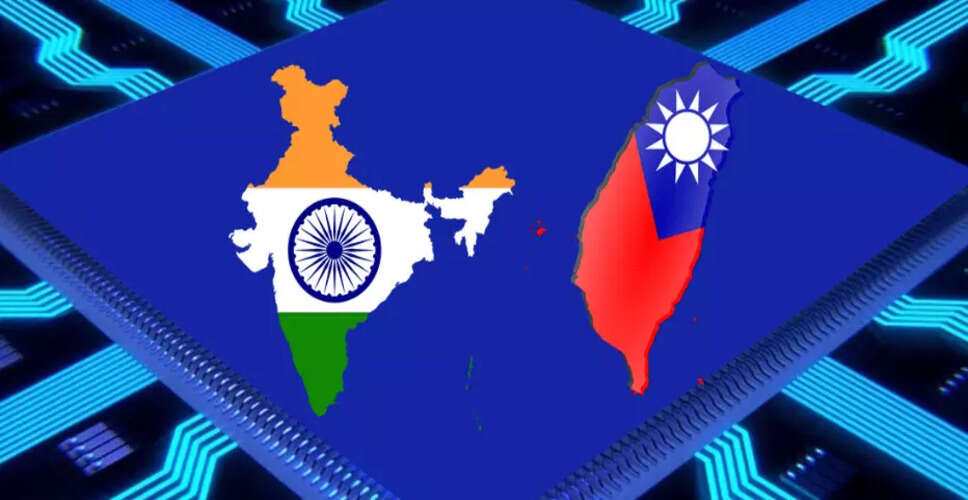
New Delhi, Dec 16: India recognizes Taiwan as a crucial ally in technology, particularly due to its prominence in chip manufacturing. Collaborating in this sector is seen as essential for economic development, technological progress, and achieving strategic independence, according to a recent media report.
The Indian government has actively sought partnerships with significant Taiwanese firms for several years. However, there is a need for broader awareness and engagement across various sectors, including institutions and policymaking, as noted in an article from a Taiwanese publication.
One notable initiative is the joint master's program in semiconductor technology, which involves four Taiwanese universities and the Indian Institute of Science. This program enhances connections between Indian educational institutions and Taiwan's semiconductor industry, encouraging Indian engineers and tech professionals to participate and facilitating the transfer of crucial expertise.
In addition to educational initiatives, India should contemplate the establishment of a science park dedicated to Taiwan. Such a facility would not only attract Taiwanese businesses but also foster structured, long-term collaborations, serving as a clear indication of India's commitment to enhancing its technological and industrial capabilities in partnership with Taiwan.
The article emphasizes that India should adopt a more assertive and consistent stance towards Taiwan, moving beyond unnecessary caution. It suggests that consultations and dialogues should be elevated, with Indian officials at various levels engaging in discussions. Ministries overseeing economics, technology, and trade should hold meetings at least at the deputy ministerial level to ensure ongoing and effective collaboration. Parliamentary channels should also be utilized to promote Indian interests.
A dedicated parliamentary committee focusing on Taiwan-India relations could ensure continuity, oversight, and strategic direction, making engagement more deliberate and long-term rather than reactive.
The article also critiques China's growing assertiveness, referencing an incident where an Indian woman from Arunachal Pradesh faced detention and harassment at a Shanghai airport, targeted solely due to China's claim over her home state. This was followed by a statement from the Chinese Ministry of Foreign Affairs, which reiterated that China does not recognize Arunachal Pradesh, referring to it as Zangnan.
It is noted that India cannot afford to be passive in its interactions with China. This approach is not about confrontation but about asserting India's priorities, protecting its sovereignty, and recalibrating its regional stance. If India continues to engage with Taiwan with excessive caution, it risks missing vital opportunities to strengthen its position in the shifting balance of power in Asia.
Furthermore, some Indian states have begun to engage with Taiwan, yielding positive results in commercial and technological collaborations. However, beyond these isolated successes, substantial outcomes remain limited.