
India's Semiconductor Revolution: PM Modi Unveils Ambitious Plans for Future Growth

A New Era in Semiconductor Manufacturing
New Delhi: On Saturday, Prime Minister Narendra Modi announced that India has commenced operations at three semiconductor manufacturing plants, with plans for an additional five to eight facilities in the near future.
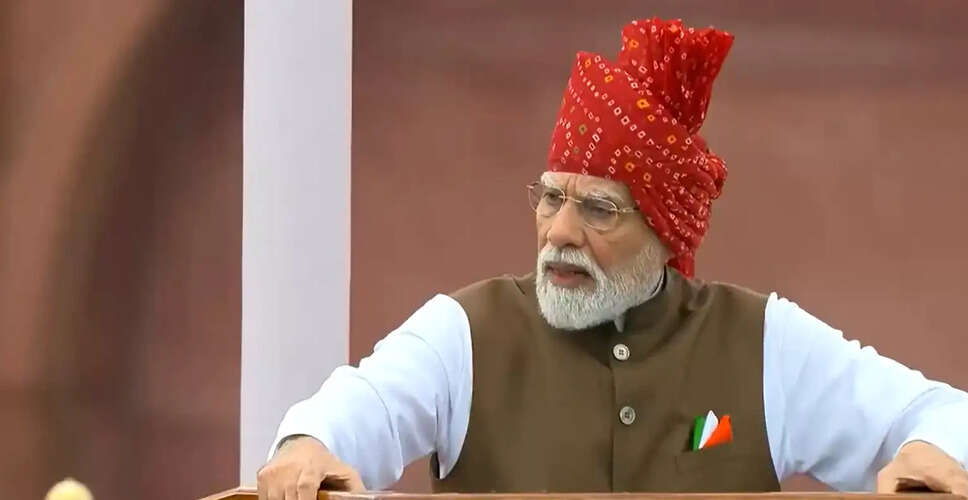
Speaking from the iconic Red Fort during the 80th Independence Day celebrations, Modi highlighted that India's semiconductor initiative signifies a significant step towards technological independence.
"Three semiconductor plants are operational now, and I have been informed that exports have already begun from these facilities. In the next seven to eight years, we expect five to eight more to be established," Modi stated.
The government initiated the Semicon India Programme (Semicon 1.0), which received approval in December 2021 with a budget of Rs 76,000 crore.
This program aims to create a robust domestic semiconductor and display manufacturing ecosystem. Following this, Semicon 2.0 was approved in July 2026, with a total investment of Rs 1,27,500 crore.
Under Semicon 1.0, 12 semiconductor projects have been sanctioned across six states, with investment commitments exceeding Rs 1.64 lakh crore.
Among the approved projects, three companies—Micron, Kaynes, and CG Semi—have already begun commercial production, with another company set to launch operations in 2026, further enhancing India's semiconductor manufacturing capabilities.
Modi emphasized the critical role of semiconductor chips in various sectors, including electronics, healthcare, and transportation.
He pointed out that while discussions about semiconductors have been ongoing for years, India previously lacked large-scale manufacturing facilities.
Recognizing the strategic significance of semiconductor production, the Prime Minister noted that India is making substantial strides towards self-sufficiency in this area.
The government's Rs 1.27 lakh-crore Semicon 2.0 initiative aims to bolster semiconductor intellectual property, chip, and system designs, positioning India as a global hub for semiconductor design.
Modi also mentioned that electronic manufacturing has surged sevenfold, mobile phone production has increased 33 times, internet users have quadrupled, and digital transactions have skyrocketed by 100 times.
The Production-Linked Incentive (PLI) scheme for Large Scale Electronic Manufacturing (LSEM) has attracted investments of around Rs 96,000 crore, with global giants like Apple, Google, and Foxconn establishing mobile phone production in India.
According to official statistics, smartphones emerged as India's leading export commodity in FY 2025-26, surpassing petroleum and gems.
In July, the government approved a mobile phone manufacturing scheme, an extension of the LSEM initiative, with a budget of Rs 62,500 crore, aimed at enhancing production, domestic value addition, supply chain resilience, and global competitiveness.
The Prime Minister underscored the importance of quality manufacturing and India's aspiration to become a reliable partner in the global supply chain.
He highlighted emerging fields such as quantum computing, artificial intelligence, space exploration, and data centers.
The government has launched the IndiaAI Mission with an investment of approximately Rs 10,372 crore.
As of June 2026, the IndiaAI Mission has expanded shared computing capacity to over 45,000 Graphics Processing Units (GPUs), essential for advancing AI technology.
By August, 237 projects had utilized subsidized AI computing, covering 93.18 lakh GPU hours, facilitating affordable high-performance computing for AI model development, training, testing, and research, thereby lowering barriers for Indian researchers and startups.
As of July 2026, the Indian government approved 13 responsible AI projects under the safe and trusted AI framework of the IndiaAI Mission, addressing critical issues such as bias mitigation, machine unlearning, deepfake detection, privacy-preserving AI, explainability, and AI risk assessment.
"We must lead in the next generation of communication technology. Our goal should be to ensure that Made in India 6G reaches every corner of the country. We need to accelerate this effort and not fall behind," Modi asserted.
He emphasized the necessity of harnessing the potential of India's youth to enhance cybersecurity.