
India's Foreign Policy: A Clear Stance on Neighbors and Global Dynamics
External Affairs Minister S. Jaishankar recently addressed key aspects of India's foreign policy at IIT Madras, emphasizing the importance of strong relationships with neighboring countries and the need for national security. He asserted India's right to protect its citizens against terrorism, particularly in relation to Pakistan. Jaishankar also highlighted India's cooperative spirit with neighbors, citing examples of support during crises. His remarks on technology and self-reliance reflect a shift towards reducing external dependencies. Overall, his statements signal a clear and confident stance on India's role in global affairs, marking a significant evolution in the country's diplomatic approach.
| Jan 2, 2026, 14:27 IST
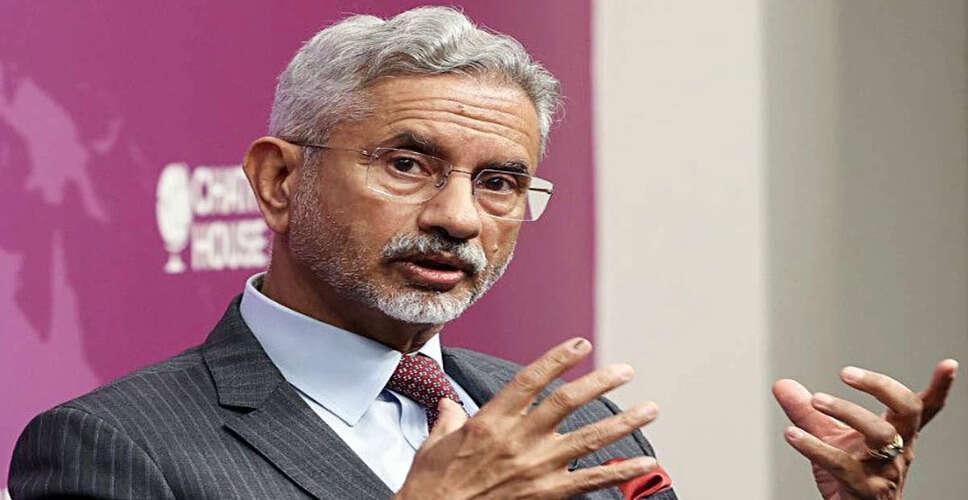
India's Foreign Policy Insights from S. Jaishankar
During an event at IIT Madras, External Affairs Minister S. Jaishankar articulated India's foreign policy, emphasizing relationships with neighboring countries, national security, global geopolitics, technological self-reliance, and the balance of personal life. He firmly stated that India is among the few ancient civilizations that have successfully emerged as a modern nation, and this historical continuity forms the foundation of India's global identity.
In response to questions regarding relations with neighboring countries, Jaishankar acknowledged that India has both good and bad neighbors. Referring to Pakistan, he asserted that if a country deliberately maintains a policy of terrorism without remorse, India has every right to protect its citizens. He emphasized that India will exercise this right and that only India can decide how and when to act. He made it clear that no external power can dictate India's actions.
Read More: Why Didn't Jaishankar Meet Yunus in Dhaka? Inside Story of India's Strategic Plan
Regarding agreements like water sharing, he stated that good neighborly relations cannot be one-sided. Jaishankar pointed out that if terrorism persists for decades, one cannot expect good neighborliness. He stressed that no country can continue terrorism while also benefiting from shared resources like water.
On the recent instability in Bangladesh, Jaishankar mentioned his recent visit where he represented India at the funeral of former Prime Minister Khaleda Zia. He noted that India is inherently cooperative towards its neighbors. Wherever the spirit of good neighborliness is evident, India invests, assists, and shares resources. He highlighted that during the COVID-19 pandemic, India was the first to send vaccines to its neighbors. During Sri Lanka's economic crisis, India provided a $4 billion package as a demonstration of support. He stated that India's growth is a rising tide that benefits the entire neighborhood.
Addressing a matter related to Arunachal Pradesh, Jaishankar firmly stated that Arunachal Pradesh is an integral part of India and will always remain so. He asserted that no manipulation or oppression can alter this reality. He mentioned that India has lodged a strong protest regarding recent incidents and demanded adherence to international norms.
Speaking on global conditions, Jaishankar noted that the past five years have seen many misconceptions shattered. It was once believed that prolonged wars were no longer possible, yet one war has now entered its fourth year. He also pointed out that it was thought that mutual dependence in global trade would prevent major risks, but this has not been the case. Consequently, many countries are adopting policies to de-risk their economies, politics, and technologies.
On technology, he remarked that while India adopted 3G and 4G from abroad, the realization during the 5G era was that external dependence poses significant risks. This understanding has accelerated efforts towards self-reliance. He noted that the opening of the defense sector to private enterprises and innovation is a direct outcome of this policy.
Discussing his personal life, Jaishankar mentioned that he does not have off days, as the world continues to operate even on weekends. He shared that he enjoys listening to music, reading books, watching films, and following sports to maintain a balanced life.
Overall, Jaishankar's clear stance on issues ranging from civilization to security, and technology to lifestyle, indicates that India is not under any illusions. His statements regarding neighboring countries and terrorism are exceptionally assertive and clear. This message is not just for one nation but for the entire world: India will no longer compromise its security under the guise of moral preaching. Terrorism and cooperation cannot coexist. Only a nation confident in its strength and legitimacy can express such courage.
Moreover, linking sensitive topics like water sharing with terrorism shows that India is reevaluating old agreements in light of new realities. The conditions for good neighborliness are now clear. This statement sets the direction for future diplomacy, where India will define relationships based on actions rather than emotions. By citing examples from Bangladesh and Sri Lanka, Jaishankar also clarified that India is not just a punitive power but also a supportive one. India's neighborhood policy model is crystal clear: those who cooperate will be supported, while those who cause harm will not be tolerated.
In conclusion, Jaishankar's statements today collectively form a declaration of India's new foreign policy. This policy is neither about aggressive expansionism nor surrender. It embodies confidence, justice, and strategic clarity. India now defines and protects its interests independently. This is the true identity of India in this era.