
India's Foreign Ministry Addresses Key National Security Issues
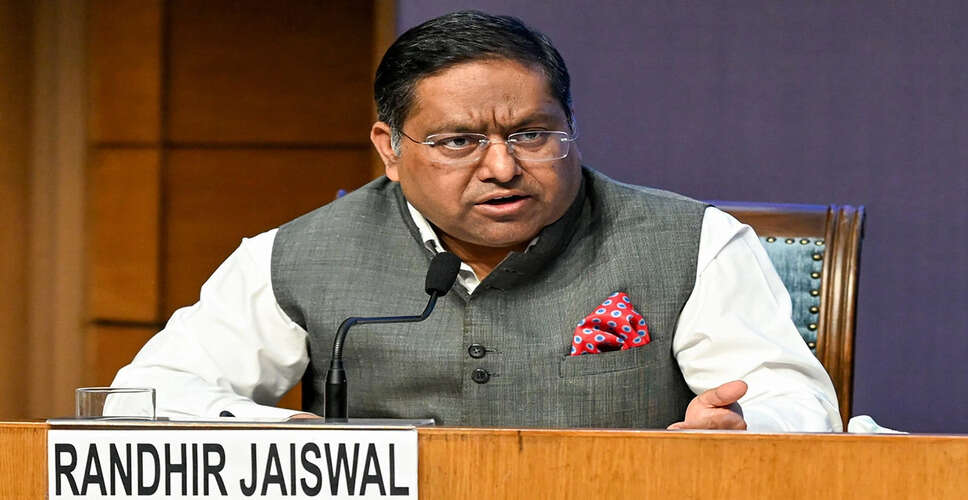
In a recent press conference, India's Ministry of External Affairs, represented by spokesperson Randhir Jaiswal, addressed critical issues surrounding national security, including Pakistan's role in terrorism and India's claims over Jammu and Kashmir. The ministry emphasized its unwavering stance on sovereignty and the safety of Indian citizens abroad, particularly in West Asia. Discussions on strategic projects like the Mumbai-Ahmedabad high-speed rail and the status of Chabahar port were also highlighted. This briefing underscores India's commitment to its national interests amidst regional challenges.
| Jul 17, 2026, 19:16 IST

India's Stance on National Security and Regional Tensions
During a recent weekly press briefing, the spokesperson for India's Ministry of External Affairs, Randhir Jaiswal, articulated the country's firm stance on several critical issues related to national security, neighboring countries, tensions in West Asia, and strategic projects. From reiterating India's claims over Pakistan-occupied Jammu and Kashmir (PoJK) to holding Pakistan accountable for the recent Pahalgam terrorist attack, the ministry's message was clear: India does not intend to leave any ambiguity regarding its national interests and security.
Jaiswal unequivocally stated that Jammu and Kashmir, along with Ladakh, are integral parts of India, emphasizing that there has been no change in India's policy regarding this matter. The country remains steadfast in its sovereign rights.
Read More: EAM Jaishankar's Successful Mission in the Gulf Region Discusses Energy Security and West Asia Conditions
In reference to the recent terrorist attack in Pahalgam, the Ministry of External Affairs launched a sharp critique against Pakistan. Jaiswal noted that this brutal attack resulted in the loss of many innocent lives, and investigations are ongoing. He highlighted Pakistan's long-standing record of cross-border terrorism, which is well-known globally, asserting that Pakistan has consistently utilized terrorism as a tool of state policy.
The ministry also expressed concern over the deteriorating situation in West Asia. Jaiswal reiterated India's long-standing position that civilian infrastructure should never be targeted in any conflict. He mentioned that, in light of the escalating tensions in the region, an advisory has been issued for the Indian maritime community, as a significant number of Indian sailors operate in these waters, and ensuring their safety is the government's responsibility.
Responding to another query, he confirmed that maritime trade between India and the Gulf region continues normally, with seven Indian-flagged vessels currently operating in the area. Regarding oil imports, he stated that India procures crude oil from various countries to meet its energy needs.
On the status of Iran's Chabahar port, the ministry clarified that the waiver granted by the United States has already expired, and India is discussing future strategies with relevant parties. He addressed recent reports of attacks on the port, assuring that the terminal operated by India has not suffered any damage.
Additionally, in response to questions about the Mumbai-Ahmedabad high-speed rail project, the ministry indicated that discussions between India and Japan are progressing positively. The Japanese E-20 train series is expected to be available in the early 2030s, as its development is still underway. To avoid delays, both nations have agreed to commence operations with Indian high-speed trains in the initial phase. The project is advancing rapidly, with the first segment targeted for launch in 2027. The ministry also clarified that no separate proposals have been received from Japan, and the signaling system is being established in accordance with international standards.
Regarding the extradition request for former Bangladeshi Prime Minister Sheikh Hasina, the ministry confirmed that a formal request has been received. Currently, it is under consideration in accordance with legal and judicial processes, and a decision will be made once the established procedures are completed.
The overarching message from the Ministry of External Affairs' press conference was that India is unequivocal about its security, sovereignty, and strategic interests. Whether addressing Pakistan-sponsored terrorism, India's claims over PoJK, the safety of Indian citizens in West Asia, the strategic significance of Chabahar port, or the Mumbai-Ahmedabad bullet train project, the government has signaled that national interests are paramount, and every step is taken with this perspective in mind.