
India's Firm Stand at UN: Rejecting Pakistan's Claims on Indus Waters Treaty
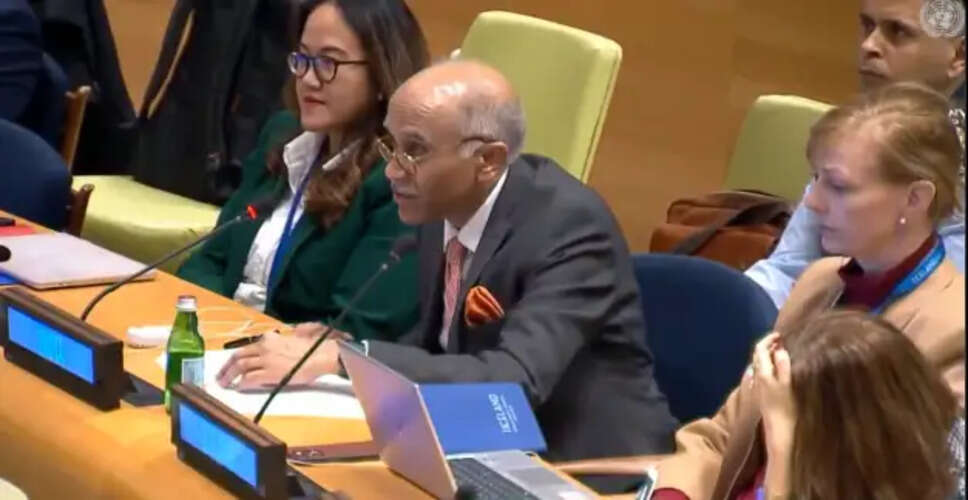

India Responds to Pakistan's Allegations at the UN
United Nations: India has categorically dismissed Pakistan's statements made during a UN session, emphasizing that collaboration under the Indus Waters Treaty is unfeasible when 'cross-border terrorism' is employed as a state policy tool.
India reiterated that Jammu and Kashmir is an inseparable part of the nation, a stance it has consistently upheld.
These comments were delivered by India's Permanent Representative to the United States, Ambassador Parvathaneni Harish, during the UN Security Council's High-Level Open Debate focused on Natural Resources Governance.
In his response to Pakistan, Parvathaneni expressed that India felt it necessary to counter Islamabad's 'misuse' of the forum to propagate a 'false narrative'.
"Our stance on the Indus Water Treaty is unwavering. We cannot expect cooperation based on mutual trust when cross-border terrorism is routinely utilized as a state policy," he stated.
India's strong response followed accusations from Pakistan's UN representative, Asim Iftikhar Ahmad, who claimed that New Delhi was 'weaponizing water' by suspending the Indus Waters Treaty (IWT), labeling the action as 'illegal' and asserting it jeopardizes the livelihoods of over 240 million Pakistanis.
The IWT, established in 1960 through World Bank mediation, regulates the distribution of water from the six rivers of the Indus basin, assigning the eastern rivers to India and the western rivers predominantly to Pakistan.
India suspended the IWT after the Pahalgam terror attack on April 22, 2025, stating that cooperation under the treaty cannot persist amidst ongoing cross-border terrorism.
"Regarding the Union Territory of Jammu and Kashmir, it has always been, is, and will continue to be an integral and inalienable part of India. This is a constitutional and legal fact that Pakistan chooses to overlook," the Indian envoy asserted during the UN Security Council debate.
"The only unresolved matter concerning Jammu and Kashmir is the blatant aggression and illegal occupation of India's sovereign territory by Pakistan. Instead of blaming India, Pakistan would benefit itself and its citizens by addressing its internal issues," he added.
During his speech, Parvathaneni noted that 'illicit exploitation and trafficking of natural resources can sometimes finance armed groups and extend conflicts', but he emphasized that natural resources should primarily drive development and prosperity for sovereign nations.
He also pointed out that the governance and management of natural resources should rest with sovereign states, advocating for transparent, accountable, and nationally owned governance, alongside responsible supply chains, enhanced transparency, and stronger international collaboration to combat the illicit exploitation of natural resources.