
India's Economic Growth Amid Global Challenges: A Closer Look
India's Economic Resilience
In a challenging global economic landscape, where US President Donald Trump has instigated a tariff conflict, India emerges as one of the few nations exhibiting consistent growth and economic resilience. Union Finance Minister Nirmala Sitharaman has asserted that India has retained its status as the fastest-growing economy in the world for the fourth consecutive year. This claim is further supported by the International Monetary Fund's (IMF) forecasts, indicating that India will continue to be the fastest-growing major economy for the next two years.
The IMF's April 2025 World Economic Outlook predicts that India's economy will expand by 6.2% in 2025 and 6.3% in 2026, ranking among the highest globally. Over the past decade, India's Gross Domestic Product (GDP) has nearly doubled. In 2014, India's GDP was approximately $2.0 trillion, which surged to $3.9 trillion by 2024, reflecting an increase of about $1.9 trillion.
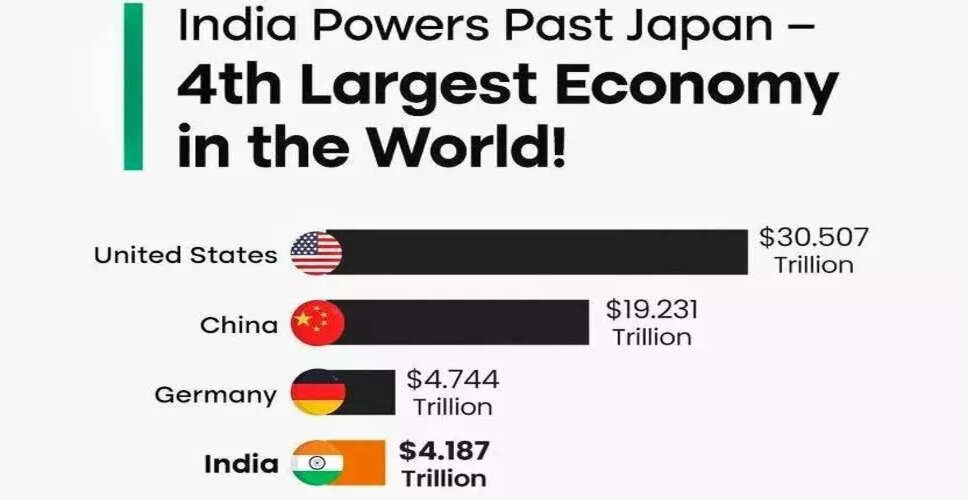
The April report from the IMF also forecasts that India's nominal GDP for FY26 will reach around $4,187.017 billion, slightly surpassing Japan's estimated GDP of $4,186.431 billion. This shift will elevate India from its current fifth position to fourth by the end of 2025, with a potential rise to third place within three years.
While these figures are commendable and the NDA government in Delhi has reason to celebrate, critics may raise essential questions regarding the real-world implications of such statistics. For instance, one might inquire about the primary contributors to the national GDP. Although the Finance Minister has indicated that all sectors—services, manufacturing, and agriculture—have significantly contributed to India's growth in FY25, there are concerns that a substantial portion of this growth is driven by a few large business conglomerates.
Another critical question is whether this growth has been inclusive and reached the grassroots level. The low per capita GDP of India, which does not even place it in the top 100 globally, reflects this issue. Despite a nominal GDP of $4.187 trillion, India's per capita GDP stands at only $2,880, in stark contrast to Japan's per capita GDP of $33,900. This disparity indicates that a significant portion of the nation's wealth is concentrated in the hands of a small elite, keeping India categorized among developing nations rather than developed ones.