
India's Defense Diplomacy Strengthens Ties with Armenia
India's Growing Defense Exports and Strategic Partnerships
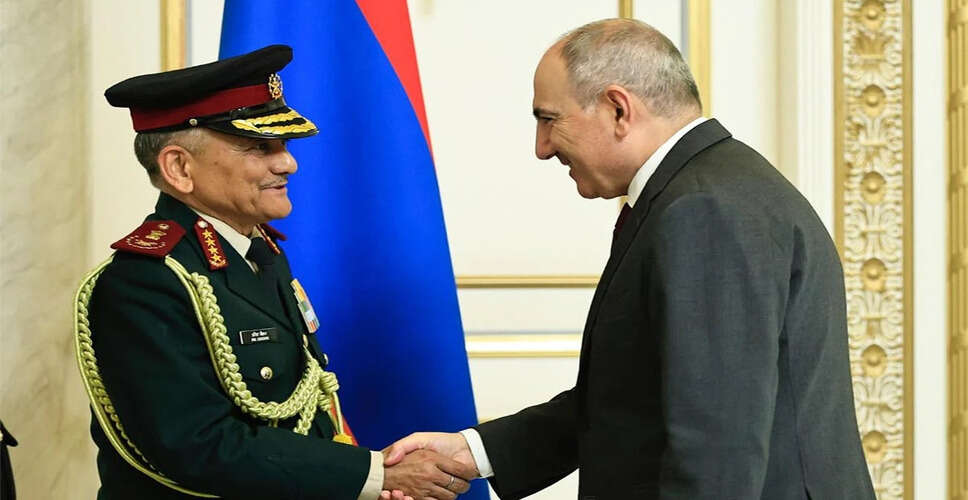
India's defense exports and indigenous weaponry are now resonating globally. Once reliant on imports, India has emerged as a trusted partner in security for allied nations. Indian missiles, rocket systems, radars, and defense technologies are asserting their strength on the international stage. A significant step in this evolving military and strategic power is the visit of Chief of Defense Staff General Anil Chauhan to Armenia, signaling India's robust presence in defense diplomacy. On February 1, under General Chauhan's leadership, a high-level Indian defense delegation arrived in Yerevan, where they received a formal welcome and honors. This marks the first time such senior military leadership from India has engaged in direct and extensive defense dialogue with Armenia at this level.
Strengthening Bilateral Defense Cooperation
General Chauhan held detailed discussions with Armenian Defense Minister Suren Papikyan. They agreed on enhancing bilateral defense cooperation, deepening long-term security partnerships, and advancing shared strategic interests. Both sides emphasized the effective implementation of planned activities for 2026, military education, professional training, joint exercises, and experience sharing. Meetings also took place with Lieutenant General Edward Asryan, Chief of Staff of the Armenian Armed Forces, focusing on the transformation of Armenia's military and India's role in it.
Insights on Global Security Dynamics
During his visit to the National Defense Research University in Yerevan, General Chauhan delivered a lecture on the changing global security landscape, the rise of technology as a key determinant of power, and the evolving nature of warfare. He highlighted that modern warfare is becoming multi-domain, integrating land, air, sea, space, and digital fields. The Indian Army's experience, adaptability, and indigenous technology are proving crucial in this new warfare environment.
Commemorating Historical Tragedies
As part of his visit, General Chauhan paid tribute at the Armenian Genocide Memorial and Museum, honoring the approximately 1.5 million Armenian citizens who lost their lives during World War I. This genocide is linked to the mass killings and forced deportations of the Armenian Christian community by the Ottoman Empire. Many historians regard it as one of the early major genocides of the 20th century. For Armenia, this memorial is a sensitive foundation of national memory and diplomacy, while Turkey continues to deny the genocide. General Chauhan's presence at the memorial conveyed a message of respect for human sensitivity and historical suffering.
Expanding Defense Cooperation
The axis of India-Armenia relations is rapidly becoming defense cooperation. Since 2020, Armenia has entered into several significant defense agreements with India, including the Pinaka multi-barrel rocket launcher, Akash air defense missiles, artillery, anti-tank missiles, radars, ammunition, and other military supplies. Armenia became the first foreign country to adopt the Akash system. India has also supplied the Swati weapon-locating radar. In 2022, a deal was made for four batteries of the Pinaka system, valued at thousands of crores. Recently, the first shipment of guided Pinaka rockets was dispatched. Armenia has also shown interest in other missile systems and is considering upgrading its Sukhoi 30 fighter jets.
Diversifying Defense Sources
Historically, Armenia has relied on Soviet and Russian-origin weapons. India has demonstrated proficiency in modernizing these weapons and integrating them with new systems. This shared background makes both countries natural partners. Armenian officials have praised Indian expertise. The changing regional dynamics, particularly tensions with Azerbaijan and Turkey, have prompted Armenia to diversify its defense sources, with India emerging as a reliable partner.
Regional Security Dynamics
On the other hand, the growing strategic closeness between Turkey, Pakistan, and Azerbaijan is also influencing regional equations. These three have openly supported each other on multiple occasions, conducted joint exercises, and enhanced military cooperation, particularly evident during the Nagorno-Karabakh conflict. The defense ties between Pakistan and Turkey are deepening, with ongoing technical collaboration. In this context, India's strong partnership with Armenia is a crucial step towards establishing balance in the South Caucasus region.
Economic Opportunities and Collaboration
There are also emerging economic opportunities between the two nations. While bilateral trade remains limited, Armenia's membership in the Eurasian Economic Union, proximity to Iran, and a vibrant information technology sector, along with its global diaspora, could make it a gateway for India. Initiatives like India's North-South Transport Corridor and plans to connect West Asia with Europe add further significance to this region.
Mining and Mineral Cooperation
Collaboration in mining and critical minerals is also on the horizon. Armenia is rich in gold, copper, and molybdenum reserves, holding a significant share of global molybdenum stocks. India requires these minerals for its defense manufacturing, renewable energy, and electric vehicle sectors. Joint ventures, investments, technology transfers, and environmentally compliant mining could be mutually beneficial. Indian industrial groups could play a role, and there is potential for increased technical education and research collaboration.
Strategic Implications of General Chauhan's Visit
Overall, General Anil Chauhan's visit is not merely formal but a strategic indication that India is expanding its defense diplomacy into new areas and becoming a reliable partner in meeting the security needs of allied nations.
India-Armenia Relations in a Changing World
The growing closeness between India and Armenia signals the emergence of a new axis in the shifting global balance. As India's indigenous missiles, rocket launchers, and defense systems instill confidence in distant borders, it reflects a direct victory of Indian science, industry, and military prowess. The valor of Indian soldiers extends beyond the battlefield, instilling confidence in allied nations.
Trust and Strategic Partnerships
When Armenia looked to India for its security, it expressed trust in a nation known for keeping its promises. This trust is built over years of credibility. Today, Indian weapons are not just being sold; they signify India's strategic presence. This sends a clear message that India is no longer just a consumer but a provider and a manufacturing power.
Implications for Regional Dynamics
For Pakistan, this development is naturally a setback. Countries that have long harbored dreams of encircling India are now witnessing India becoming a respected partner in areas they consider their sphere of influence. The understanding between India and Armenia is establishing a balance against the trio of Turkey, Pakistan, and Azerbaijan. This is not an aggression against anyone but a firm defense of national interests.
Future Directions for India
Moving forward, India must advance its defense exports, strategic partnerships, and economic cooperation. Countries like Armenia can serve as bridges for India, connecting it deeply with Europe, Eurasia, and West Asia. This is a time when India is showcasing the impact of its valor, weaponry, and policy simultaneously. General Anil Chauhan's visit resonates with this newfound confidence.