
Indian Cricket Team's Young Talent Shines Amidst Challenges
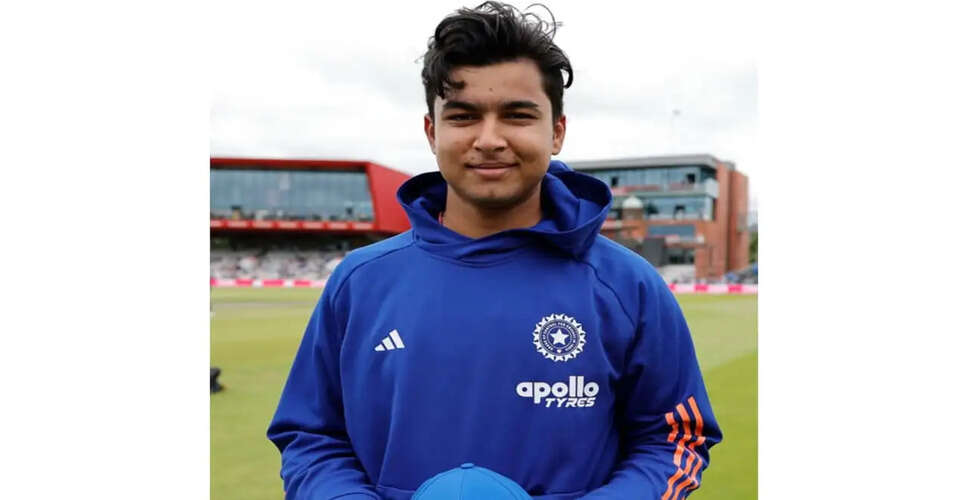

Vaibhav Sooryavanshi's Historic Debut
As India gears up for their third T20I against England in Nottingham, batting coach Sitanshu Kotak discussed the remarkable debut of 15-year-old Vaibhav Sooryavanshi in the previous match. Kotak emphasized that Sooryavanshi was prepared for his debut from the moment he joined the squad, encouraging him to maintain the aggressive style of play that has brought him early success. During the second T20I in Manchester, Sooryavanshi made history by becoming the youngest Indian international cricketer at 15 years and 99 days, surpassing the legendary Sachin Tendulkar, who debuted at 16 years and 238 days. Despite the excitement surrounding his debut, Sooryavanshi did not play in the Ireland series, which India lost 2-0, nor did he feature in the first T20I against England, which was abandoned due to rain. In his first innings, he scored 14 runs off 10 balls, including two sixes.
Encouragement to Play Naturally
In a press conference, Kotak shared insights on Sooryavanshi's debut and the rationale behind it. He stated, "From the moment Vaibhav joined the team, we knew he was ready to debut. It wasn't a last-minute decision. Our only advice was to play instinctively and stick to the style that brought him success. We didn't impose any specific batting instructions on him."
Challenges in Middle Overs
Addressing India's difficulties in maintaining a high scoring rate during the middle overs, Kotak noted that wind conditions significantly impacted the last match. He acknowledged that not every match would yield scores of 225-250 runs. "England bowled effectively during that phase. A score of 190 was likely above par, and in certain conditions, we can't always expect to reach 225-250. For this ground in Nottingham, the dimensions are smaller, so our strategy will adapt accordingly," he explained.
Transitioning Team Dynamics
Kotak also recognized the shift in perception surrounding the team, moving from a dominant phase to facing scrutiny under Shreyas Iyer's captaincy. He dismissed concerns, stating that the team is integrating new talent, adapting to a new captain, and coping with injuries to key players like Hardik Pandya. "Our goal is to enhance our performance across batting, bowling, and fielding. Since winning the last World Cup, we've been focused on how to elevate our game for the next World Cup in two years. We don't judge our progress based on a single match. While we had a successful run, losing two matches has led to criticism. This is part of the game, and transitions like these are expected, especially with new players coming in," he added.
Pace-Bowling All-Rounder Reserves
Regarding the team's reserves for pace-bowling all-rounders following injuries to Hardik Pandya and his backup, Nitish Kumar Reddy, Kotak highlighted the promising young talent Suryansh Shedge. Shedge had an impressive IPL season, scoring 157 runs in seven innings with a strike rate over 175, and performed well in the Sri Lanka tri-series for India A. Kotak remarked, "In T20 cricket, a pace-bowling all-rounder is crucial as they can serve as a sixth bowler when needed. Suryansh has shown potential, and while not all young players will play immediately, being part of the team helps them acclimate to the environment. We have two years to prepare, with plenty of domestic cricket and IPL ahead. The BCCI and selectors are committed to building a strong team for future events, even if they are two years away."