
India Takes Strong Stance Against Pakistan's Human Rights Violations in PoJK
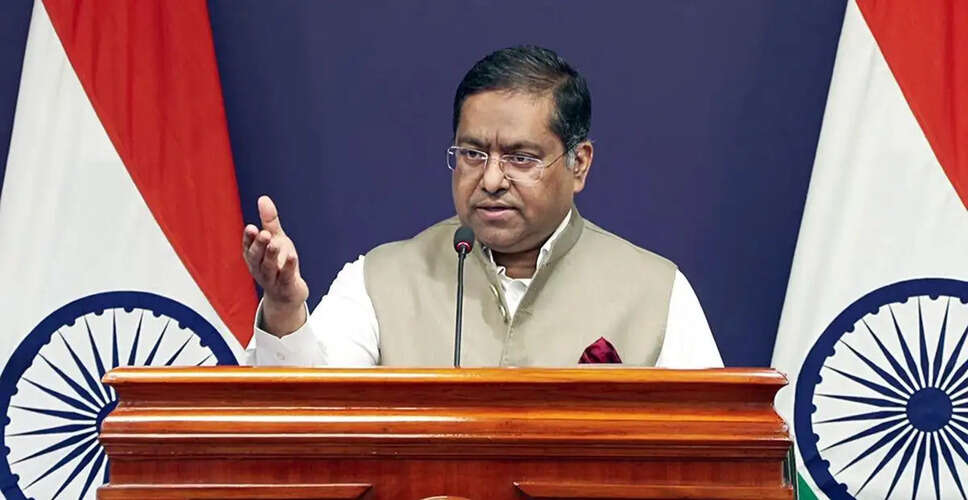

India's Firm Response to Human Rights Abuses in PoJK
India has adopted a robust and aggressive stance against Pakistan regarding the oppression of civilians in Pakistan-occupied Jammu and Kashmir (PoJK). During a weekly press briefing, spokesperson Randhir Jaiswal directly criticized Pakistan, stating that its government is employing brutal force against its own citizens, urging the international community not to remain silent on this issue.
Jaiswal highlighted that over 40 innocent lives have been lost due to the violent crackdown on peaceful protesters in PoJK, with many others suffering serious injuries. He pointed out that the contempt shown by Pakistan's authorities towards the local populace was starkly revealed when the country's defense minister labeled the protesting citizens as 'enemies.'
In a significant political attack on Pakistan's internal situation, the spokesperson noted that the Prime Minister's special assistant has admitted that the militants trained and funded by the Pakistani government to spread terror in India have now turned their weapons against Pakistan itself. India views this as a major acknowledgment of Pakistan's terrorism-supporting policies, indicating that the very framework of terrorism it established has now become its greatest threat.
Jaiswal also referred to the so-called elections in PoJK, describing them as a humiliating rejection of Pakistan's governance. He mentioned that the people of PoJK have called for an independent investigation into unlawful killings by international organizations. India has appealed to the global community to conduct an impartial inquiry into Pakistan's actions and hold it accountable for its atrocities.
In response to a question about development cooperation with Bhutan, the Ministry of External Affairs stated that the recent visit of the Foreign Secretary was part of the India-Bhutan Development Cooperation Platform. During this visit, both nations reviewed their bilateral development partnership and assessed the progress of various projects. The Ministry announced that two significant agreements were signed: one related to a line of credit for Bhutan and another aimed at enhancing health sector cooperation between AIIMS and Bhutan's Khesar Gyalpo Hospital. Both sides also discussed future development projects and new initiatives, reaffirming Bhutan's status as a key partner in India's 'Neighborhood First' policy.
Additionally, in response to queries about maritime security and international navigation, India reiterated its established position, emphasizing its support for unobstructed and free navigation on international sea routes and the importance of securing global maritime trade.
Regarding relations with Nepal, Jaiswal indicated that several bilateral issues are on the agenda, with regular discussions ongoing through various institutional mechanisms, suggesting that India-Nepal relations are progressing based on continuous dialogue and cooperation.
On the issue of Indian citizens recruited by the Russian army, the Ministry reported that 139 individuals have been successfully released due to India's efforts. However, approximately two dozen Indian citizens are still reported to be in Russia, and ongoing contact is being maintained for their return. The Ministry once again cautioned youth to be wary of dubious agencies and risky foreign job offers.
In response to a question about a bill presented in the U.S. Senate, India provided a measured yet clear response, stating that it is closely monitoring the situation. The Ministry emphasized that energy security is a national priority, and India will continue to ensure supply from diverse sources to meet its citizens' energy needs, with ongoing dialogue with various stakeholders in the U.S.
Regarding the BRICS summit, India clarified that it is currently holding the presidency of the organization and is making extensive preparations to host the summit. Invitations and other technical details will be shared in due course.
On the Amnesty International report, the Ministry stated that India has a robust legal and regulatory framework for strategic trade controls, ensuring that the export of dual-use technologies and materials complies fully with national laws and international obligations.
Furthermore, concerning the situation of Indian nationals aboard the MV AGN Ragnar, which was attacked after departing from the port of Odesa in Ukraine, the Ministry reported that four Indian crew members were on board, with two safe and two still missing. Search and rescue operations are underway by both Ukraine and Romania, and India is in contact with both countries, providing all possible assistance to the families of the missing individuals.
The Ministry also shared statistics on the deportation of Indian citizens from the U.S., noting that since January 1, 2026, a total of 1,273 Indian citizens have been sent back to India, compared to 3,567 in 2025.
The most impactful message from this press briefing was India's changed diplomatic tone towards Pakistan. For the first time, India has articulated its concerns about human rights violations in PoJK, Pakistan's terrorism-supporting policies, and the failures of its governance in a unified manner, aiming to bring these issues to the forefront of global discourse. This indicates that India is now addressing not only cross-border terrorism but also the internal human rights situation, democratic legitimacy, and governance failures in Pakistan on international platforms.