
India Strengthens Security in Siliguri Corridor Amid Rising Geopolitical Tensions

Strategic Enhancements in Siliguri Corridor
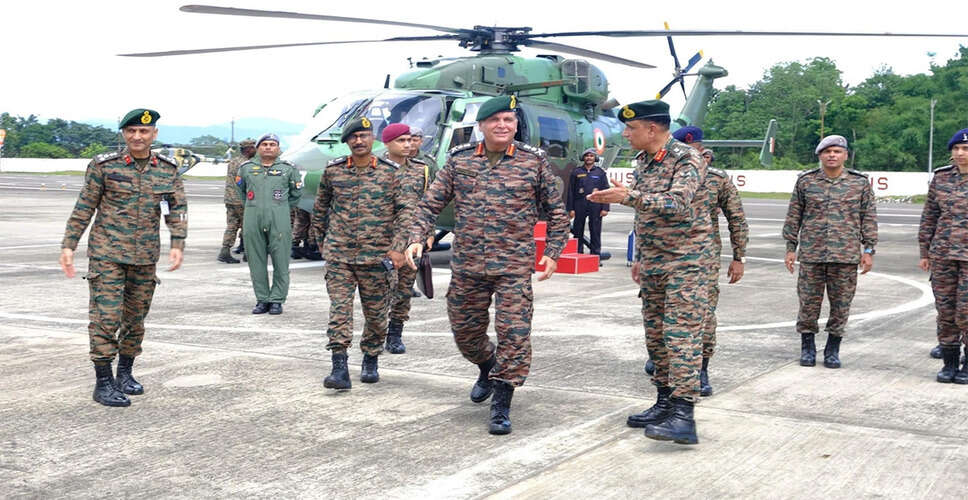
India has taken significant steps to fortify the Siliguri Corridor, often referred to as the 'Chicken Neck', a crucial strategic area. The visit of Army Chief General Dheeraj Seth to key military installations in the Eastern Command, particularly the Bengdubi Military Station and the 3 Corps in Nagaland, signals India's readiness to respond swiftly and decisively to any provocations, rather than merely monitoring its borders. The focus on enhancing security in the Northeast, modernizing military capabilities, and strengthening strategic infrastructure is being accelerated to address any challenges to this vital lifeline effectively.
Importance of Bengdubi Military Station
The Bengdubi Military Station holds exceptional significance as it is located at the northern entrance of the Siliguri Corridor. This narrow stretch, known as the 'Chicken Neck' in military terms, is less than 20 kilometers wide at its narrowest point, situated between Nepal and Bangladesh. It serves as the sole road and rail link connecting the Indian mainland to eight northeastern states, including Assam, Arunachal Pradesh, Manipur, Meghalaya, Mizoram, Nagaland, Sikkim, and Tripura. Any disruption to this connection during a conflict or crisis could severely impact logistics, military support, and civilian supplies in the entire northeastern region.
Infrastructure Development Initiatives
In light of these sensitivities, the central government is rapidly enhancing defense and transportation infrastructure in the region. Recently, Indian Railways announced plans to construct a 35-kilometer underground rail line aimed at ensuring uninterrupted military logistics and civilian supplies during wartime, terrorist attacks, or sabotage. This underground rail connectivity could significantly boost India's strategic capabilities in any future conflict.
Strengthening Road Networks
Not only is the railway network being reinforced, but road infrastructure is also receiving significant upgrades. The West Bengal government has entrusted the National Highways Authority (NHAI) and the National Highways and Infrastructure Development Corporation (NHIDCL) with the rapid development of seven critical national highways. Additionally, over 120 acres of land have been transferred to the Border Security Force (BSF) and other central agencies to enhance surveillance capabilities and ensure the swift movement of troops.
Role of Air Bases in Security Framework
The role of Bagdogra Airport and Hasimara Air Force Station is also crucial within this security framework. Hasimara Airbase is home to the Indian Air Force's 101 Squadron, which hosts one of the two operational Rafale squadrons in the country. This means that any emergency or military challenge in the eastern region can now be addressed more quickly, accurately, and effectively than before.
Focus on Modern Warfare Preparedness
During his visit, Army Chief General Dheeraj Seth was briefed on the current security situation, troop deployments, and advanced surveillance systems in the Eastern Command's operational area. He reviewed programs related to increased technology use, military capability expansion, and modernization efforts. This indicates that the Indian Army is not only preparing for conventional warfare but is also focusing on network-centric warfare, modern surveillance systems, artificial intelligence-based technologies, and rapid response capabilities.
Introduction of 'VIJAY' Vision
General Seth also visited the 3 Corps (Spear Corps) in Nagaland, where he was informed about the evolving security landscape, coordination among various security agencies, and measures to enhance combat readiness. During this visit, he introduced a new vision for the Indian Army called 'VIJAY', which stands for Vigilance, Innovation, Jointness, Atmanirbharta (self-reliance), and Yodha First (warrior first). He emphasized that these five principles will guide the Indian Army to become more agile, adaptable, and fully prepared for future challenges.
Comprehensive Security Assessment
This marks General Seth's second visit to a forward area since taking command. Previously, he inspected forward posts of the 16 Corps (White Knight Corps) in the Poonch-Rajouri-Sunderbani sector. This indicates that military leadership is actively assessing security preparations on both the western and eastern fronts.
Strategic Importance of Siliguri Corridor
From a strategic perspective, securing the Siliguri Corridor is not just about protecting a border area; it is essential for India's territorial integrity and its geographical and strategic connections with the northeastern states. The increasing competition along the Line of Actual Control with China, sensitive security conditions in the Northeast, and shifting geopolitical dynamics in the Indo-Pacific region have heightened the corridor's significance. Thus, the multi-layered security framework that India is building, integrating road, rail, air force, border security, and modern military technology, is not only a response to current challenges but also a robust strategic investment for potential future conflicts. General Seth's visit underscores the message that India is determined to maintain the security of its most sensitive territories at all costs.