
India Shines at Asian Games 2026 with Record Wrestling Medals
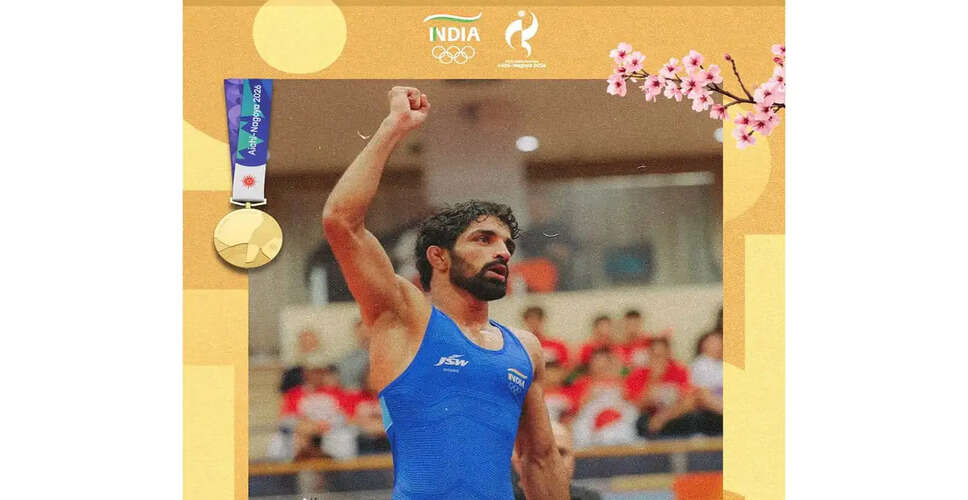

Historic Performance at Aichi-Nagoya 2026
India achieved its most successful wrestling performance at the Asian Games in over sixty years, concluding the Aichi-Nagoya 2026 event with a total of six medals: two gold, two silver, and two bronze. This remarkable achievement saw Aman Sehrawat and Sujeet Kalkal crowned as champions, showcasing India's prowess in both freestyle and Greco-Roman wrestling categories.
India's Best Medal Count Since 1962
The six medals secured by India represent the best outcome since the Jakarta 1962 Asian Games, where the country won 12 medals, including three golds, six silvers, and three bronzes, as reported by Olympics.com. The gold medals in Aichi-Nagoya were clinched by Aman in the men's freestyle 57kg and Sujeet in the men's freestyle 65kg categories, while Antim Panghal and Nitesh Siwach earned silver medals. Additionally, Deepak Punia and Sunil Kumar contributed bronze medals to the tally.
Aman Sehrawat's Stellar Performance
Aman, the youngest Olympic medallist from India, delivered an outstanding performance by defeating reigning world champion Han Chong Song from North Korea with a score of 11-7 in the 57kg final. Despite initially leading 6-1, Aman faced a comeback from Han, who took a 7-6 lead. However, Aman executed a crucial four-point move to regain control at 10-7, and an unsuccessful challenge from Han's team awarded him another point, securing the gold medal.
Han had previously won both the 57kg World and Asian Championships titles in 2025, making Aman's victory a significant milestone for Indian wrestling.
Sujeet Kalkal and Antim Panghal's Contributions
Sujeet Kalkal added to India's medal tally by winning gold in the men's freestyle 65kg category, marking India's second wrestling title at Aichi-Nagoya. Antim Panghal also made her mark by securing a silver medal in the women's 53kg category, finishing second to Japan's Moe Kiyooka, the 2024 world champion in the 55kg division. Antim's journey to the final included a strong performance, defeating Kazakhstan's Shugyla Omirbek and Uzbekistan's Sakibjamal Esbosynova before overcoming China's reigning Asian champion Zhang Jin in the semi-finals.
Bronze Medals for Deepak Punia and Sunil Kumar
Deepak Punia earned his second consecutive Asian Games medal, clinching bronze in the men's freestyle 97kg category. He triumphed over Mongolia's Gankhuyag Ganbaatar 2-1 in the bronze-medal match after narrowly missing the final with a close 9-8 loss to Uzbekistan's Sherzod Poyonov. Deepak's campaign began with a dominant 12-2 victory over China's Junpeng Zhou and a quarter-final walkover against Hong Kong's Wui Fung Vincent Li.
Nitesh Siwach also secured a silver medal in the Greco-Roman 97kg category, while Sunil Kumar rounded out India's medal count with a bronze in the Greco-Roman 87kg division, ensuring representation on the podium in both wrestling styles.
Overall Performance and Historical Significance
Several Indian wrestlers faced narrow defeats, including Sagar Jaglan, who lost his bronze-medal match in the men's freestyle 74kg category to Kazakhstan's Nurkozha Kaipanov, and Manisha Bhanwala, who was eliminated in the quarter-finals after a loss to Japan's Akari Fujinami.
India's six medals at Aichi-Nagoya signify a remarkable improvement over previous Asian Games performances. The country had previously won two wrestling golds at Bangkok 1978 and Jakarta 2018, but only managed three medals at those events. The benchmark remains Jakarta 1962, where Indian wrestlers achieved 12 medals, including three golds. Aichi-Nagoya thus stands as India's strongest wrestling performance since that historic event, with two golds and four additional podium finishes highlighting the depth of talent within the team.