
India Rejects Pakistan's Objection to Life Sentence of Separatist Leader Asiya Andrabi
India Dismisses Pakistan's Objection to Andrabi's Sentence
India has firmly rejected Pakistan's objection regarding the life sentence imposed on separatist leader Asiya Andrabi. The Indian Ministry of External Affairs stated unequivocally that Pakistan has no right to comment on India's judicial processes. This incident has once again highlighted the ongoing tensions between India and Pakistan concerning the Kashmir issue.
Court Sentences Andrabi for Serious Offenses
Recently, a court in Delhi sentenced Asiya Andrabi, the head of the banned organization Dukhtaran-e-Millat, to life imprisonment under various serious charges, including the Unlawful Activities (Prevention) Act. Alongside her, her associates Sofi Fahmida and Nahida Naseem received thirty-year sentences. The investigating agency presented evidence in court showing that Andrabi and her organization engaged in activities against the sovereignty and integrity of the nation, inciting violence and rebellion in Kashmir.
Allegations Against Andrabi
According to the prosecution, Andrabi was also accused of having connections with Pakistan-based terrorist organizations and inciting youth to take up arms. Investigations revealed her links to Hafiz Saeed, the leader of Lashkar-e-Taiba, and Syed Salahuddin, the head of Hizbul Mujahideen. Based on these facts, the court deemed the harsh sentence appropriate.
Pakistan Condemns the Verdict
In response, Pakistan's Ministry of Foreign Affairs condemned the ruling, labeling it a gross violation of justice. They referred to Andrabi as a prominent political leader in Kashmir, claiming that the sentence aims to suppress the freedom of expression of the local populace. The statement from Pakistan also highlighted the ongoing violations of fundamental rights in Kashmir.
India's Strong Response
India reacted sharply to this statement. A spokesperson from the Ministry of External Affairs remarked that Pakistan's stance is not only inappropriate but also akin to endorsing violence and the killing of innocent people. They clearly stated that a country that has long supported terrorism has no right to comment on India's internal matters.
Focus on Human Rights Violations
India advised Pakistan to focus on the serious and systematic human rights violations occurring within its own borders rather than making accusations against others. India also asserted that Pakistan has consistently attempted to create confusion on international platforms through false and baseless statements.
India's Stance on Kashmir
A significant aspect of this entire matter is India's reaffirmation that Kashmir is an internal issue, and no external commentary will be tolerated. India's policy has always been to take stringent action against terrorism and separatism. Experts believe this ruling sends a clear message that the law will act firmly against those involved in anti-national activities, emphasizing that India will not compromise on its sovereignty and security.
Political Reactions in India
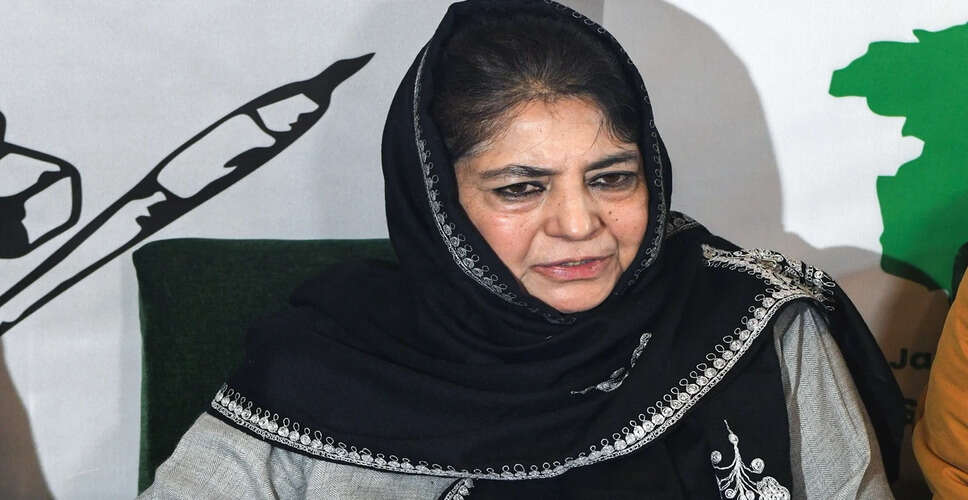
Interestingly, while Pakistan is expected to make unfounded statements regarding Kashmir, there are individuals within India who do not hesitate to question the judicial system and support separatists. Notably, Mehbooba Mufti, the leader of the People's Democratic Party (PDP), has called for a review of Andrabi's life sentence. This raises several questions, particularly why Mehbooba aligns with Pakistan's narrative.
Mufti's Appeal for Reconsideration
The former Chief Minister of Jammu and Kashmir appealed for a reconsideration of Andrabi's life sentence on humanitarian grounds. Mufti stated, 'While we have ideological differences with her (Asiya Andrabi), humanity demands that, given her age and the years she has spent in prison, her sentence should be reviewed.' The PDP president suggested that Andrabi should be released on parole, urging that her conviction be reassessed on humanitarian grounds.