
India Reduces Excise Duty on Fuel Amid Rising Oil Prices
Government Cuts Excise Duty on Fuel
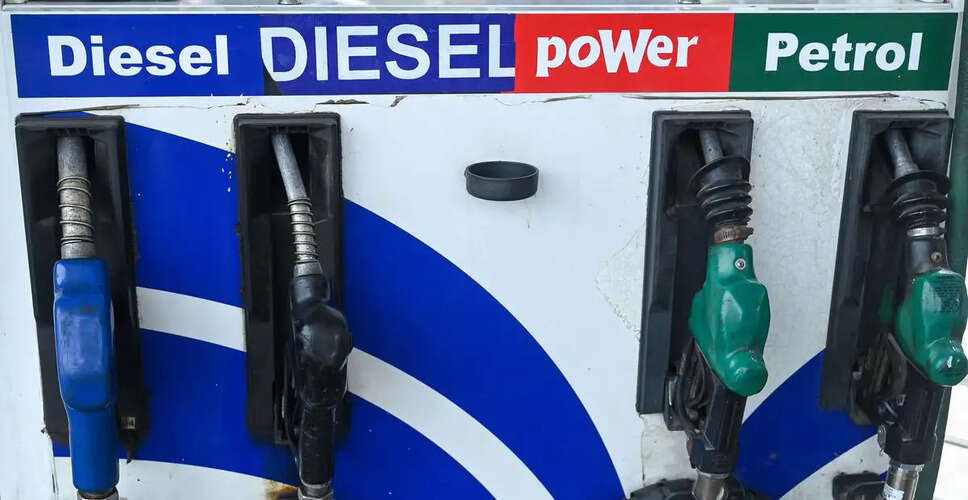
The Indian government has significantly reduced the special additional excise duty on petrol from Rs 13 to Rs 3 per litre, and on diesel from Rs 10 to zero. This move aims to stabilize fuel prices for consumers and support oil marketing companies.
Fuel marketing firms have faced challenges as retail prices for petrol and diesel have remained unchanged, despite a nearly 50% increase in global oil prices since the conflict in West Asia began on February 28.
In addition to the excise cuts, the government has imposed duties of Rs 21.5 per litre on diesel exports and Rs 29.5 per litre on aviation turbine fuel exports. Union Minister Nirmala Sitharaman stated that this is to ensure these products remain available for domestic use.
Increased LPG Allocation to Support Industries
The Union government has also raised the commercial allocation of liquefied petroleum gas (LPG) to 70% of pre-conflict levels, up from 50%. This increase is intended to assist industries such as steel, automobiles, and textiles, according to Petroleum Secretary Neeraj Mittal.
Mittal emphasized that priority would be given to process industries that require LPG for specialized heating that cannot be replaced by natural gas.
Petroleum Minister Hardeep Singh Puri has dismissed rumors of a potential lockdown in India due to the ongoing conflict.
Nepal Welcomes Youngest Prime Minister
In Nepal, rapper-turned-politician Balendra Shah, known as Balen, has been sworn in as the country's prime minister, making him the youngest individual to hold this position in decades.
Shah, who previously served as the mayor of Kathmandu, assumed office after his Rastriya Swatantra Party secured 182 out of 275 seats in the recent elections.
Indian Rupee Hits Record Low
The Indian rupee has fallen to an all-time low of 94.82 against the US dollar amid the ongoing conflict in West Asia. It opened at 94.18 in the interbank foreign exchange market but dropped 86 paise as foreign fund outflows persisted and domestic equity markets weakened.
On Friday, the benchmark Sensex declined by 2.25%, while the Nifty fell by 2.09%. Brent crude oil was trading at $109.8 per barrel, reflecting a 0.53% increase in futures trading.
Opposition MPs Demand Film Certification
A coalition of opposition MPs has urged the Union government to instruct the Central Board of Film Certification to evaluate the film 'The Voice of Hind Rajab' in line with constitutional principles regarding freedom of expression. They are advocating for the film's certification.
This request follows reports indicating that the film's release was halted due to concerns it might harm relations between India and Israel. The Oscar-nominated film tells the true story of a five-year-old Palestinian girl who was killed during an Israeli attack in Gaza.