
India Raises Concerns at BRICS Meeting Over West Asia Crisis and Energy Security

India's Stance on West Asia Crisis
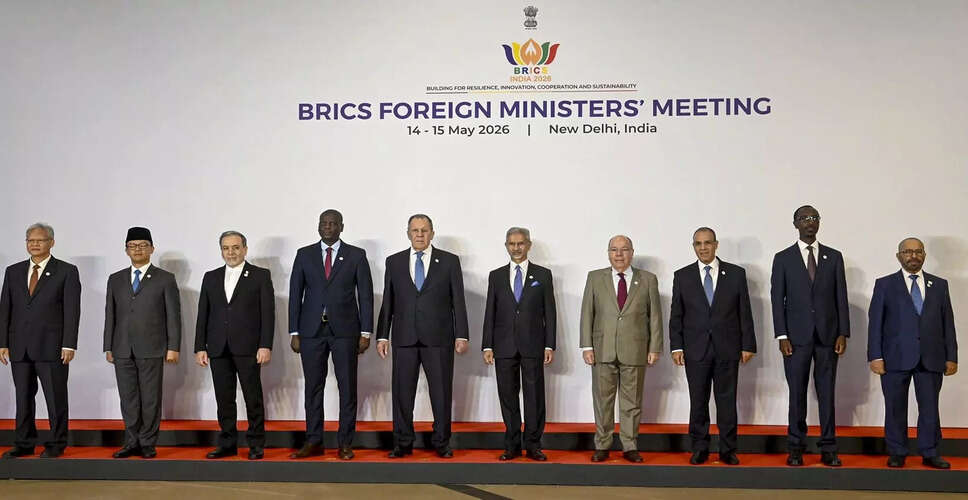
Jaishankar (5th right) with the foreign ministers during the BRICS Foreign Ministers' Meeting, in New Delhi on Thursday. (Photo:PTI)
New Delhi, May 14: On Thursday, India expressed serious concerns regarding the ongoing crisis in West Asia and its repercussions on energy supplies. During the BRICS meeting held in the capital, External Affairs Minister S. Jaishankar called on member nations to devise "practical strategies" to address geopolitical challenges and the impact of "unilateral coercive" sanctions.
In his opening remarks at the two-day BRICS conclave, Jaishankar emphasized the importance of respecting sovereignty and territorial integrity in international relations, without naming specific countries.
He reiterated India's commitment to contribute positively towards de-escalation efforts and support initiatives aimed at restoring stability, stressing that "peace cannot be piecemeal" and that it is crucial to uphold international law, safeguard civilians, and avoid targeting public infrastructure.
Jaishankar highlighted the need for particular attention to the West Asia conflict, pointing out that ongoing tensions, threats to maritime traffic, and disruptions to energy infrastructure underscore the precariousness of the situation.
He advocated for ensuring safe maritime navigation through the Strait of Hormuz and the Red Sea, while also expressing deep concerns regarding the "grave humanitarian implications" stemming from the conflict in Gaza.
This meeting, hosted by India, holds significant importance as the influential bloc addresses the economic ramifications of the West Asia crisis, especially the severe disruptions in energy supply and the implications of Washington's trade policies.
Among the senior leaders present at the meeting were Iranian Foreign Minister Abbas Araghchi, Russian Foreign Minister Sergey Lavrov, Brazil's Mauro Vieira, Indonesian Foreign Minister Sugiono, and South Africa's Minister for International Relations Ronald Lamola.
Jaishankar also pointed out the necessity of addressing the increasing reliance on unilateral coercive measures and sanctions that contradict international law and the UN Charter, without naming any specific nation.
He described terrorism as a "persistent threat," asserting that there is no justification for terrorism in any form. He stated, "Cross-border terrorism undermines the fundamental principles of international relations. Zero tolerance must remain an unwavering and universal standard."
Additionally, the External Affairs Minister advocated for reforming the UN Security Council, noting that as challenges escalate, the multilateral system is unfortunately deteriorating. He expressed concern over the current state of the United Nations, emphasizing that the case for reformed multilateralism grows stronger with each passing day.
As the chair of BRICS, India is hosting this conclave of foreign ministers in anticipation of the annual summit scheduled for September, with Jaishankar presiding over the meeting.