
India Launches Key Environmental and Solar Calibration Facilities
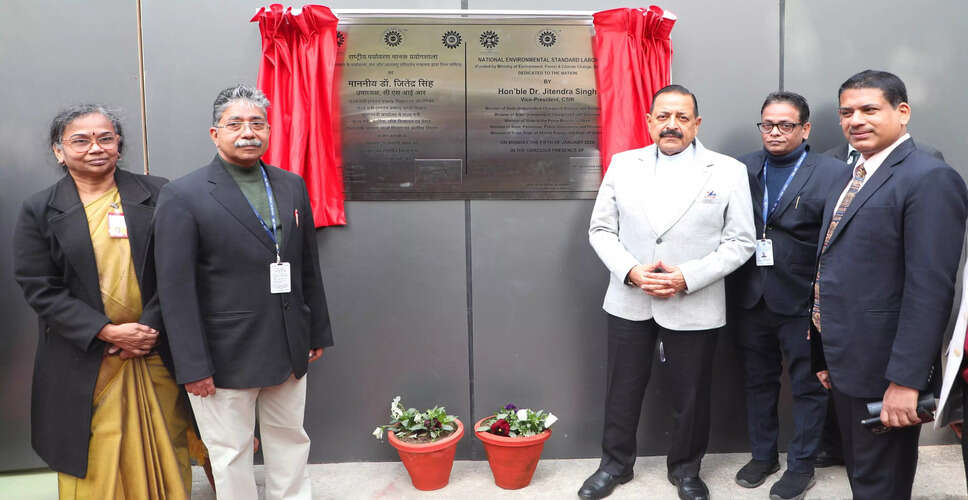
Inauguration of National Facilities
New Delhi, Jan 6: The CSIR-National Physical Laboratory (NPL) has unveiled the second "National Environmental Standard Laboratory" and the fifth "National Primary Standard Facility for Solar Cell Calibration" globally, aimed at enhancing India's environmental and renewable energy sectors, as stated by the Union Minister of State (Independent Charge) for Science & Technology.
During the 80th Foundation Day of CSIR-NPL, the Minister emphasized that the National Environmental Standard Laboratory is a significant advancement in bolstering India's environmental governance.
He remarked, "The need for reliable, India-specific calibration and certification for air pollution monitoring systems has been long overdue. This facility will now facilitate transparent, traceable, and precise environmental data, aiding regulatory bodies, industries, and startups by ensuring that monitoring instruments are evaluated under Indian climatic conditions. This will enhance policy enforcement under initiatives like the National Clean Air Programme."
The Minister also referred to the Solar Energy Complex as a state-of-the-art facility that positions India among the elite in global photovoltaic measurement standards.
Developed in partnership with PTB, Germany, the laser-based Differential Spectral Responsivity (L-DSR) system boasts the lowest global uncertainty of 0.35 percent (k=2) for reference solar cell calibration.
He highlighted that this facility will lessen India's reliance on international certification bodies, conserve foreign currency, expedite calibration processes, and boost investor confidence in the burgeoning solar sector.
The Minister asserted that reforms in science and technology will be pivotal in shaping India's socio-economic landscape.
He described India's leading scientific institutions as "monuments of the 20th and 21st centuries," stating that laboratories like CSIR-NPL represent India's scientific evolution from pre-Independence to becoming a global technology leader.
The MoS noted that the laboratory has been operational since before Independence and has since become a cornerstone of India's scientific framework post-Independence.
He pointed out that CSIR predates independent India, making NPL one of the earliest among the 37 CSIR laboratories.
In discussions with the media, the Minister mentioned that the laboratory has been guided by notable national figures such as Dr. Syama Prasad Mukherjee and Sardar Vallabhbhai Patel, calling NPL a unique institution where history and science converge.
He added, "For decades, half the nation synchronized its watches with the atomic clock at NPL," highlighting the laboratory's crucial role in establishing Indian Standard Time (IST).
Singh concluded by stating that Indian scientists are now integral to national goals and aspirations, no longer working in isolation.