
India Denies Involvement in Khalistani Leader's Killing in Canada
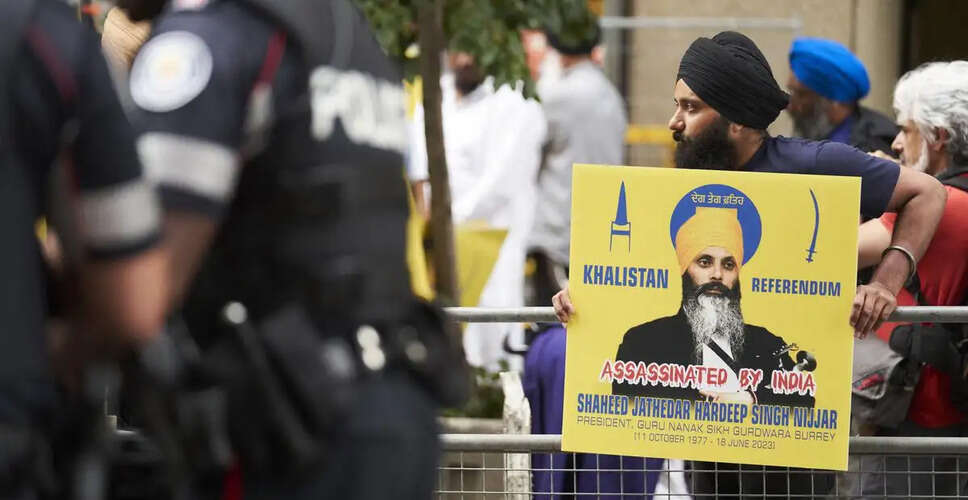
India Responds to Allegations of Involvement in Nijjar's Death
On Monday, the Ministry of External Affairs firmly dismissed claims suggesting that Indian officials played a role in the 2023 assassination of Khalistani separatist Hardeep Singh Nijjar in Canada.
P Kumaran, the ministry's secretary for East, stated that New Delhi categorically rejects any allegations of involvement in organized crime or transnational violence.
During a press briefing, Kumaran described these accusations as unfounded, politically charged, and lacking credible evidence, despite multiple requests for substantiation. He emphasized that such issues should be resolved through legitimate law enforcement and judicial channels rather than through politicized narratives.
His remarks were made in response to inquiries regarding the alleged participation of Indian diplomatic personnel in Nijjar's murder.
A report from a Toronto newspaper claimed that Canadian security agencies had received information indicating that Indian consular staff in Vancouver had allegedly assisted in Nijjar's killing.
#WATCH | Delhi: P Kumaran, Secretary (East), states, "India categorically rejects allegations of involvement in transnational violence or organised crime. These claims are baseless, politically motivated and unsupported by credible evidence despite repeated requests. India believes… pic.twitter.com/s4zdPchv91
— News Media (@NewsMedia) March 2, 2026
Additionally, a report from another Canadian outlet cited Ottawa's domestic intelligence agency, which alleged that India remains a significant actor in foreign interference and espionage within Canada.
These allegations surfaced during Canadian Prime Minister Mark Carney's inaugural official visit to India, coinciding with a warming of diplomatic ties. Carney engaged in discussions with Prime Minister Narendra Modi in Delhi on Monday.
Kumaran noted that the investigation into Nijjar's murder is progressing according to legal protocols in Canada.
He stated, "It will advance to the full jury trial phase." He reiterated India's commitment to the judicial process.
Kumaran further asserted that sensitive judicial matters should be allowed to unfold through established legal frameworks without public commentary.
Nijjar was shot dead by masked assailants in June 2023, an event that escalated diplomatic tensions between New Delhi and Ottawa after Prime Minister Justin Trudeau indicated in September 2023 that intelligence agencies were probing credible allegations linking Indian government agents to the incident.
India has consistently refuted Canada's claims.
Nijjar was a proponent of Khalistan, a proposed independent Sikh nation, and led the Khalistan Tiger Force, which is recognized as a terrorist organization in India.
Currently, four Indian nationals are facing trial in Canada related to Nijjar's murder, charged with first-degree murder and conspiracy.
On Saturday, a spokesperson for the Canadian Security Intelligence Service confirmed that their assessment regarding India's involvement had not changed, contradicting a statement from a senior government official who suggested that Ottawa no longer associates India with violent crimes.
Previously, Ottawa had accused India of foreign interference.
A Canadian inquiry commission in January 2025 accused India of meddling in the electoral process by covertly funding political figures and spreading disinformation.
The Indian external affairs ministry rejected this inquiry report, asserting that it is Canada that has been interfering in India's internal matters.
In March 2025, the Canadian Security Intelligence Service warned that India, along with China, Russia, and Pakistan, might attempt to interfere in the upcoming Canadian general election scheduled for April 2025.
On February 8, India and Canada announced a collaborative work plan aimed at enhancing cooperation on national security and law enforcement.