
India Critiques Pakistan's Terrorism Policies at UN Assembly
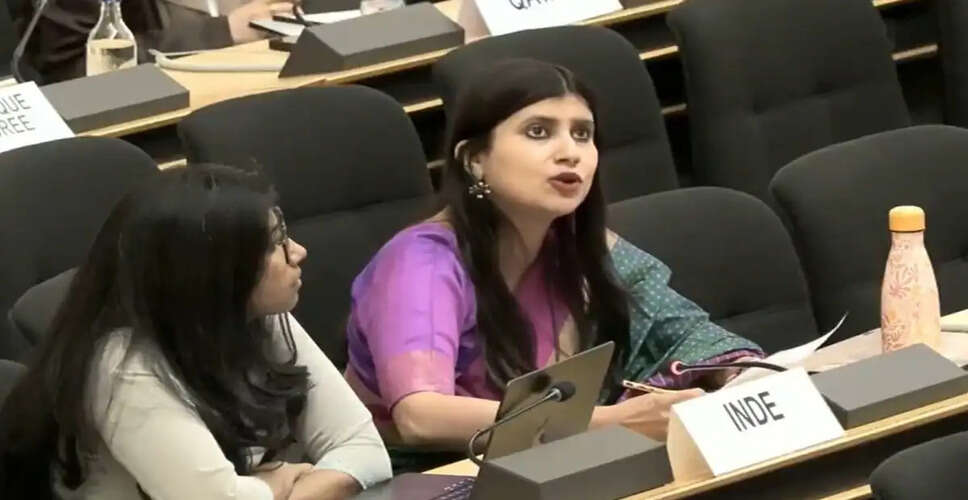

India's Strong Response to Pakistan at the UN
At the United Nations, India has once again condemned Pakistan's policies that support terrorism. During discussions on the annual report from the UN High Commissioner for Human Rights, India adopted a firm stance against Pakistan, which is grappling with economic difficulties and internal political strife. Anupama Singh, India's young diplomat, took Pakistan to task under the 'Right to Reply', labeling it a 'Frankenstein State'—a term used to describe a nation that creates forces leading to its own destruction.
India asserted that a country that has nurtured terrorists cannot claim to be a victim when those very forces turn against it.
Accusations Against Pakistan
India accused Pakistan of supporting terrorism while simultaneously portraying itself as a victim of terrorist attacks. Singh pointed out that Pakistani leaders have openly discussed providing shelter and training to terrorists in the past. She emphasized that it is ironic for Pakistan to claim victimhood when the monsters it created turn against it.
Singh stated, "Yet, Pakistan continues to present itself as a victim of terrorism. This is truly a paradox that only Pakistan can maintain. It exemplifies a Frankenstein State, shocked when its own monster strikes back."
Highlighting Human Rights Violations
India also drew attention to the situation in Pakistan-occupied Kashmir, particularly the recent unrest in Rawalkot. According to the Indian diplomat, years of oppression, restrictions on freedom, and stringent policies have fueled growing anger among the people in that region. She argued that demands for basic rights and improved living conditions are often met with violence.
Singh remarked that the ongoing tragedy in Rawalkot, which has resulted in numerous civilian deaths and brutal actions in Pakistan-occupied Jammu and Kashmir, is a direct outcome of a system built on forced occupation and oppression.
Concerns Over the Indus Water Treaty
In addition to discussing terrorism and Kashmir, India utilized this opportunity to address the Indus Water Treaty. Singh argued that the 1960 agreement cannot be viewed in isolation from current realities. She questioned whether a country accused of promoting cross-border terrorism can expect the benefits of cooperation based on trust and goodwill.
India has maintained that there is a need to reconsider this treaty in light of changing circumstances and new security concerns. Singh stated, "Our position on the Indus Water Treaty is clear. It is illogical for a country that promotes terrorism as a policy to demand privileges based on goodwill and friendship."
Revisiting the Treaty
She further added, "The treaty established in 1960 cannot be regarded as an eternal right, disconnected from accountability, and unaffected by significant changes over the past six decades."
Social Media Reaction
#WATCH | First Secretary at the Permanent Mission of India to the United Nations, Anupama Singh says, "Jammu and Kashmir was, is and will always remain an integral and inalienable part of India. The only unresolved issue is Pakistan's illegal occupation of Indian territories and… pic.twitter.com/Kjr0mq1STZ
— Media House (@MediaHouse) June 18, 2026