
India Challenges Pakistan's Claims on Indus Water Treaty Amid Terrorism Allegations
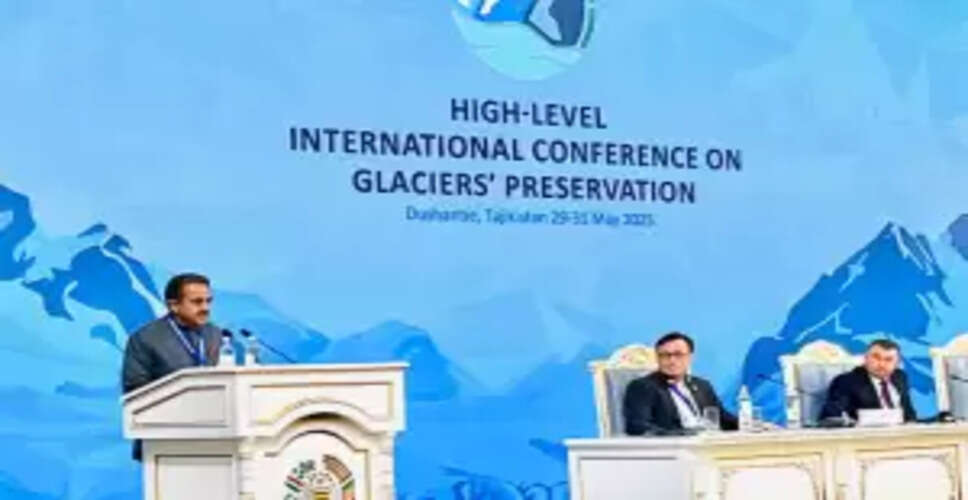
India's Stance at the UN Glacier Conference
New Delhi: India has urged Pakistan to cease its accusations regarding the violation of the Indus Water Treaty, asserting that persistent cross-border terrorism from Pakistan is hindering the treaty's enforcement.
During a plenary session at the inaugural UN conference on glaciers held in Dushanbe, Tajikistan, Minister of State for Environment Kirti Vardhan Singh emphasized that Pakistan is itself breaching the treaty through acts of terrorism.
"We are dismayed by Pakistan's attempt to misuse this platform to introduce irrelevant issues that do not pertain to the conference's agenda. We strongly denounce such actions," he stated.
Singh pointed out that significant changes have occurred since the Indus Waters Treaty was established, necessitating a reevaluation of its terms.
These changes encompass advancements in technology, shifts in demographics, climate change, and the ongoing threat posed by cross-border terrorism.
The minister highlighted that the treaty was founded on principles of goodwill and friendship, and it is crucial to uphold it in good faith.
"However, the continuous cross-border terrorism from Pakistan obstructs the effective utilization of the treaty's provisions.
"Pakistan, which is in violation of the treaty itself, should refrain from blaming India for any breaches," he added.
At the same conference, Pakistan's Prime Minister Shehbaz Sharif asserted that his country would not permit India to suspend the Indus Waters Treaty, which he claimed jeopardizes millions of lives for political motives.
"India's unilateral and unlawful decision to suspend the Indus Waters Treaty, which regulates the distribution of water from the Indus Basin, is extremely regrettable," Sharif was quoted by the Pakistani media.
This announcement followed a terrorist attack in Pahalgam, Jammu and Kashmir, on April 22, which resulted in 26 fatalities, prompting India to halt the treaty as part of various punitive actions against Pakistan.
The Indus Waters Treaty, signed in 1960 with the World Bank as a mediator, governs the water-sharing arrangements of the Indus River system between India and Pakistan.
The three-day UN conference on glaciers, concluding Saturday, aims to emphasize the crucial role of glaciers in sustaining global ecological balance and addressing water-related issues.
Over 2,500 delegates from 80 UN member states and 70 international organizations are participating in the conference.