
India and US Move Towards Bilateral Trade Agreement Amid Tariff Proposals

India's Commitment to Trade Relations with the US
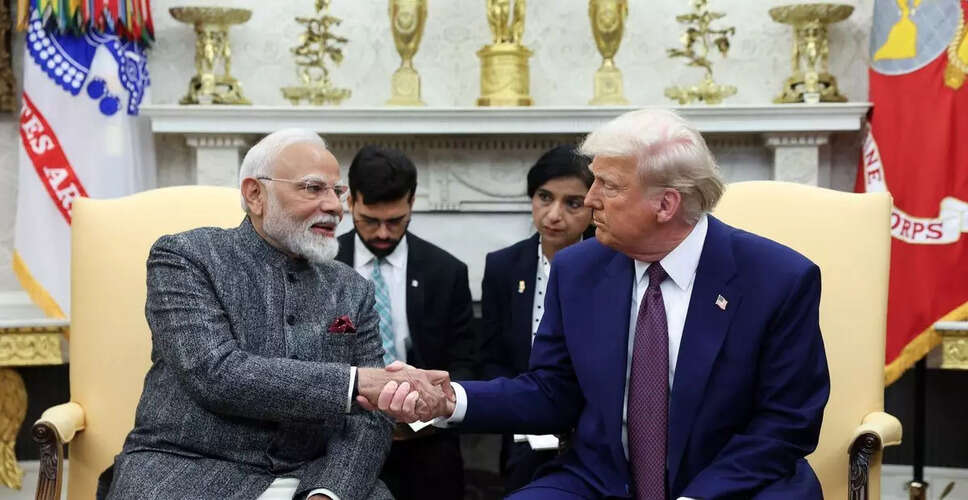
A file image of PM Modi with US President Donald Trump. (Photo:X)
Washington, Nov 25: The Indian government has reaffirmed its dedication to collaborating with the United States to finalize a bilateral trade agreement, countering claims from Washington regarding India's manufacturing capacity.
The Commerce Ministry released a statement on Wednesday, acknowledging the Notice of Determination and Request for Comments from the United States Trade Representative (USTR) regarding the structural excess capacity and production practices of 14 economies, including India.
According to the statement, "The Government of India is committed to working closely with the United States towards the early conclusion of the India-US Bilateral Trade Agreement, as announced on February 2, 2026, and in line with the Joint Statement issued on February 7, 2026."
The ministry noted that the notice is currently under review.
"India has engaged constructively throughout this investigation. In response to the Notice of Initiation and subsequent proceedings, the Department of Commerce asserted that India does not possess structural excess capacity in any sector," the statement added.
This announcement follows the US's proposal of a 25% tariff on imports from India, which could be reduced to 17% if both nations reach a trade agreement, providing India a competitive advantage over several Asian countries.
The proposed tariffs are a result of investigations by the USTR into 16 economic jurisdictions, including China, the EU, and others, concerning structural excess capacity in manufacturing.
Under the USTR's proposed tariff framework, Indian imports could incur a 17% tariff if a trade deal is finalized, offering India a slight edge over Bangladesh, Cambodia, Indonesia, Malaysia, and Thailand, which would face an 18% tariff, and a three percentage point advantage over Vietnam and China, which would face a 20% tariff.
On Wednesday, the USTR introduced tariff proposals targeting 14 economic jurisdictions, featuring two distinct rates: a higher rate as part of the Section 301 investigation and a lower "deal rate" contingent on trade agreements with the US.
According to US Trade Representative Jamieson Greer, the proposed rates, generally ranging from 15% to 20%, are "not really additive" and will not stack on top of existing duties, effectively acting as a top-up.
During trade negotiations, India has emphasized the need for a competitive edge over its Asian counterparts, a concern that has been acknowledged in the tariff proposals from Washington.
However, it remains uncertain whether the one percentage point differential will sufficiently address India's concerns.
The USTR has planned public hearings on these proposals for January 25 and has requested written comments from interested parties by January 5 as part of the regulatory process before the tariffs are implemented.
The USTR's report highlighted that India maintains trade surpluses in sectors like pharmaceuticals, steel, and ICT goods, indicating a reliance on Indian manufacturing in critical areas.
India and the US are currently negotiating an interim bilateral trade agreement after the framework established in February was returned to the discussion phase, following the Supreme Court's decision to overturn the IEEPA tariffs imposed last year.