
India and Sri Lanka Forge Stronger Defence Ties: A New Era of Cooperation
Strengthening Strategic Relations
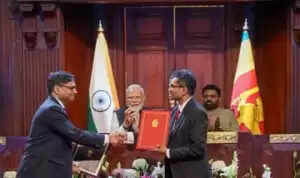
Colombo: In a significant move to enhance their strategic partnership, India and Sri Lanka signed a defence agreement on Saturday, nearly 40 years after the Indian Peace Keeping Force (IPKF) operation. Prime Minister Narendra Modi emphasized the interconnected security of both nations during discussions with Sri Lankan President Anura Kumara Dissanayake.
The two leaders finalized seven agreements, including a plan to develop Trincomalee as an energy hub in collaboration with the United Arab Emirates, alongside an agreement for power grid connectivity.
Modi reiterated India's commitment to supporting Sri Lanka, while Dissanayake assured that Sri Lanka would not permit its territory to be used against India's security interests.
During the talks, Modi advocated for a compassionate resolution to the fishermen dispute and expressed hope that Sri Lanka would address the aspirations of the Tamil population and hold provincial council elections.
In his address, Modi revealed that India had converted over $100 million in loans to grants for Sri Lanka in the past six months and announced a reduction in interest rates for loans extended to the island nation.
In addition to the seven agreements, a debt restructuring deal was also established to provide economic assistance to Sri Lanka, aimed at delivering immediate relief to its citizens.
Modi announced a support package of approximately 2.4 billion Sri Lankan rupees for the socio-economic development of Sri Lanka's Eastern provinces.
Reflecting the significance of Modi's visit, he received a ceremonial welcome at Independence Square and was awarded Sri Lanka's highest civilian honor, the Mithra Vibhushana.
The defence pact emerged as a focal point of the discussions, marking a positive shift in defence relations and moving past the historical context of the IPKF withdrawal.
Modi stated, “We share security interests. The safety of both nations is intertwined.” He expressed gratitude to Dissanayake for his consideration of India's concerns.
Dissanayake affirmed Sri Lanka's commitment to not allowing its territory to be used against India's security or regional stability.
Modi highlighted India's role as a supportive neighbor, stating, “We have stood by the people of Sri Lanka during crises, including the 2019 terrorist attack and the COVID pandemic.”
He also paid tribute at the IPKF memorial in Colombo, honoring Indian soldiers who sacrificed their lives during the intervention.
Foreign Secretary Vikram Misri explained that the defence pact serves as a comprehensive framework to enhance existing cooperation, emphasizing the close alignment of national security narratives between both nations.
The agreement will facilitate joint military exercises, capacity building, and increased naval cooperation, potentially leading to collaboration in the defence industry.
Other notable agreements included cooperation in digital solutions and India's multi-sectoral grant assistance for the Eastern province.
Modi announced a capacity-building initiative for 700 Sri Lankans annually and pledged support for the development of several temples in Sri Lanka.
He emphasized that the relationship between India and Sri Lanka is founded on mutual trust and goodwill, and both nations will continue to work towards fulfilling the aspirations of their peoples.
Dissanayake's choice of India for his first foreign visit as president underscores the depth of their bilateral relations.
Modi noted that Sri Lanka holds a special place in India's 'Neighbourhood First Policy' and the 'MAHASAGAR' vision for mutual growth.
Following their discussions, Modi and Dissanayake virtually inaugurated the Sampur solar power plant and other India-supported projects.
Modi stated, “The Sampur solar power plant will enhance Sri Lanka's energy security. The agreements to develop Trincomalee as an energy hub will benefit all Sri Lankans.”
He added that the grid connectivity agreement would create opportunities for Sri Lanka to export electricity.
Modi also pledged support for the Sri Lanka Unique Digital Identity project.
Addressing the fishermen issue, Modi advocated for a humane approach and emphasized the need for the immediate release of detained fishermen and their boats.
He expressed hope that the Sri Lankan government would fully implement its Constitution and conduct provincial council elections to meet the Tamil community's aspirations.
Modi met with Tamil leaders from Northern and Eastern provinces, reaffirming India's commitment to equality and justice for the Tamil community within a united Sri Lanka.
The Tamil community has been advocating for the implementation of the 13th Amendment, which allows for power devolution, established after the Indo-Sri Lankan agreement of 1987.
Modi reiterated India's support for Sri Lanka in overcoming its economic challenges, highlighting the conversion of loans to grants and the debt restructuring agreement as immediate relief measures.
He stated, “This demonstrates that India continues to stand with the people of Sri Lanka.”
The prime minister also referenced the historical Buddhist ties between the two nations, announcing the return of Holy Relics of Lord Buddha to Sri Lanka for an exposition.
Modi confirmed India's assistance in renovating several temples and supporting the construction of sacred sites in Sri Lanka.
The discussions took place shortly after Modi's visit to Bangkok for the BIMSTEC summit.