
India and Poland Set Ambitious Trade Goals for 2030

Strengthening Economic Ties
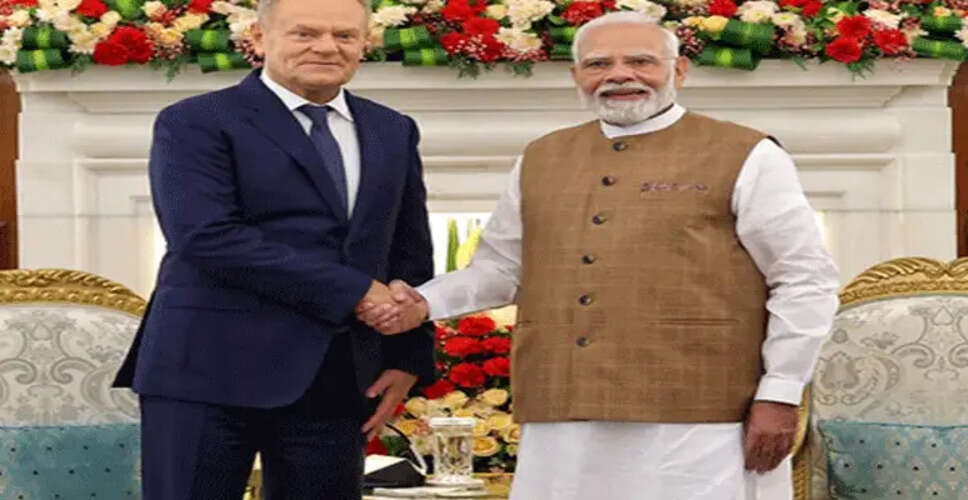
New Delhi - India and Poland have established a target to double their bilateral trade by the year 2030. This announcement was made following a meeting between Prime Minister Narendra Modi and Polish Prime Minister Donald Tusk on Thursday, as detailed in a joint statement. The two nations expressed their commitment to enhancing economic relations through increased trade, investment, and technological collaboration.
The joint statement emphasized the urgency of signing, approving, and implementing the proposed Free Trade Agreement (FTA) between India and the European Union (EU) within a specified timeframe. Both leaders believe that this agreement will create new opportunities for trade and investment, diversify and strengthen critical value chains, and facilitate easier access for businesses in both countries to new markets.
Prime Minister Modi invited Polish companies to invest in India and expand their operations. He highlighted that India's vast market, skilled workforce, rapidly growing manufacturing sector, and innovation-driven economy present significant opportunities for foreign enterprises. Investing in India would not only enhance Polish companies' presence in the Indian market but also allow them to leverage the industrial capabilities and growth potential available here.
On the other hand, Prime Minister Tusk praised the investments made by Indian companies in Poland, stating that Poland could serve as a crucial gateway for Indian firms looking to expand into Central and Eastern Europe, as well as the broader European market. Both leaders underscored the importance of promoting investment opportunities and strengthening business ties to further enhance the economic partnership between India and Poland.
Enhancing cooperation in the agricultural sector was also a priority for both nations. The two prime ministers agreed to restart the activities of a bilateral working group to accelerate collaboration in this area, which would encourage agricultural trade, promote the exchange of technical knowledge, and better utilize the potential available in the agricultural sector.
The leaders welcomed the organization of the India-Poland Business Forum, which saw participation from leading industrialists and company representatives from both countries. They called for strengthening partnerships in key sectors such as industrial machinery, defense, infrastructure, pharmaceuticals, mining, critical minerals, energy, and information and communication technology. Both parties believe that joint efforts in these areas could expand trade relations and create new projects, investments, and job opportunities.
During the discussions, the importance of building strong and diverse supply chains, encouraging small and medium enterprises (SMEs), promoting innovation-driven development, and accelerating digital transformation was also highlighted. The leaders acknowledged the necessity of making supply chains more secure, resilient, and diverse in light of changing global economic conditions. Increasing the participation of SMEs could provide a broader foundation for trade cooperation between the two countries.
Both nations identified digital technology and artificial intelligence (AI) as vital tools for economic growth, enhancing productivity, and improving the quality of public services. Keeping in mind the comprehensive strategic agenda between India and the EU, both sides agreed to promote joint research in the fields of AI, semiconductors, and quantum technology. They also emphasized strengthening collaboration among startups and advancing the development and practical application of new technologies.
The space sector was recognized as a significant component of the strategic partnership between India and Poland. The prime ministers welcomed efforts to strengthen cooperation at both institutional and industry levels in this area, agreeing to identify beneficial space projects and develop new opportunities for collaboration. They believe that joint efforts in space technology could lead to advancements in research, technological development, and industrial partnerships.
The joint statement included the semiconductor sector as a key area for future bilateral cooperation. Additionally, both countries discussed the potential for collaboration in circular economy practices, battery recycling, and the processing of rare earth minerals. Partnerships in these areas could enhance resource utilization, promote recycling, and secure the supply of critical industrial materials.
Agreement was also reached on enhancing cooperation in geosciences, mining, and critical minerals. Negotiations are ongoing regarding a Memorandum of Understanding (MoU) aimed at advancing collaborative opportunities in these sectors and exploring new avenues for technical and industrial partnerships. Given the rising global demand for critical minerals, cooperation in this area could prove beneficial for both nations.
The two prime ministers also discussed improving transportation and connectivity. They welcomed the prospects of initiating direct air services between India and Poland and encouraged the aviation authorities of both countries to advance direct discussions on this matter. The establishment of direct flights could enhance passenger mobility, business connections, and tourism opportunities. Furthermore, both sides explored opportunities for increased cooperation in maritime transport and maritime security.
The leaders noted that strengthening cooperation between ports could aid in building secure, resilient, and integrated supply chains. This would help reduce transit times for goods and ensure the security of critical infrastructure amid geopolitical disruptions. Both countries emphasized that enhancing maritime connectivity and transport systems is crucial for maintaining smooth business activities and the stability of global supply chains.
Additionally, the prime ministers highlighted the significance of initiatives like the India-Middle East-Europe Economic Corridor (IMEEC). They stated that improved regional and international connectivity could play a vital role in the economic development of India, Poland, and the broader region. Joint efforts to expand trade, investment, technology, transportation, and industrial cooperation between the two nations are expected to strengthen bilateral relations. The goal of doubling trade by 2030 is part of this broader strategy to make the economic partnership more comprehensive, diverse, and aligned with future needs.