
India and Germany Strengthen Ties: A New Era of Cooperation in Defence and Trade
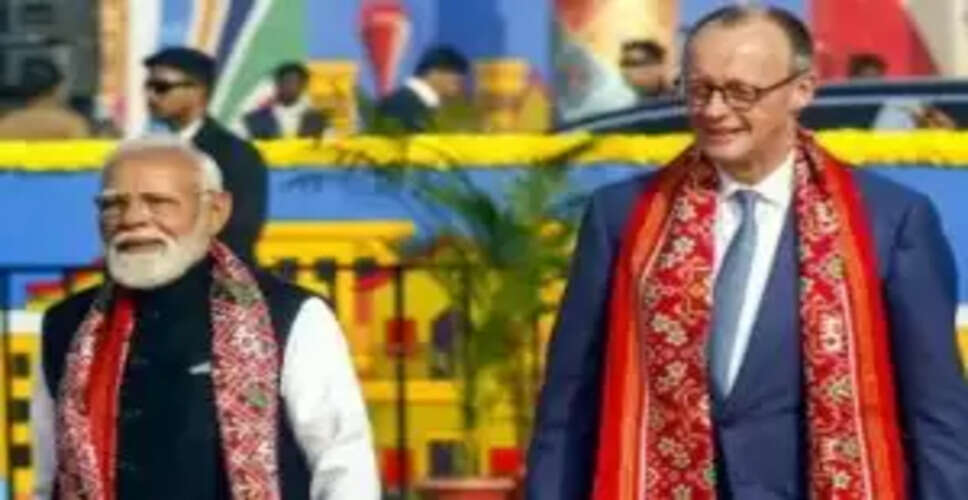
Strengthening Bilateral Relations
Prime Minister Narendra Modi and German Chancellor Friedrich Merz announced new initiatives on Monday aimed at enhancing collaboration in defence, trade, critical minerals, and semiconductors. They expressed a commitment to strengthen bilateral relations to effectively address challenges posed by global geopolitical shifts.
After their discussions, the leaders signed 19 agreements, which included a framework for defence industrial cooperation and an expansion of partnerships in higher education. Additionally, a separate agreement was established to enhance engagement in the telecommunications sector.
Both leaders advocated for the swift conclusion of the India-European Union (EU) free trade agreement to broaden trade opportunities. They also introduced a visa-free transit policy for Indian passport holders traveling through Germany to foster closer people-to-people connections.
Chancellor Merz, who arrived in Ahmedabad with a significant business delegation for a two-day visit, marked his first trip to Asia as the German Chancellor.
Modi highlighted that the growing defence and security collaboration symbolizes mutual trust and a shared vision, expressing gratitude to Chancellor Merz for streamlining defence trade processes.
He added that a roadmap for enhancing cooperation between their defence industries would create new avenues for co-development and co-production.
During their talks, both leaders reiterated their dedication to a free and open Indo-Pacific region, adherence to international law, including the UN Convention on the Law of the Sea (UNCLOS), and announced a new bilateral Indo-Pacific consultation mechanism.
This initiative comes in response to China's increasing military assertiveness in the region.
Modi and Merz also expressed strong support for the India-Middle East-Europe Economic Corridor (IMEC), emphasizing its potential to transform global commerce, connectivity, and prosperity.
The Prime Minister noted that both nations are collaborating on new projects in climate, energy, urban development, and urban mobility.
He described a new green hydrogen mega project involving companies from both countries as a potential game-changer for future energy solutions.
Modi emphasized that India and Germany are working together to establish secure, reliable, and resilient supply chains.
He remarked that the burgeoning trade and investment relationship has injected 'new energy' into the India-Germany strategic partnership, with bilateral trade surpassing USD 50 billion for the first time.
With over 2,000 German companies operating in India, Modi pointed out their enduring confidence in the country and the vast opportunities it presents.
Both leaders acknowledged that terrorism poses a significant threat to humanity and committed to combating it with unwavering resolve.
Chancellor Merz highlighted the increasing demand for skilled workers from India, including caregivers and nurses, and discussed the importance of people-to-people connections.
An agreement on skill partnerships was signed to facilitate the movement of Indian healthcare professionals to Germany, which hosts around 300,000 Indian expatriates and 60,000 students.
Merz noted that major powers are increasingly using supply chains and raw materials as tools of influence, and both countries aim to counter this trend.
He stated that reducing unilateral dependencies in supply chains would enhance the resilience of both economies.
Modi underscored the Indo-Pacific as a priority area for both nations.
The leaders also engaged in discussions on various global and regional issues, including the Ukraine conflict and the situation in Gaza.
Modi reiterated India's long-standing advocacy for peaceful resolutions to disputes and endorsed all efforts in this direction.
Both leaders agreed on the necessity of reforming global institutions to tackle worldwide challenges, with their joint efforts through the G4 group aimed at reforming the UN Security Council exemplifying this shared commitment.
On talent mobility, Modi emphasized the importance of enhancing migration, mobility, and skills development.
He noted that India's skilled young workforce significantly contributes to Germany's economy.
The Prime Minister invited German universities to establish campuses in India, aiming to reshape the educational partnership.
A joint statement from the leaders condemned terrorism and violent extremism in all forms, including cross-border terrorism, and called for coordinated international efforts to combat it effectively.
Modi and Merz strongly condemned the terrorist attack in Pahalgam last April and the incident in Delhi in November, committing to strengthen cooperation against terrorism and terrorist entities, including those listed by the UN 1267 Sanctions Committee.
They urged all nations to work towards dismantling terrorist safe havens and networks in accordance with international law.