
India and Canada Set to Finalize Economic Partnership Amid Diplomatic Thaw
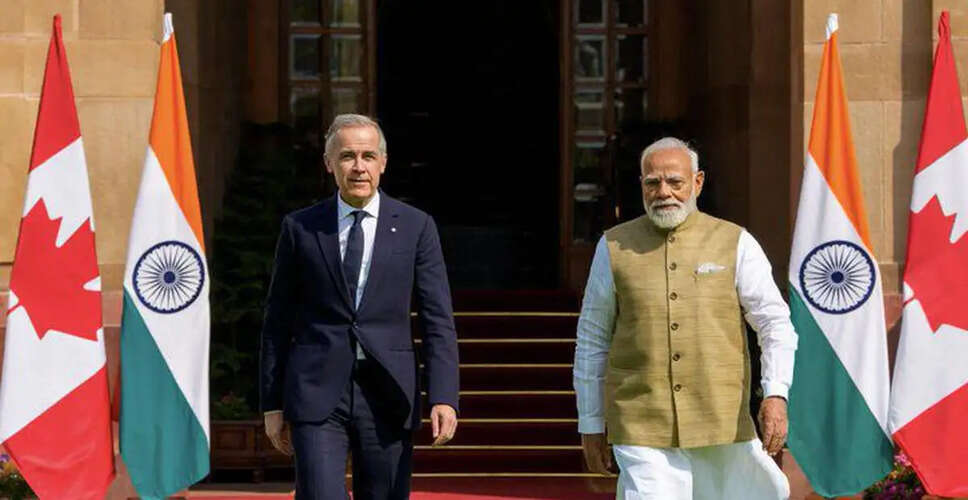
Strengthening Ties Between India and Canada
On Monday, Canadian Prime Minister Mark Carney announced that India and Canada are working towards finalizing a Comprehensive Economic Partnership Agreement by the end of this year.
This agreement aims to eliminate trade barriers, enhance certainty, and create opportunities for exporters, investors, and workers in both nations, according to Carney.
Carney, who arrived in India on Friday for his inaugural visit as prime minister, engaged in bilateral discussions with Prime Minister Narendra Modi at Hyderabad House in New Delhi.
Additionally, the two nations have reached a $1.9 million uranium agreement and plan to collaborate on developing small modular nuclear reactors and advanced reactor technologies.
This deal was formalized between India's Department of Atomic Energy and Cameco, a leading publicly traded uranium firm in Canada.
Cameco is set to provide 11,000 tons of reactor fuel to India from 2027 to 2035, as reported by Carney’s office.
Both countries have also committed to working together in various sectors, including liquefied natural gas, critical minerals, solar energy, and hydrogen.
Prime Minister Modi expressed aspirations for bilateral trade to reach $50 billion by 2030, emphasizing the importance of maximizing economic collaboration.
He also highlighted discussions on enhancing cooperation to combat terrorism, stating, “We agree that terrorism, extremism, and radicalization pose serious challenges not just for our nations but for humanity as a whole.”
Carney's visit occurs during a period of improving diplomatic relations between India and Canada.
Relations had significantly soured in 2023 after former Prime Minister Justin Trudeau informed Parliament about credible allegations linking Indian government agents to the murder of Khalistani separatist Hardeep Singh Nijjar in Canada.
Nijjar, who advocated for Khalistan, was the leader of the Khalistan Tiger Force, recognized as a terrorist organization in India.
India has firmly denied these allegations from Canada.
Prior to Carney's visit, an unnamed senior official in Ottawa indicated that the Canadian government believed India was no longer associated with alleged violent crimes in Canada.
However, on Monday, a report from the Canadian newspaper The Globe and Mail cited two unnamed officials claiming that security personnel had received evidence suggesting that Indian consular staff in Vancouver provided information that allegedly aided in Nijjar’s assassination.