
India and Canada Aim for Landmark Free Trade Agreement by 2025

Strengthening Bilateral Relations
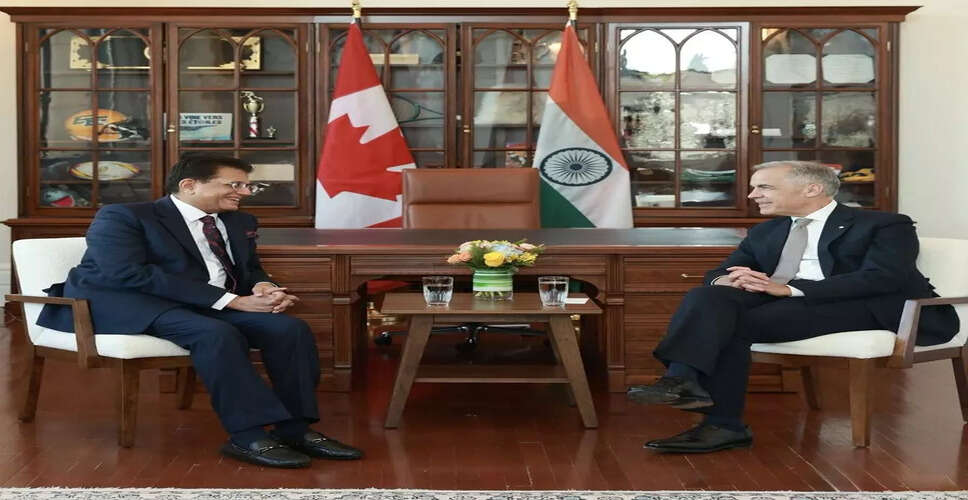
Union Minister Piyush Goyal during a meeting with Canadian Prime Minister Mark Carney, in Canada. (Photo:PTI)
New Delhi/Ottawa, May 26: India and Canada are working towards finalizing a significant free trade agreement by the end of 2025, marking a notable shift in their previously strained relations.
During a three-day official visit to Canada starting May 25, Commerce and Industry Minister Piyush Goyal announced this initiative alongside Canada's International Trade Minister Maninder Sidhu in Ottawa.
In addition to finalizing the trade agreement, both countries aim to increase bilateral trade from the current USD 17 billion to USD 50 billion by 2030.
Goyal stated at a joint press conference, "Our prime ministers have instructed us to not only finalize the free trade agreement with a comprehensive approach before the year's end but also to triple our trade by 2030."
A Diplomatic Revival
This development signifies a remarkable diplomatic recovery, as relations had deteriorated in 2023 following allegations from Canadian authorities regarding India's involvement in the murder of Sikh activist Hardeep Singh Nijjar near Vancouver.
New Delhi firmly rejected these allegations, leading Ottawa to suspend trade talks and further strain ties under former Prime Minister Justin Trudeau.
The relationship began to improve with the arrival of Prime Minister Mark Carney, whose visit to India in late February, the first by a Canadian prime minister in eight years, is credited with revitalizing the partnership.
Goyal remarked that this visit "completely changed the way Canada and India viewed each other," paving the way for a comprehensive re-evaluation of their relationship and the establishment of new objectives.
During this visit, several agreements were signed, including a CAD 2.6 billion (approximately USD 1.9 billion) deal for Canada to supply around 22 million pounds of uranium to India for nuclear energy production.
Carney expressed optimism on social media, describing the potential free trade agreement as "a game changer for Canadian workers and businesses," highlighting energy, agri-food, technology, and education as key areas for collaboration.
Accelerating Negotiations
The two nations are currently engaged in formal negotiations for a Comprehensive Economic Partnership Agreement (CEPA), with two rounds already completed.
The third round of discussions is taking place in Ottawa from May 25 to 29, led by Joint Secretary Brij Mohan Mishra for India and Bruce Christie for Canada.
Goyal's visit is supported by India's largest business delegation to Canada, comprising over 100 senior representatives from various sectors, including mining, energy, automotive, and aerospace.
Analysts suggest that this renewed engagement is partly motivated by a mutual strategic interest in reducing reliance on the United States.
Vina Nadjibulla, Vice President of Research and Strategy at the Asia Pacific Foundation of Canada, noted, "India is now pivoting towards Europe and other Western economies like Australia and Canada to fulfill its requirements for capital, technology, and innovation."
India's recent trade agreements with the European Union, the United Kingdom, and New Zealand further emphasize this broader shift towards Western economic partnerships, in which Canada is eager to establish its role.