
Increasing Flood Risks in Assam: A Climate Change Analysis
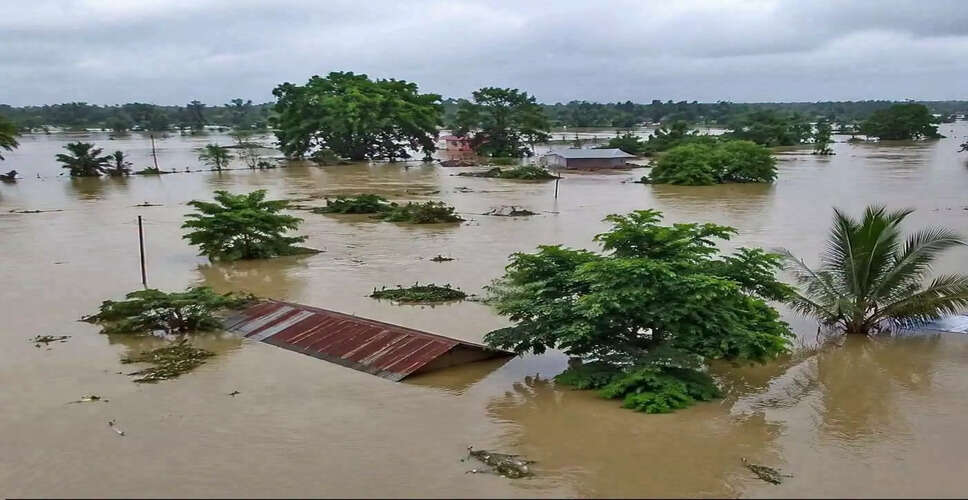

Flooding Crisis in Assam
Only rooftops remain visible as devastating floodwaters engulf an entire village in Upper Assam, leaving families stranded
New Delhi, Aug 8: The frequency and severity of floods in Assam have escalated, becoming increasingly unpredictable and destructive. This trend is attributed to several factors, including heavy rainfall, warming temperatures in the Himalayas, shifting river patterns, accelerated erosion, and the expansion of human settlements in flood-prone regions, as highlighted in a recent analysis.
Assam's geography has long made it susceptible to flooding, with approximately 40% of its land classified as flood-prone. The Brahmaputra River, known for its dynamic and sediment-rich nature, frequently alters its course, leading to riverbank erosion and changes in floodplains.
According to the analysis released by Climate Trends, a climate research organization based in Delhi, these existing vulnerabilities have intensified. A significant factor contributing to this year's floods has been a series of persistent monsoon systems originating from the Bay of Bengal.
Mahesh Palawat, vice-president of meteorology and climate change at Skymet Weather, noted, "In July, we observed consecutive weather systems forming over the Bay of Bengal. As long as these systems remained over the ocean, they continuously supplied moisture to the northeastern states."
This ongoing moisture influx created conditions favorable for rainfall, occasionally resulting in cloudbursts. Palawat emphasized that such high-intensity rainfall events are becoming more common as global temperatures rise. Research indicates that warmer air can retain more water vapor—approximately 7% more for every 1°C increase in average temperature.
This phenomenon can intensify storms, leading to increased precipitation intensity, duration, and frequency, thereby elevating the risk of severe flooding.
Additionally, warming temperatures have accelerated the melting of snow and glaciers in the eastern Himalayas, which contributes to heightened water flow in the Brahmaputra and its tributaries.
Consequently, when intense rainfall occurs, it can result in higher flood peaks and prolonged inundation, as per the analysis.
The report also highlighted that human activities, such as deforestation, urbanization, and unplanned land use, exacerbate flood vulnerability by increasing runoff and diminishing the landscape's natural water retention capabilities.
Palawat pointed out that climate change has led to greater unpredictability in Assam's flood patterns. Changes in weather patterns have resulted in increased variability in rainfall and shifts in monsoon behavior.
Despite improvements in flood forecasting and early warning systems, their effectiveness is hampered by limited observations, inadequate data sharing, and insufficient transboundary coordination, according to the analysis.
Moreover, climate change is projected to significantly heighten flood risks across the Brahmaputra Basin, rendering Assam one of the most vulnerable regions in India, with about 36% of the basin's drainage area located within the state.
Climate modeling studies predict an increase in the frequency and intensity of extreme flooding events across the Indus-Ganga-Brahmaputra river basins from 2020 to 2059, driven by intensified monsoon rainfall and accelerated glacier melt in the Himalayas and Tibetan Plateau as temperatures rise.
These changes are expected to exacerbate soil erosion, sediment deposition, wetland degradation, and agricultural losses, further compounding existing flood risks, the analysis stated.
Dr. Akshay Deoras, a research scientist at the National Centre for Atmospheric Science, University of Reading, UK, remarked, "We are observing sharp intraseasonal variations in rainfall patterns; rainfall is either extremely intense or there are prolonged dry spells, leading to extreme weather events. This is a direct consequence of global warming."
"It is crucial that we prepare for the season, taking into account these changes in rainfall patterns rather than just the total rainfall amount," he added.