
How India's Ancient Contributions to Mathematics Shape Today's Digital World

A Call for Historical Recognition
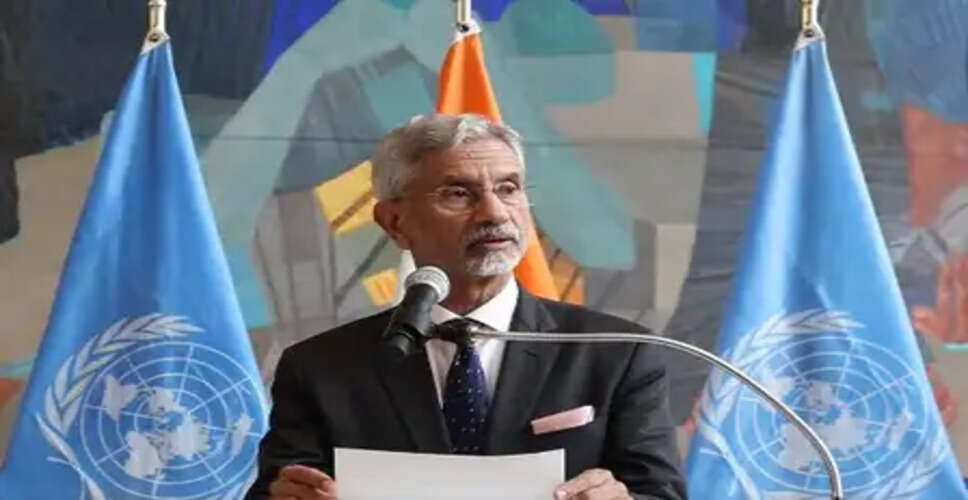
United Nations: India's External Affairs Minister, S. Jaishankar, emphasized the need to shift from a simplistic view of mathematics and sciences to a more inclusive understanding that acknowledges India's significant historical contributions.
During the inauguration of an exhibition showcasing India's mathematical heritage, he highlighted the binary system, which originated in India during the third century, as a cornerstone of the digital era and artificial intelligence.
Jaishankar remarked, "As we delve into AI, the insights from our past will enhance our future capabilities."
He noted that the exhibition serves as a reminder of mathematics as a universal language that benefits the global community.
He also mentioned that the AI Impact Summit held in India earlier this year conveyed a powerful message about the importance of creativity and innovation being accessible to all.
Addressing the UN, he stated, "To build a diverse and democratic collective, we must move beyond a one-dimensional narrative."
He stressed that the democratization of technology and the world necessitates a re-examination of historical narratives.
Jaishankar pointed out that scientific advancements have often been viewed through a limited perspective, constrained by time and geography.
He added that the current geopolitical shifts are leading to a cultural rebalancing that allows for a broader range of narratives.
The exhibition, titled "Global Diffusion of Mathematics," was developed under the India International Centre’s SAMHITA initiative to highlight India's extensive contributions across various fields, including mathematics, medicine, and philosophy.
Digital panels at the exhibition illustrate India's ancient mathematical achievements, from the binary system to algebra and calculus.
Jaishankar referenced significant mathematical milestones, including the binary system from Pingala’s Chanda Sutra, the algorithmic nature of ancient verse rhythms, the infinite series for Pi, and the principles of what is now recognized as the Pythagorean theorem.
Located at the delegates’ entrance, the exhibition aims to challenge existing biases regarding technology's role in modern society.
India’s Permanent Representative, P. Harish, remarked that the exhibition traces foundational concepts like zero, the decimal system, and early ideas of infinity, which spread from India to other cultures through renowned centers of learning.
He concluded by stating, "India has always shared its knowledge with the world, embodying an open-source philosophy long before it became a modern concept."