
Historic Free Trade Agreement Signed Between India and the UK During Modi's Visit
Significant Milestone in India-UK Relations
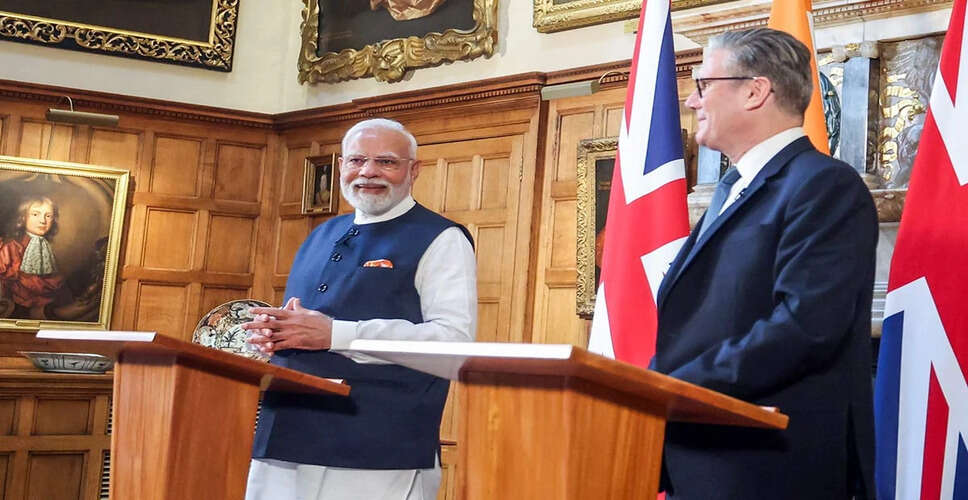
Prime Minister Narendra Modi's visit to the United Kingdom reached a historic milestone today with the formal signing of a Free Trade Agreement (FTA) between India and the UK. This high-level meeting at Chequers with British Prime Minister Keir Starmer has not only redefined the strategic relationship between the two nations but also heralded a new era in bilateral trade, investment, and technological collaboration.
Economic Significance of the FTA
This FTA is regarded as the most significant bilateral trade agreement for the UK since its exit from the European Union. The agreement was signed in the presence of both prime ministers by India's Commerce Minister Piyush Goyal and his UK counterpart Jonathan Reynolds. According to the British government, this deal is expected to generate an additional $34 billion in bilateral trade annually. Currently, trade between India and the UK stands at approximately $60 billion, with India enjoying a favorable trade balance. The agreement is projected to double this figure by 2030.
Long-term Strategic Framework
The meeting between Prime Minister Modi and Keir Starmer extended beyond trade discussions. Through the unveiling of the 'UK-India Vision 2035' document, both countries have laid out a long-term strategic framework for the coming years, focusing on deepening partnerships in technology, defense cooperation, climate change, investment, and immigration.
Key Aspects and Challenges of the FTA
The FTA is set to enhance India's market access in sectors such as textiles, pharmaceuticals, IT, auto parts, and services, while opening new opportunities for the UK in Indian education, legal services, and alcohol sectors. However, concerns have been raised regarding the potential impact on MSMEs (Micro, Small, and Medium Enterprises) and the agricultural sector. Nevertheless, Commerce Minister Piyush Goyal described it as a 'new standard for fair and ambitious trade between two major economies.' The implementation of this trade agreement is expected to take about a year.
Global Trade Context
This agreement comes at a time when global trade is facing instability. The protectionist policies and tariff strategies of former US President Donald Trump have cast a shadow over the global trading system. In this context, the India-UK FTA is poised to provide economic support to both nations and contribute to a sustainable direction for global trade cooperation. Prime Minister Modi praised the agreement, stating, 'This is not just an economic partnership but a plan for shared prosperity... This agreement will particularly benefit India's youth, farmers, fishermen, and the MSME sector.' The UK Prime Minister also commended the deal.
Strengthening National Interests
Prime Minister Modi's visit to the UK was not limited to bilateral trade and strategic partnerships; it also marked significant progress in securing India's national interests and addressing anti-India elements abroad. During this visit, signals were sent regarding actions against Khalistani extremists and economic fugitives like Nirav Modi and Lalit Modi, reflecting India's assertive and results-oriented foreign policy.
Addressing Khalistani Activities
The issue of Khalistani activities in the UK is not new. Incidents such as attacks on the Indian High Commission in London and rallies promoting 'Khalistan Zindabad' have raised concerns in recent years. During Modi's visit, India clearly articulated to the British government that such elements pose a threat not only to India's sovereignty and unity but also to the UK's internal security and social harmony. The bilateral talks prioritized the need to curb Khalistani activities, and the UK indicated it would take India's concerns seriously and closely monitor the activities of related groups.
Legal Actions Against Economic Offenders
The presence of economic offenders like Nirav Modi, Lalit Modi, and Vijay Mallya in the UK has been a longstanding challenge for India. Although India had already initiated the legal process for extradition in these cases, Modi's visit has given new momentum and direction to these efforts. India conveyed to the UK that harboring economic offenders raises questions about the credibility of its judicial system. It was also reported that the UK government is considering adopting a 'fast-track legal cooperation mechanism' for these cases. The extradition process for Nirav Modi is already in its final stages, while reports from the Enforcement Directorate (ED) and CBI regarding Lalit Modi are being effectively presented in UK courts.
Enhancing Security and Intelligence Cooperation
A new dimension added during this visit was the agreement to deepen security and intelligence cooperation between India and the UK. The aim is to control terrorist financing and funding for separatist movements, with real-time intelligence sharing between the agencies of both countries. This includes joint strategies for cybersecurity, digital surveillance, and tracking of suspicious individuals, aligning with India's 'zero tolerance towards terrorism and economic fugitives' policy. Upon arriving in London, Prime Minister Modi received a warm welcome from the Indian community.