
Heightened Vigilance in Jammu and Kashmir Amid Security Threats
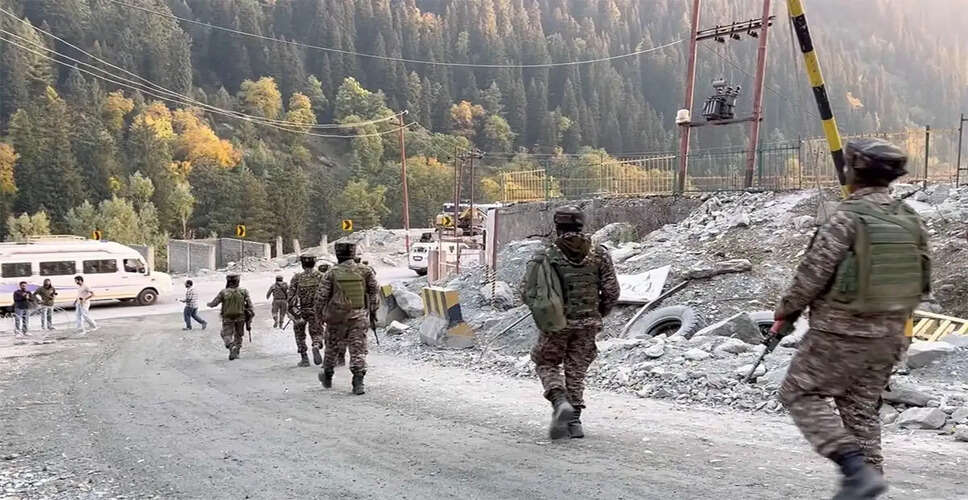

Increased Security Measures in Jammu and Kashmir
Recent developments in Jammu and Kashmir have highlighted the ongoing challenges posed by infiltration attempts, illegal communication networks, and efforts to revive terrorist operations, all under the watchful eye of security agencies. Officials report that activities linked to Pakistan-backed elements are being closely monitored, with significant intelligence and successes achieved in recent operations. In a joint effort, the army and police apprehended three individuals in the Uri sector of Baramulla district, who were allegedly attempting to cross into Pakistan-administered Kashmir. Based on intelligence, the operation led to the detention of two individuals from Sopore and their guide, identified as Adil Hussain, Ishfaq Lone, and Jafar Hafiz. Authorities are conducting a thorough investigation to ascertain their intentions and connections.
Capture of Infiltrator from Pakistan-Administered Kashmir
In another incident in the Uri area, the army captured a 22-year-old youth from Muzaffarabad who had crossed the Line of Control into Indian territory. He claimed during initial questioning that he had crossed over to meet a girl he had connected with on social media. He has since been handed over to the Jammu and Kashmir police for legal proceedings.
Concerns Over Illegal Communication Signals
Officials have raised alarms regarding a serious security challenge, noting that Pakistan is allegedly sending unnecessary and illegal telecommunication signals that violate international standards. Security agencies believe these signals are intended to provide covert communication capabilities to active terrorist groups in Jammu and Kashmir, particularly in the Jammu region. There has been an increase in the number of telecommunication towers in Pakistan-administered Kashmir, with signals reaching sensitive areas within Indian territory.
Potential Misuse of Signals in Prisons
Reports indicate that such signals have been detected in sensitive areas including Kathua, Rajouri, Poonch, and the highly sensitive Kot Bhalwal jail area. Authorities express concerns that these signals could be misused through illegally smuggled mobile devices in some prisons. Current traditional jammers are ineffective in blocking these signals, prompting security agencies to advocate for next-generation technology capable of detecting and neutralizing unauthorized devices.
Revival of Terror Networks
Security experts suggest that these communication networks established by Pakistan could help terrorists maintain connections with operators across the border. Authorities have previously dismantled several such illegal networks and continue to take action to thwart current efforts. They emphasize that these signals violate international telecommunications regulations and global standards.
Concerns Over ISI's New Strategy
Additionally, security agencies have expressed concern over a purported new strategy by Pakistan's intelligence agency, the ISI. Officials indicate that the ISI is encouraging its old over-ground worker network to infiltrate mainstream national political parties to evade scrutiny and action from security agencies. Recent interrogations of arrested terrorist supporters have revealed connections to mainstream political activities.
Adapting to Changing Circumstances
Officials believe this strategy is a response to the changing landscape, as ongoing security operations and anti-terror actions have weakened the ISI's traditional network and diminished local support. Consequently, the ISI is attempting to embed itself within the political framework to protect its supporters and influence a new generation.
Historical Context of Political Manipulation
When security forces tighten their grip during raids, terrorist supporters often resort to showing membership cards of national political parties in a desperate attempt to escape. Security officials noted that this tactic has evolved over decades. In the late 1990s, suspects would often present voter ID cards to avoid police action, while in later years, they attempted to use Aadhaar cards to evade thorough investigations. Authorities clarified that no political party leadership has ever intervened to protect such individuals.
Monitoring Resurgence of Terror Groups
Security agencies are now closely monitoring the resurgence of terrorist groups that defined the early and bloody phases of terrorism in Jammu and Kashmir during the 1990s and early 2000s. This includes organizations like Al-Umar Mujahideen, Al-Badr, and Tehrik-ul-Mujahideen. Officials assert that the ISI aims to demonstrate that terrorist violence in Jammu and Kashmir is not merely a cross-border proxy war but is also directed internally and locally.
Ongoing Surveillance and Countermeasures
Central intelligence agencies are keeping a vigilant eye on these developments and are actively working to dismantle the logistical and support networks being established by re-emerging terrorist supporters. They are also aggressively countering attempts by these supporters to ideologically mislead and radicalize youth, as maintaining the hard-won peace and stability in the region is of utmost importance.
Evolving Security Challenges
Recent events indicate that security challenges in Jammu and Kashmir are continually evolving. From infiltration attempts to the revival of illegal communication networks and terrorist support mechanisms, security agencies are employing a multi-layered strategy. Officials assert that enhancing vigilance, technical capabilities, and intelligence coordination is crucial for maintaining peace, stability, and security in the region.