
Haldi Ghati: A Symbol of Valor and National Pride Revisited
The Haldi Ghati battlefield has become a hot topic of discussion following Mohan Bhagwat's remarks about Maharana Pratap's legacy. This article delves into the historical significance of the battle, the ongoing debates on social media, and the Rajasthan government's tourism initiative aimed at preserving Maharana Pratap's struggle for future generations. As we celebrate the 450th anniversary of this pivotal event, the article highlights the enduring symbol of resistance and self-respect that Maharana Pratap represents in Indian culture.
| Jun 18, 2026, 11:59 IST

Haldi Ghati: A Historical Debate Rekindled
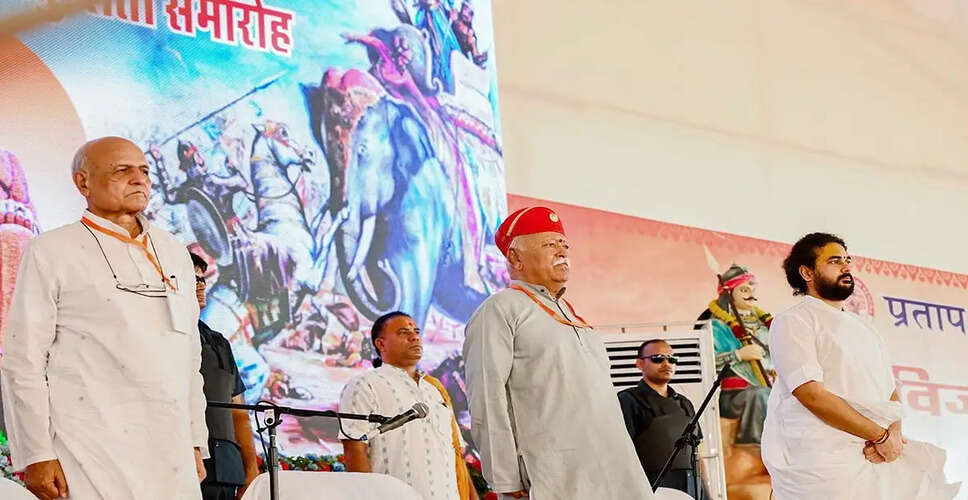
The battlefield of Haldi Ghati has once again become a focal point of national discourse. This pride of Mewar received renewed recognition when Mohan Bhagwat, the chief of the Rashtriya Swayamsevak Sangh, stated clearly at the Rashtriya Chetna Sankalp Sabha held in Udaipur that the 1576 battle symbolizes Maharana Pratap's victory, despite historians attempting to suppress the true essence of this conflict. The event, marking the 486th birth anniversary of Maharana Pratap and the 450th anniversary of the battle, was attended by Rajasthan's Chief Minister Bhajanlal Sharma and various public representatives.
Social Media Buzz Following Bhagwat's Remarks
Following Bhagwat's statement, discussions have intensified on social media. Many view Maharana Pratap as the ultimate symbol of Indian pride, freedom, and resistance, declaring the Haldi Ghati battle a moral and strategic victory. Conversely, some individuals reference historical documents and Mughal records to present differing opinions. The debate surrounding Akbar versus Maharana Pratap is rapidly spreading across social platforms, where people are sharing their views on history, nationalism, and cultural identity. Numerous commentators have highlighted Maharana Pratap's struggle and the valor of his horse, Chetak, as emblematic of Indian identity, while others have raised questions about viewing history through a political lens.
Bhagwat's Perspective on Historical Narratives
In his address, Bhagwat not only interpreted history but also challenged the mindset that has long portrayed Maharana Pratap's struggle in a limited context. He posed the question, “While we celebrate Maharana Pratap's birth anniversary, has anyone ever heard of a celebration for Akbar's birth?” Through this inquiry, he aimed to convey that the answer to who lives in the hearts of the people is found more in societal memory than in history books.
The Essence of the Haldi Ghati Battle
Bhagwat emphasized that if Mughal historians themselves recorded that the Mughal army had to retreat after initial attacks, then who should be considered victorious? He articulated that Haldi Ghati was not merely a battle between two armies but a struggle for India's free spirit, self-respect, and cultural identity. He portrayed Maharana Pratap as a warrior who, despite limited resources and challenging circumstances, refused to surrender. Bhagwat asserted that Maharana Pratap emerged victorious in this battle, symbolizing the defense of dharma, culture, and self-respect. He noted that Maharana Pratap fought not for personal gain but for the protection of these values.
Historical Figures and the Call for Unity
Bhagwat referenced historical warriors like Bappa Rawal, Lalitaditya Muktapida, and Rana Sanga, stating that India's history is one of resistance rather than subjugation. He remarked, “Whenever an invader arrived on this land, efforts to expel them began on the same day.”
Addressing Contemporary Challenges
Bhagwat accused that false narratives are being constructed both domestically and internationally to hinder India's progress. He stated, “Today, attempts are being made to prevent India from advancing. False news is being spread, and various methods are being employed to mislead people.” He emphasized the need to remain steadfast based on our values, despite those opposing India's rise possessing population, power, economic resources, and organizational capacity. Bhagwat called for national unity, cultural pride, and collective resolve, asserting that to face current challenges, we must adhere to our ideals and civilizational values.
The Strength of India's Civilizational Values
He articulated that India's strength lies not merely in its population or material resources but in its civilizational values. Bhagwat urged people to remain united and rise above narrow identities, stating, “We should unite just as the people of Mewar stood with Maharana Pratap. For India's progress, we must work together.” He added, “Various invaders have come, some have even gained power, but India has never accepted slavery on a social and cultural level. Even during difficult historical periods, India has preserved its cultural identity. We have witnessed both good and bad times, but our dharma and culture have remained intact.” Bhagwat concluded that India's rise is crucial not only for itself but also for the welfare of the world, and a strong India is essential for the globe.
Maharana Pratap Tourism Circuit Initiative
Additionally, the Rajasthan government's ambitious Maharana Pratap tourism circuit plan is also in the spotlight. The proposed circuit aims to connect historical sites such as Kumbhalgarh Fort, the Haldi Ghati battlefield, Gogunda, Chavand, Chittorgarh, Devar, and Udaipur. This project seeks not only to boost tourism but also to bring Maharana Pratap's struggle to life for the new generation.
Haldi Ghati: A Battle Beyond Conventional Definitions
It is noteworthy that the Haldi Ghati battle is one of those events in Indian history that challenged traditional definitions of defeat and victory. Fought on June 18, 1576, in the narrow valleys of the Aravalli range, this battle was not merely a clash of military might. On one side was the Mughal army led by Raja Man Singh of Amer, while on the other stood Maharana Pratap, resolute in his quest for Mewar's freedom. Despite being outnumbered, Maharana Pratap mounted such resistance that Haldi Ghati remains synonymous with valor even centuries later.
Chetak's Heroic Sacrifice
Among the most poignant memories of this battle is the sacrifice of Chetak, Maharana Pratap's horse. Despite being injured, Chetak managed to carry his master to safety before succumbing to his wounds. The yellow soil of Haldi Ghati, Chetak's leap, and Maharana Pratap's indomitable resolve continue to echo the spirit of that era.
Celebrating the 450th Anniversary of Haldi Ghati
As we commemorate the 450th anniversary of Haldi Ghati, it is not merely a celebration of history but a renaissance of the consciousness that conveys the message of self-respect, struggle, and cultural identity. Debates about history will persist, but the undeniable truth remains that Maharana Pratap is not just a king in the Indian psyche; he stands as an immortal symbol of resistance and self-respect.