
Guwahati's Flooding Crisis: A Call for Urgent Urban Planning

The Aftermath of Assam Assembly Elections 2026
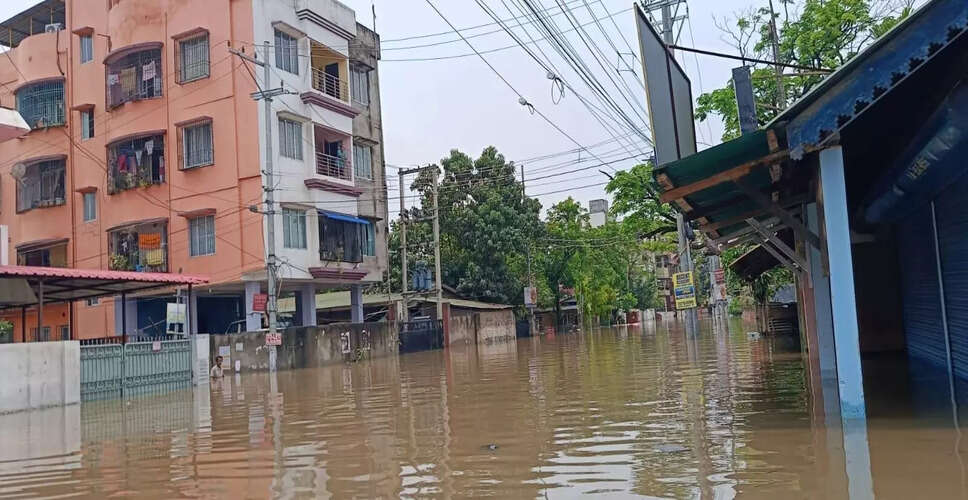
Waist-deep water floods a Rukminigaon neighbourhood. (AT Photo)
The Assam Assembly Elections 2026 have recently concluded. During election periods, every wall transforms into a canvas for campaign messages, with loudspeakers heralding promises of a 'new Assam', a 'smart Guwahati', and a 'flood-free city'. The major political parties, including BJP, Congress, AIUDF, and AJP, have made grand claims about numbers, schemes, and timelines. However, the true evaluation of the city may lie in the aftermath of the first heavy rainfall.
Over the past decade, Guwahati has witnessed memorable scenes during the monsoon. At the Shraddhanjali Flyover, vehicles have been stuck for hours, not solely due to traffic but because the road below was inundated, making the flyover the only dry passage. Recently, at Commerce Point, residents resorted to using a rubber boat to navigate the flooded streets. In Panjabari, individuals climbed onto a backhoe loader to traverse the waterlogged areas. While these images may appear dramatic on social media, they represent a grim reality for families trying to return home.
Assam has a long history of battling river floods. The Brahmaputra and Barak rivers can overflow, erode land, and cause loss of life in ways that urban areas struggle to manage. According to the Assam State Disaster Management Authority (ASDMA), 2024 experienced three significant flooding events, impacting all 35 districts and approximately 4.295 million people, leading to substantial loss of life and property. The official documentation also indicates that Assam's designated flood season spans from May 1 to October 31 each year, serving as a calendar warning of impending danger.
However, the 'artificial floods' in Guwahati present a different kind of crisis. These floods are less about rainfall and more about urban planning failures—what has been built over, what has been neglected, and what has been improperly maintained, including drains, manholes, slopes, and wetlands.
Historically, Guwahati had a natural advantage with adequate drainage systems. Channels, lowlands, beels, and outlets functioned effectively. So, what has changed? Issues such as garbage accumulation, silt buildup, encroachment, and construction over drainage systems have created significant bottlenecks.
The term 'artificial flood' may seem debatable, but it has real consequences. Over the last decade, Guwahati has seen fatalities linked to urban water issues—waterlogging, open drains, and electrical hazards in submerged streets.
A troubling pattern has emerged over the past ten years: Dulal Malakar lost his life in June 2017 after coming into contact with an exposed wire in a flooded area (Sugam Path/Zoo Road Tiniali). In October 2021, Mehendi Baruah was electrocuted in her waterlogged home in Pandu as rainwater surged in. In June 2023, Naren Choudhury (43) fell into an open drain in Hatigaon during heavy rains. Tragically, Abinash Sarkar (8) was swept away after falling into a stormwater drain in July 2024, with his body recovered days later in Rajgarh. In August 2025, Ashok Sharma (41) died after falling into a drain near Jorabat during severe waterlogging. Most recently, on April 19, 2026, Payal Nath (32) was swept into an open drain in Maligaon, with her body found hours later.
This grim reality highlights that in an 'artificial flood', death can strike unexpectedly. Beyond Guwahati, towns across Assam are echoing similar warnings. While it may be tempting to view Guwahati as a unique case due to its size, the monsoon is imparting the same lessons across various districts.
In Silchar, persistent waterlogging has revealed the vulnerabilities of the drainage system. Key areas such as Link Road, Hailakandi Road, Ghaniala, Tarapur Shivbari Road, and Sonai Road frequently flood, even early in the monsoon season.
Dibrugarh has also faced significant flooding from a single heavy rainfall event, affecting major roads like Mancotta Road, Jail Road, and Seujpur Road. Similar issues are reported in Sivasagar, Tinsukia, and other regions.
Even smaller urban centers like Nalbari and Barpeta have long histories of artificial flooding due to inadequate drainage and unplanned construction.
Thus, while Assam continues to combat floods, it also grapples with its own planning deficiencies. Surprisingly, the efforts made so far seem insufficient.
On a positive note, it would be misleading to claim that no progress is being made. The Guwahati Municipal Corporation (GMC) has prioritized drainage improvements in recent years, with tenders available for cleaning, desilting, and maintaining drains, as well as major channel desilting specifically aimed at 'urban flood mitigation' in Guwahati.
External expertise has also been sought. In 2024, the State government enlisted Royal HaskoningDHV, a Dutch firm, to assist in developing a drainage master plan for Guwahati. That same year, the Assam government approved structural flood-control initiatives worth ₹167 crore for the city. IIT Guwahati has also contributed insights periodically.
So, where does the gap lie? Local studies and committees focusing on problematic areas like Rukminigaon consistently highlight basic necessities: cross drains, restoration of flow paths, and management of inflow from surrounding areas, such as Dispur’s Supermarket/Secretariat side, and bottlenecks at locations like PIBCO/Chinaki Path.
This raises a critical question: Why do flash floods still occur under flyovers? A report in March 2026 suggested that flyovers could have been designed with rainwater-harvesting and water-management features, rather than merely serving as additional hard surfaces that exacerbate flooding on already stressed roads.