
Government to Enhance Support for North East Residents in Urban Areas

Strengthening Grievance Mechanisms for North East Communities
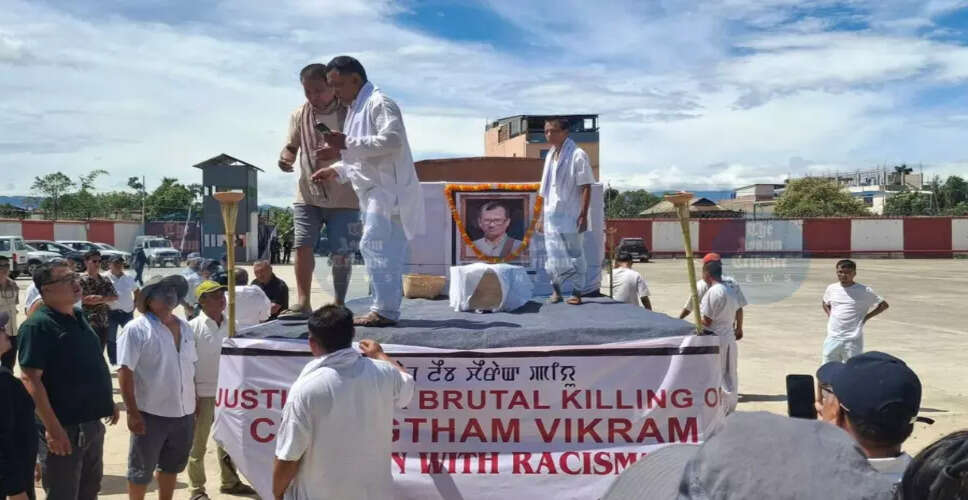
Manipuri musician Chongtham Vikram Singh’s mortal remains were brought to Imphal on Wednesday (Photo: AT)
New Delhi, Sept 10: The central government has announced plans to enhance the institutional framework aimed at addressing the grievances of North East residents living in major cities. The Union Ministry of Home Affairs (MHA) is set to instruct all states to designate nodal officers in urban areas with significant populations from the North East.
The MHA will reach out to Chief Secretaries and Directors General of Police (DGPs) across states, requesting the appointment of nodal officers in metropolitan areas to act as dedicated contacts for North East individuals facing issues such as discrimination, harassment, and violence.
This decision emerged from a meeting of the MHA's monitoring committee focused on North East issues, held shortly after the tragic death of Manipuri musician Chongtham Vikram Singh, who was fatally assaulted in southeast Delhi.
Joram Maivio, a special invitee to the committee, indicated that the initial focus for appointing nodal officers would be in metropolitan areas with a higher concentration of North East residents.
The initiative aims to ensure that complaints from individuals in the region are managed through a dedicated administrative and police framework, while also fostering better coordination among nodal officers and relevant agencies.
Several major cities, including Delhi, Gurugram, Bengaluru, Ghaziabad, and Noida, already have nodal officers for North Eastern residents. However, the committee believes that the current system requires enhancement and greater cohesion.
“Despite the presence of nodal officers in some key metropolitan areas, incidents continue to occur. Therefore, we have reassessed the situation and decided on a more unified approach by these officers to prevent such occurrences,” Maivio stated.
He noted that while government initiatives and the existing nodal officer framework have contributed to a reduction in incidents against North East individuals, recent events indicate a need for further strengthening of these measures.
“Numerous initiatives have been implemented by the government, leading to improvements in various aspects. However, given the troubling trends and incidents observed recently, a cohesive strategy is essential,” he added.
The MHA monitoring committee was established in 2018 following Supreme Court directives to oversee and address grievances related to racial discrimination faced by North East residents across the country.
The proposed enhancement of the nodal officer framework is particularly significant in light of Singh's death, a 54-year-old musician from Manipur who was allegedly attacked by a group of eight individuals in Delhi after he confronted them about noise disturbances outside his home. He later succumbed to his injuries.
This incident has reignited concerns regarding the safety of North East individuals in urban settings, especially among the many young people from the region who live, work, and study outside their home states.
Maivio emphasized that the issues faced by North East residents should not be regarded merely as isolated law enforcement challenges, highlighting the necessity for improved coordination and institutional responses.
The meeting, chaired by Niraj Kumar Bansod, Joint Secretary of the North East Division at the MHA, included representatives from various states and government departments, including the Delhi Police, Ministry of Development of North Eastern Region (DoNER), NCERT, and MHA officials.
Among the attendees were Dr. Alana Golmei, Secretary of the North East Support Centre in New Delhi; Dr. Michael D'Souza, Professor at Delhi University's Faculty of Law; and Maivio.
In addition to bolstering the nodal officer framework, the committee discussed potential amendments to the Bharatiya Nyaya Sanhita (BNS), the incorporation of North East history and culture into school curricula, the enhancement and monitoring of existing government initiatives, and progress on the proposed North East Social and Cultural Institution.
The meeting also evaluated the need for increased personnel and the strengthening of the Special Police Unit for the North East Region, along with reviewing the operations of North East hostels and cases involving individuals from the region nationwide.
Legal measures, police initiatives, awareness programs about the North East, and the implementation of the Bezbaruah Committee's recommendations were also key discussion points.