
Government Considers Committee for Review of UGC 2026 Equality Regulations

Government's Proposal for UGC Regulations Review
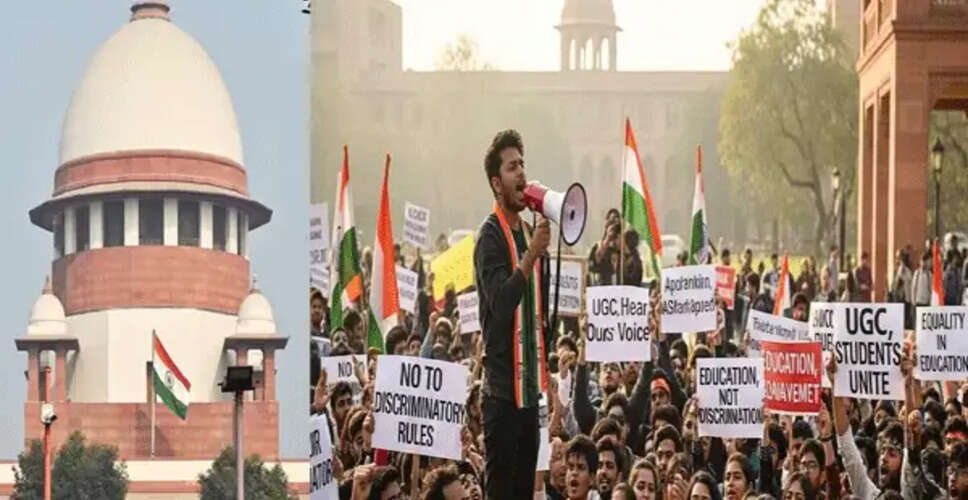
New Delhi. On Thursday, the central government informed the Supreme Court that it is contemplating the formation of a committee to reassess the University Grants Commission (UGC) equality regulations for 2026. This decision comes in light of controversies surrounding these regulations and concerns regarding their potential misuse. Notably, the Supreme Court had previously imposed a stay on these regulations in January of this year, expressing worries that the ambiguous language could lead to misuse and have serious, long-lasting societal impacts.
This information emerged during a session with Chief Justice D.Y. Chandrachud and Justice Joymalya Bagchi, who suggested that the government should undertake a fresh review of the regulations. The court emphasized that the framework of these rules should safeguard the interests of all students and prevent any feelings of insecurity or dissatisfaction among any group.
The bench urged Solicitor General Tushar Mehta, representing the government, to reconsider these regulations to protect the interests of future generations. In response, Mehta indicated that the government is indeed considering establishing a committee for this review and is investigating the matter to ensure no group feels discontented or apprehensive.
Following the suggestions from the bench, the court postponed further hearings on the case, stating that it had provided its recommendations and it remains to be seen what actions the government will take.
The UGC's 2026 regulations, aimed at promoting equality in higher educational institutions, have been a subject of extensive legal and public debate. These regulations were notified on January 13, 2026, but faced challenges in the Supreme Court, leading to an interim stay on January 29.
The Supreme Court had remarked that the current form of the regulations is unclear and could be exploited by malicious actors. The court expressed concerns that such provisions might foster division within society and could have severe consequences. Additionally, it directed that until a decision is reached in this matter, the UGC's 2012 anti-discrimination regulations would remain in effect, ensuring that students facing discrimination in higher education have access to grievance redressal mechanisms.
Under the 2026 regulations, universities, colleges, and deemed universities are required to establish Equal Opportunity Centers and Equality Committees. These institutional arrangements aim to address complaints related to discrimination and promote an inclusive environment in higher education institutions. The provisions include mechanisms for addressing student grievances and ensuring equality on campuses.
However, reactions to these regulations have been mixed. Several organizations representing marginalized and disadvantaged students have welcomed the regulations, arguing that such measures are essential to prevent caste-based discrimination in higher education and to provide protection to affected students. Conversely, many upper-caste organizations and students have opposed the regulations, claiming that some provisions are biased and could be misused. A group of upper-caste students even protested outside the UGC headquarters in Delhi on Tuesday, demanding the withdrawal of these regulations.
The petitions filed in the Supreme Court primarily challenge Rule 3(c), which defines caste-based discrimination against members of Scheduled Castes, Scheduled Tribes, and Other Backward Classes solely based on caste or tribe. Petitioners argue that this definition excludes students from the general category who may also face caste-based discrimination. They also contend that the regulations lack adequate provisions to address false complaints.
Social activist and entrepreneur Rahul Diwan, postdoctoral researcher Mritunjay Tiwari, and lawyer Vineet Jindal have filed petitions in the Supreme Court regarding this matter. Advocate Vishnu Shankar Jain represented Diwan in court. The petitioners have raised questions about the legality and fairness of various provisions within the regulations.
The background of these regulations is linked to a petition filed in the Supreme Court in 2019, which sought stronger safeguards against caste discrimination in higher educational institutions. This petition was submitted by the families of Rohith Vemula, a research scholar at Hyderabad University who died in January 2016, and Payal Tadvi, a medical student who allegedly faced caste discrimination before her death in May 2019.
The petitioners highlighted that the UGC had previously established equality-related regulations in 2012 to prevent discrimination, but these were not effectively implemented at the ground level. They argued that merely creating regulations is insufficient; a robust institutional framework is necessary for effective enforcement.
In this context, the Supreme Court emphasized the need for a more effective system to address discrimination in higher educational institutions. Now, amid the ongoing controversy surrounding the 2026 regulations, the government's consideration of forming a committee for review is noteworthy. It will be crucial to observe which aspects the government includes in its review and whether the revised framework can ensure equal protection and justice for all student groups.