
Gauhati High Court Relocation Sparks Controversy and Protests
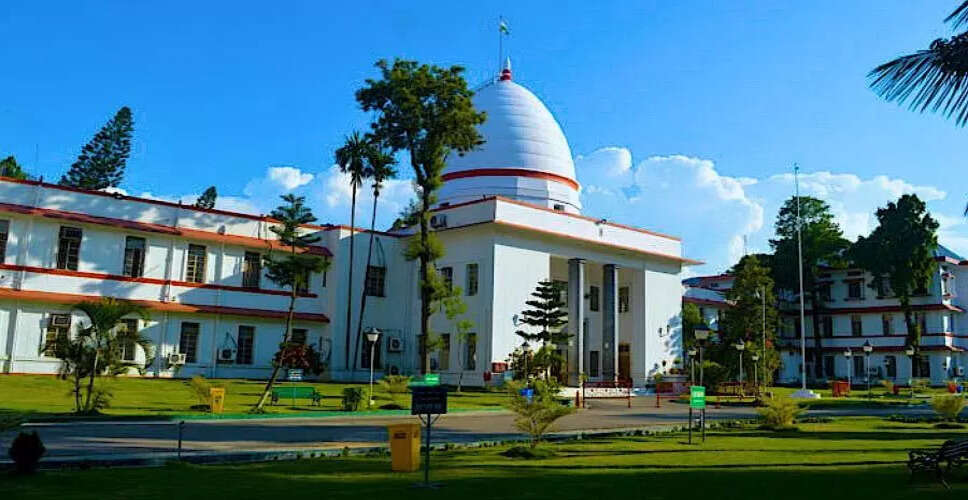
Gauhati High Court's Future in Question
The iconic white dome of the Gauhati High Court, located near Dighalipukhuri, has served as more than just a judicial hub; it has been a vital part of the city's identity for many years.
For countless lawyers, litigants, and court personnel, this institution has been a bustling, albeit imperfect, part of their daily lives. However, as discussions intensify regarding its potential move to Rangmahal in Amingaon, the city's legal landscape is facing significant scrutiny.
While some advocate for the relocation as a necessary upgrade to outdated infrastructure, others express concerns about the potential disruption to justice access, livelihoods, and the overall legal community. For court employees dealing with cramped conditions, a new facility could provide much-needed relief.
One staff member highlighted the challenges of their current workspace, stating, "Our files are overflowing, and privacy is a rare commodity. A new complex in Amingaon would offer us better facilities and a more conducive work environment."
However, many in the legal profession are less enthusiastic about the proposed shift.
For numerous advocates, especially those balancing work and family commitments, the relocation feels more like a setback than an advancement.
Prapti Gogoi, a member of the Bar Association, articulated a common concern among working parents: "Amingaon is practically on the outskirts. A commute of that length would take up our entire day. We already struggle with balancing court duties and school runs. If the court moves that far, it will complicate our lives significantly."
The legal community's unease extends beyond the distance of the new location; many are troubled by the lack of transparency surrounding the decision-making process.
Apurba Kumar Sharma, the general secretary of the Lawyers’ Association, Guwahati, criticized the lack of communication, stating, "We have not received any clear instructions. We are being told to temporarily relocate near the BSNL office, but we have no idea what facilities will be available. Is this how the legal community should be treated?"
Sharma also expressed concern for the existing High Court building, emphasizing its historical significance: "This is a heritage site where many distinguished lawmakers and judges have served. The idea of demolishing it is deeply unsettling. Development should not come at the cost of our history," he urged, calling for the preservation of the building even if the court relocates.
Adding to the anxiety are claims that files are being moved discreetly, away from public oversight. "Documents are being transferred at night, hidden from view. Everything is happening without any transparency," remarked one lawyer, highlighting fears of a process lacking openness and dialogue.
These issues culminated in a protest on January 6, where members of the Lawyers’ Association staged a sit-in at the Chief Judicial Magistrate court. The demonstration was aimed at opposing both the proposed permanent relocation to Amingaon and the temporary shift of court facilities without adequate planning.
Protesters warned that moving such a crucial institution without proper infrastructure could severely hinder access to justice for litigants statewide.
Pradip Konwar, president of the Lawyers’ Association, emphasized that the protest was also about maintaining the dignity of the institution. "We have been told this move is temporary, yet no solid plan has been presented. Sufficient land, chambers, courtrooms, and facilities must be guaranteed for all involved. The court is situated on government land, yet no notice was given before the demolition decision was made," he stated.
The extent of opposition became evident on December 12, when the Gauhati High Court Bar Association held a referendum regarding the proposed move to North Guwahati. Out of 1,358 votes cast, a staggering 1,164 were against the relocation, while only 154 were in favor. Twenty-seven votes were marked as NOTA, and 13 were invalid, according to Returning Officer Parag Jyoti Saikia. For many, this referendum was not just a vote against the move but a call for their voices to be heard.
Despite the pushback, the state government has continued its plans, acquiring approximately 100 bighas of land in North Guwahati for the new judicial complex. The situation escalated further when Chief Minister Himanta Biswa Sarma announced on November 9 that the Chief Justice of India is expected to lay the foundation stone for the new Gauhati High Court complex in January 2026.
An official invitation has now confirmed that the foundation stone for the Integrated Judicial Court Complex will be laid on January 11, 2026, at 11:30 AM in Rangmahal, North Guwahati. The ceremony will be presided over by Justice Surya Kant, Chief Justice of India, alongside senior Supreme Court judges, the Chief Minister of Assam, and the full bench of the Gauhati High Court.
With 129 bighas (over 42.5 acres) of land already secured, the Chief Minister has reiterated that the project will be significant. "I believe there is no other high court in India located on such a vast expanse of land. This will be a grand and beautiful project for Assam," Sarma stated previously.
The preparations for the event highlight the project's advancement into the implementation phase. An internal order has been issued to Gauhati High Court officers and staff, detailing their responsibilities from January 10 to 12 in relation to the ceremony.
The duty assignment outlines extensive administrative arrangements, including control rooms, protocol teams, security coordination with state agencies, IT and technical teams, transport units, and monitoring officers deployed across various locations, including Rangmahal, Kamakhya Temple, Guwahati Railway Station, and Lokpriya Gopinath Bordoloi International Airport.
Registrars, joint registrars, judicial assistants, translators, technical staff, and Grade-IV employees have been assigned mandatory duties.
The proposed relocation has thus become a reflection of broader questions regarding development that respects both people and history. As Assam contemplates the promise of a modern judicial complex, the future of the Gauhati High Court hangs in the balance, awaiting a resolution that ensures justice for all.