
Farmers' Protest in Madhya Pradesh Escalates Over Moong Purchase Issues
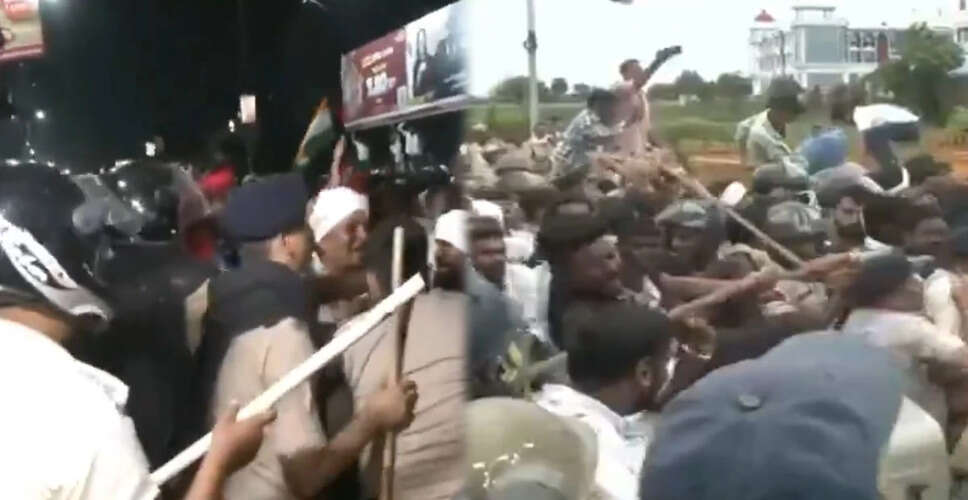

Intensifying Farmers' Movement in Madhya Pradesh
The conflict between farmers and the government regarding the purchase of moong in Madhya Pradesh has reached a critical juncture. Thousands of farmers, carrying bags of grain, bedding, cooking supplies, and a week's worth of rations, are marching towards Bhopal. Their clear message is that they will not end their protest until the government commits to purchasing 100% of the state's moong crop at the minimum support price (MSP) and addresses other pending demands, including fertilizer distribution. This march has emerged as the most significant political challenge for Chief Minister Mohan Yadav's administration this year.
Farmers Break Through Police Barricades
Under the banner of the Samyukt Kisan Morcha (SKM), nearly 2,000 farmers from 19 organizations managed to breach multiple layers of police barricades, reaching the outskirts of Bhopal. Despite the administration's efforts to halt them in the southern part of the capital, the farmers remained resolute. Tensions escalated in the area as the group continued to advance towards the city, despite the presence of police and administrative forces.
Demand for 100% Government Purchase
The primary reason behind this protest is the demand for the government to purchase 100% of the moong crop. Farmer organizations argue that while the central government has decided to buy 100% of arhar, urad, and lentil crops, moong remains under the Price Support Scheme (PSS), which allows for the purchase of only up to 25% of a state's estimated total yield. Farmers claim they are forced to sell the remaining produce at significantly lower prices in the open market, leading to substantial financial losses, especially with the MSP for moong set at ₹8,768 per quintal for the 2026-27 season.
Farmers' Frustration Grows
Farmer leader Santosh Patwari stated that for the past 20 days, farmers have been trying to communicate their concerns to the government, submitting several memorandums without receiving any substantial response. He emphasized that farmers are not receiving a fair price for their produce, which has compelled them to march towards the Chief Minister's residence.
The Journey of the 'Kisan Kranti Padayatra'
The farmers' 'Kisan Kranti Padayatra' began at Sethani Ghat in Narmadapuram. Initially, the administration attempted to prevent the march, leading to a sit-in by the farmers. As tensions rose in the evening, authorities removed barricades, allowing the march to proceed. The farmers then moved towards Bhopal, passing through Obedullaganj and Raisen, where additional barricades were set up at various points, including toll plazas. Officials urged farmer leaders to submit their memorandums instead of entering the capital, but the farmers insisted on written commitments rather than mere assurances.
Broader Issues Beyond Moong Purchase
This movement is not limited to the purchase of moong. Farmer organizations have long raised issues regarding delays in procurement, limits on purchase quantities, registration challenges, and recurring fertilizer shortages. They argue that the rising costs of farming are not matched by stable market prices for crops, forcing farmers to sell their produce at lower rates despite good yields, which severely impacts the rural economy.
Political Implications for the Government
From a political standpoint, this protest poses a significant test for the Mohan Yadav government. Following farmer protests against land pooling policies related to the 2028 Ujjain Simhastha Fair, the government had to amend its proposals. After prolonged protests, several provisions were revised, assuring farmers that their land would not be taken without their consent. Now, the issue of moong procurement is once again placing the government in direct opposition to the farmers.
Allegations of Police Interference
Farmer organizations have also alleged that barricades were set up on routes from villages to Bhopal in districts such as Raisen, Vidisha, Harda, Narmadapuram, and Budhni to prevent supporters from reaching the capital. However, the administration has denied these claims, stating that police presence is solely for maintaining law and order. According to Additional Superintendent of Police Anil Sharma, the administration is in continuous dialogue with farmer leaders, seeking a peaceful resolution.
Future of the Movement
Currently, farmers have made it clear that this protest is far from over. The movement, now at the gates of Bhopal, transcends the issue of moong procurement, symbolizing rising farming costs, flaws in government purchasing systems, and rural discontent. All eyes are now on whether the government will yield to the farmers' demands or if this protest will escalate into a broader political struggle in the coming days.