
Farmers in Jorhat Face Drought Amid Floods in Assam
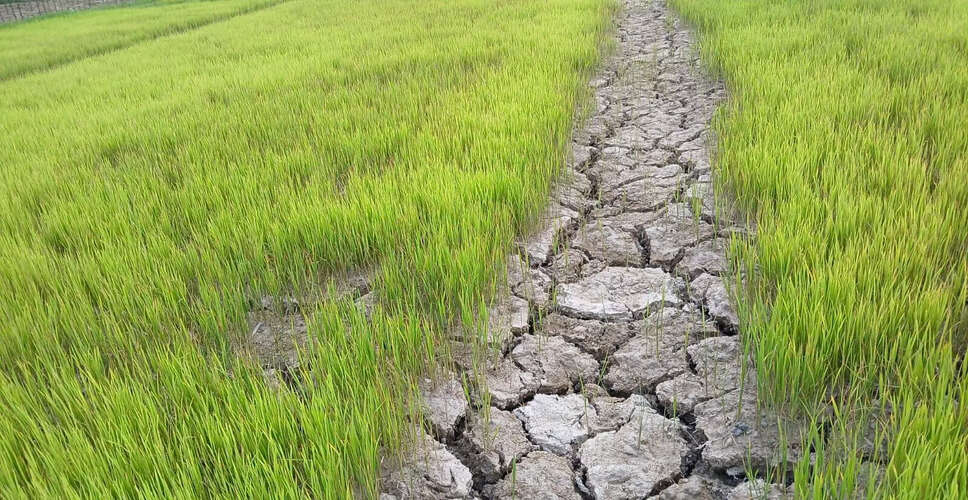

Drought Conditions in Jorhat
Prolonged dry spells have left agricultural fields parched across Titabor, Borholla, Nagabat and several other farming belts. (AT Photo)
Jorhat, July 5: While many regions in Assam are dealing with flooding, farmers in Jorhat are experiencing a contrasting challenge.
Extended dry spells during the crucial paddy sowing season have resulted in parched fields, wilting crops, and cracked soil, raising concerns about potential widespread crop failures.
In areas like Titabor, Borholla, and Nagabat, thousands of hectares of paddy fields lack sufficient moisture, disrupting normal farming activities.
Farmers report that the combination of insufficient rainfall and unreliable irrigation systems has created a drought-like scenario during what is typically one of the wettest times of the year.
One farmer from Titabor expressed, "The land has dried up to such an extent that it is difficult to tell whether it is a farmland or a playground. Had there been proper irrigation facilities, we would not have been facing this crisis today."
The dry weather has severely impacted newly sown paddy, with many fields turning brown before the seedlings could establish themselves.
Deep cracks have emerged in several farmlands, highlighting the seriousness of the moisture shortage.
Official statistics indicate that Jorhat district encompasses nearly 90,000 hectares of agricultural land, with around 27,230 hectares dedicated to paddy cultivation.
However, only about 3,000 hectares benefit from irrigation, and farmers claim that many of these systems are either broken or not operational.
As most farmland relies solely on rainfall, the ongoing dry spell has left farmers increasingly worried about the prospects for this year's kharif crop.
"We rely on our harvest for sustenance throughout the year. We urge the Agriculture Department, the Water Resources Department, and the government to take immediate action. We also request our local MLA, Dhiraj Gowala, to visit the affected fields with agriculture officials, assess the situation, and help implement effective measures to resume cultivation," another farmer stated.
Farmers have historically depended on the monsoon for their crops, but increasingly unpredictable weather patterns have made them more vulnerable.
They cautioned that without significant rainfall in the coming days, thousands of hectares of paddy fields in Upper Assam could face irreversible damage.
The farmers have called on the state government to enhance irrigation infrastructure, restore non-functional irrigation projects, and provide immediate support to those affected by the prolonged dry spell to mitigate further losses during the current agricultural season.