
Exploring the Rich History and Demographics of Jalpaiguri District
A Glimpse into Jalpaiguri's Historical Significance
Jalpaiguri district, located in West Bengal, boasts a rich historical background, with references found in the Mahabharata. During the medieval period, it was part of the Kamata Empire. The district extended from the eastern banks of the Teesta River to the banks of the Bagmati River in Rangpur, Bangladesh. In 1865, the British seized the Duars region from the Bhutanese Empire.
Formation and Administrative Recognition
The eastern part of the region became known as Golpara in Assam, while the western part was recognized as Jalpaiguri. In 1869, Jalpaiguri was designated as an administrative unit. The term 'Duars' translates to 'doors' or 'pathways,' which were historically used by Bhutanese traders.
Historical Context and Strategic Importance
According to historians, ancient Jalpaiguri was part of the Kamrup Empire. The three capitals of the Kamata Empire—Chilapata, Mainaguri, and Panchgarh—are located within Jalpaiguri. Additionally, Hingulv, the first capital of the Koch Empire, is also situated here. Strategically, this district is crucial as it connects the northeastern part of India with the rest of the country.
Etymology of Jalpaiguri
The name 'Jalpaiguri' is believed to be derived from the combination of 'Jalpai,' referring to the olive tree, which was once abundant in the area, and 'Guri,' meaning place. Thus, Jalpaiguri translates to 'the place of olive trees.' Another theory suggests that the name comes from the Bhutanese phrase 'Je-le-pe-guri,' meaning a trading center or market.
Overview of the District
Jalpaiguri is divided into several administrative subdivisions, including Jalpaiguri Sadar, Dhupguri, and Mal. The district comprises blocks such as Jalpaiguri Sadar, Dhupguri, Mainaguri, Rajganj, Mal, Matiyali, Nagarakata, Kranti, and Banarhat. It includes the Siliguri Municipal Corporation and several municipalities. The district has a total of nine police stations, with 404 inhabited villages and 29 forest villages, resulting in a population density of 701 people per square kilometer, with 956 females for every 1,000 males.
Demographic Composition
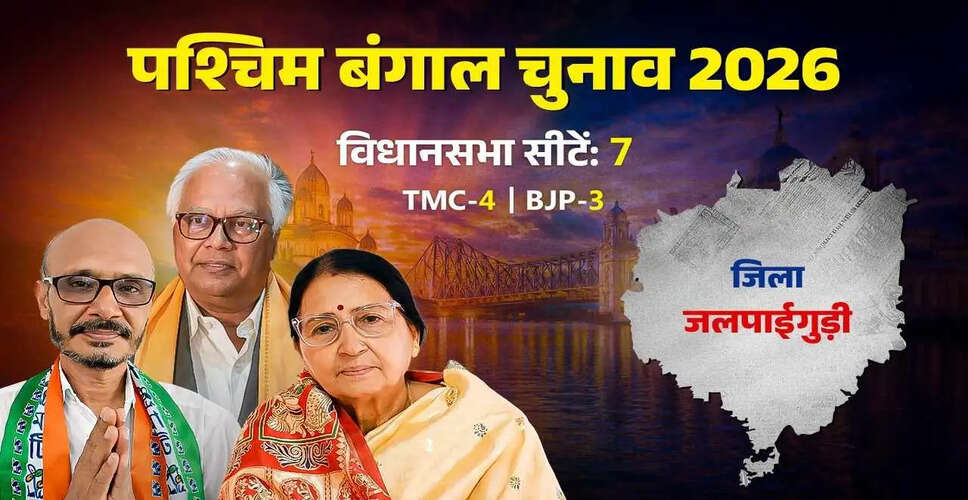
Out of the seven assembly seats in the district, six are reserved—four for Scheduled Castes and two for Scheduled Tribes. The only general seat is Dubgram-Fulbari. This distribution reflects the district's demographic dynamics, with a significant rural population, primarily consisting of Scheduled Castes and Scheduled Tribes.
Assembly Constituencies
- Dhupguri (SC)
- Mainaguri (SC)
- Jalpaiguri (SC)
- Rajganj (SC)
- Dubgram-Fulbari
- Mal (ST)
- Nagarakata (ST)
Geographical Features
Jalpaiguri is surrounded by forests, with the Himalayas to the north and tea plantations in the plains. The district is located along the banks of the Teesta River in northern Bengal. It is bordered by Bhutan to the northeast and Bangladesh to the south, with Darjeeling to the northwest and Cooch Behar to the southeast. The region is known for its cultivation of tea, potatoes, jute, tobacco, sugarcane, and rice, and it also has deposits of coal, copper ore, limestone, and dolomite.
Current Status of Assembly Constituencies
Dhupguri Assembly: This seat is reserved for Scheduled Castes, currently represented by TMC's Nirmal Chandra Roy. After BJP's Bishnu Pada Roy won in 2021, TMC secured victory in the 2023 by-election following his demise. The seat was held by the CPI(M) from 1977 to 2011, with Banmali Roy serving five terms.
Mainaguri: Surendra Nath Roy won the first election here in 1951 on a Congress ticket. TMC's Ananta Deb Adhikari won in 2011, while BJP's Kaushik Roy emerged victorious in 2021. The seat has seen dominance from the Revolutionary Socialist Party and Congress.
Jalpaiguri: From 1951 to 1967, Congress's Khagendra Nath Dasgupta won four consecutive terms. Congress has historically dominated this seat, with TMC winning for the first time in 2021. BJP has yet to secure a win here.
Rajganj Assembly: BNR Hakim from the Socialist Party was the first MLA in 1967. Congress won three consecutive terms from 1969 to 1972, while CPI(M) held the seat from 1977 to 2006, and TMC has been in power since 2009, with Khageshwar Roy serving four terms.
Dubgram-Fulbari: BJP's Shikha Chatterjee is the current MLA. TMC's Gautam Deb won from 2011 to 2016 but lost in the last election. The upcoming election will determine if BJP maintains its influence.
Mal Assembly: TMC's Bulu Chik Barik has held this seat since 2011, with Congress and CPI(M) having the most wins historically. This seat is reserved for Scheduled Tribes and is part of the Jalpaiguri Lok Sabha constituency.
Nagarakata Assembly: Budhu Bhagat from Congress won the first election in 1962. BJP's Puna Bhengra is the current MLA, with TMC winning only once in 2016. CPI has won nine out of fifteen elections, with Chaiten Munda serving four terms.
District Statistics
Area: 3386.18 square kilometers
Literacy Rate: 73.79%
Assembly Seats: 7
Municipalities: 4
Municipal Corporation: 1
Block Panchayats: 9
Gram Panchayats: 80
Inhabited Villages: 404