
Exploring Marital Rape in India: A Review of 'Chiraiya'
A Deep Dive into 'Chiraiya'
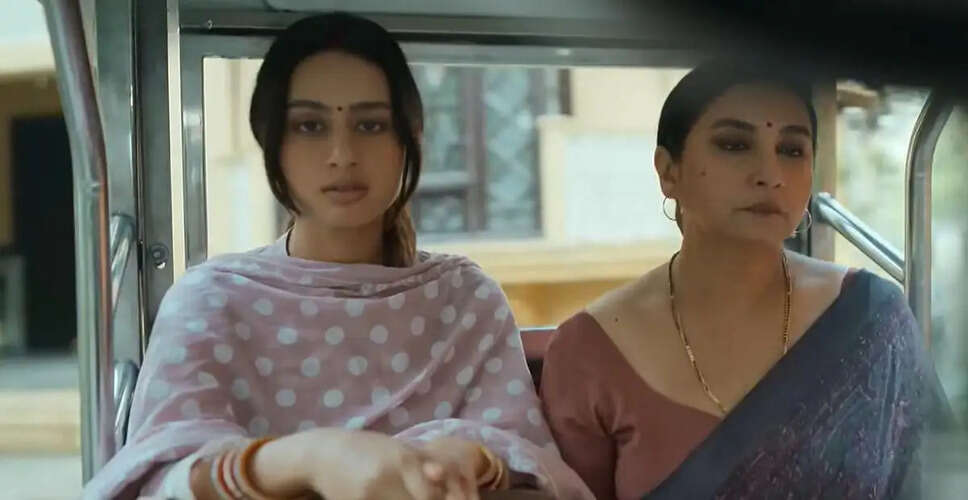
Chiraiya tackles the sensitive and often overlooked issue of marital rape in India. This series on JioHotstar challenges the notion that marriage equates to consent. Initially, Chiraiya delves into this discomforting theme, but as the narrative unfolds, it shifts from a character-driven exploration to a more heavy-handed approach that may leave viewers wanting.
This six-episode Hindi series, conceived by Soumyabrata Rakshit and brought to life by Divy Nidhi Sharma and director Shashant Shah, is set in Lucknow. It centers around Kamlesh (Divya Dutta), who embodies the ideal daughter-in-law in a close-knit family led by the learned Papaji (Sanjay Mishra).
Kamlesh takes pride in her traditional role, ensuring that everyone adheres to their expected positions. She has a nurturing relationship with her younger brother-in-law Arun (Siddharth Shaw), whom she treats almost like a son, and enjoys a seemingly perfect marriage with her husband Vinay (Faisal Rashid). This dynamic reinforces her belief in the system, even as she compensates for her disappointment over having a daughter by indulging Arun.
The family dynamics shift dramatically with the arrival of Arun’s new wife, the progressive Pooja (Prasanna Bisht). It quickly becomes evident that she is coerced into sexual relations within her marriage. Pooja’s reluctance is dismissed as mere immaturity, and initially, Kamlesh is complicit, urging her to conform, maintain harmony, and uphold the family's reputation.
The first episodes effectively illustrate how deeply ingrained these beliefs are, from Kamlesh’s view that women should focus on trivial matters while men handle significant issues, to the silence maintained by the older women in the household. As Pooja begins to resist, familial tensions escalate, prompting Kamlesh to confront uncomfortable truths and address generational inequalities.
There are notable elements in the storytelling, such as Arun's casual entitlement and Pooja's gradual isolation and manipulation. A subplot involving Nanaji (Tinnu Anand) highlights the glaring absence of laws regarding marital rape and the loopholes that exist.
However, the narrative often relies on exposition, repetition, and excessive emotional displays. The inclusion of NGO-style meetings and lengthy discussions about consent, while significant, can feel more like public service announcements than a cohesive story.
The non-linear storytelling adds depth through flashbacks, revealing Kamlesh’s early experiences as a bride, her respect for her father-in-law, and her unwavering belief in a woman's responsibilities within the family.
Unfortunately, the tone occasionally veers into soap opera territory. The entrenched gender roles and the introspection primarily focus on Kamlesh’s realization. The climax, while ambitious, feels forced and overly dramatic rather than genuinely impactful.
The character development lacks cohesion; Kamlesh’s transformation seems hurried when it should have been the emotional core of the series. Vinay, the supportive husband, is underdeveloped until the narrative demands his presence. Arun remains a somewhat flat character, which diminishes the conflict's complexity.
Pooja’s storyline is also underwhelming, failing to adequately explain her acceptance of an arranged marriage or provide her with a narrative beyond her trauma. A scene depicting her participation in an LGBTQ rally feels more like tokenism than genuine representation.
Despite these shortcomings, the cast delivers strong performances. Divya Dutta shines, carrying the weight of the narrative even when the writing falters. Sanjay Mishra brings a subtle authority to his role as Papaji, while Prasanna Bisht and Siddharth Shaw effectively portray the central couple. Faisal Rashid adds depth to Vinay's character.
The series concludes with a slate presenting statistics from the 2019-21 National Family Health Survey regarding domestic and sexual violence, emphasizing that in the absence of clear laws against marital rape, the responsibility for change lies with families and communities to foster equality among boys and girls. While Chiraiya addresses a crucial issue, its heavy-handed messaging sometimes overshadows the storytelling, making it feel more like a lesson than a narrative.