
Eviction Drive in Assam Displaces Families Again, Raising Concerns
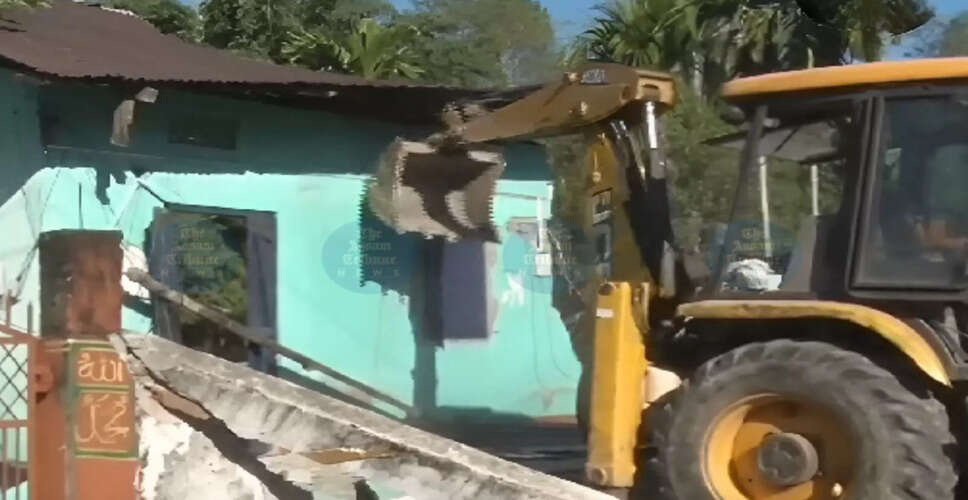

Eviction Operation in North Lakhimpur
The eviction drive at Bogeenadi (Image)
North Lakhimpur, Nov 13: In a troubling turn of events, families affected by the 1983 Assam Agitation violence have once again found themselves homeless following an eviction drive conducted by the Lakhimpur district authorities at Bogeenadi PGR under the Kadam Revenue Circle. This operation involved the demolition of homes and other structures, including a mosque.
The eviction commenced early in the morning at the Muslim Camp, situated near Bogeenadi Weekly Haat and the local police station. A contingent of revenue officials, supported by a significant security presence, utilized bulldozers to dismantle the settlement while families, including women and children, looked on helplessly.
Among those affected was 73-year-old Manik Ali, a local BJP leader and resident of Muslim Camp, whose family had previously been displaced during the 1983 violence in Bhimpora village. He is one of the 25 families that were relocated to Bogeenadi PGR after the unrest.
Ali recounted, “In 1983, our village was attacked by mobs supporting the Assam Movement, forcing us to flee. The government later settled us on this land near Bogeenadi Weekly Haat.”
Initially, the displaced families were housed at Bogeenadi Police Station before receiving land from the district administration. Their settlement was documented with identity cards issued by the Sub-Registrar in North Lakhimpur, dated June 17, 1983.
Another resident, 70-year-old Mujibur Rahman, shared that his family had also been displaced from Bhimpora, where they worked as sharecroppers alongside the local Mising community. They spent six days at the police station and three months at the weekly market before being settled at the PGR.
For some elderly residents, this eviction signifies a prolonged history of displacement. Seventy-five-year-old Hanif Ali mentioned that his family had previously relocated from Barpeta to Badulipara in 1977 due to riverbank erosion, only to be displaced again during the 1983 violence and now face homelessness once more.
The Bogeenadi PGR was established as a settlement area for families affected by the 1983 disturbances. Over the years, essential infrastructure has been developed, including a local school, an Anganwadi center, and a piped water supply under the Jal Jeevan Mission, along with electricity connections.
The eviction also resulted in the destruction of a mosque and its adjacent cemetery. Residents reported that four bighas, two kathas, and ten lechas of land had been allocated for the mosque and cemetery by the Special Officer and Secretary-cum-Manager of Boginadi Agriculture and Farming Corporation through an order dated September 25, 1992.
Residents have alleged that the eviction was selective, claiming that other communities occupying nearby PGR land were not targeted. Many women expressed concerns about why only Muslim families received eviction notices.
The operation has also sparked accusations of political betrayal, with Ali expressing his dismay over being evicted despite his affiliation with the BJP and his family's active participation in party activities.
The affected families have reached out to the state government, seeking assistance for relocation and urging authorities to acknowledge their history of displacement and the administration's previous role in their rehabilitation.
Reports indicate that the eviction operation cleared approximately 320 hectares of land.