
Escalating Tensions: U.S. Military Action in Iran Faces Domestic Backlash
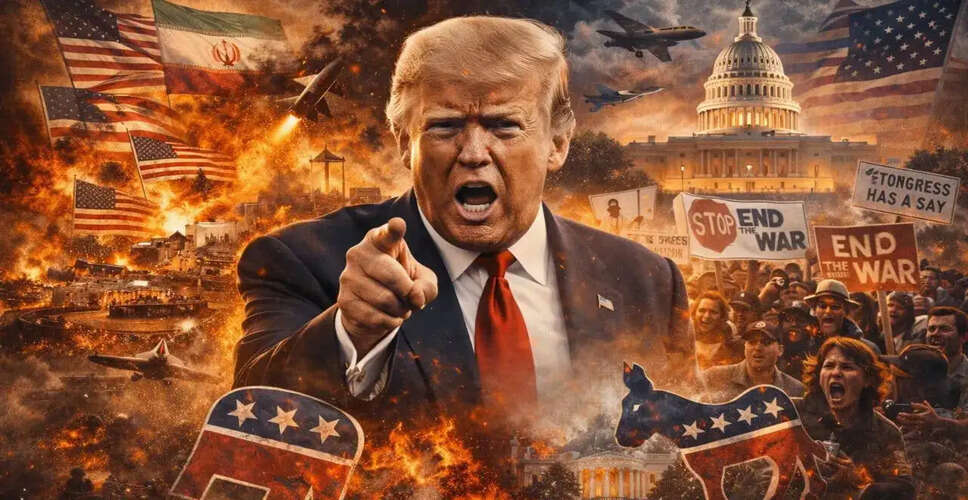
U.S. Strikes in Iran Spark Protests and Political Division
On Saturday morning, as American airstrikes targeted Tehran, resulting in the deaths of key figures including Iran's Supreme Leader Ayatollah Ali Khamenei, demonstrators gathered outside the White House. By Sunday, the discourse shifted to television networks, Senate offices, and the halls of Congress, where members of President Donald Trump's own Republican Party began to voice dissent. A YouGov poll conducted on the day Operation Epic Fury commenced revealed that only 34% of Americans supported the military action against Iran, while a Morning Consult survey indicated that 44% were opposed. This marks the lowest approval rating for a U.S. military operation in recent history, even lower than the 72% approval at the onset of the Iraq invasion in 2003. There was no surge of national unity; instead, the public expressed disapproval of the president's actions.
The disapproval numbers worsened when respondents were informed that the strikes could lead to increased gas prices, with support plummeting to 18%. A significant 74% of those surveyed believed Trump should have sought congressional approval before initiating the strikes, a sentiment echoed by 21% of Republicans. Additionally, 46% of registered voters opposed deploying ground troops under any circumstances, including 30% of Trump supporters. In Congress, dissent is growing. Senator Tim Kaine has prepared a War Powers Resolution for a vote this week, while Representative Ro Khanna is advocating for a similar measure in the House, claiming he has sufficient support.
Notably, the opposition is not limited to Democrats. Republican Representative Thomas Massie, a long-time critic of Trump, labeled the strikes as 'unauthorized acts of war' and stated, 'I am opposed to this War. This is not America First.' Rand Paul, known for his libertarian stance, co-sponsored the war powers resolution based on constitutional grounds.
Democrats are following a predictable narrative. Senate Minority Leader Chuck Schumer criticized the administration for failing to provide Congress with essential details regarding the threat's scope and immediacy. House Minority Leader Hakeem Jeffries accused Trump of neglecting to seek Congressional authorization, leaving American troops exposed to potential Iranian retaliation. Tragically, three American soldiers have already lost their lives.
Legally, Trump faces challenges as well. The White House has not publicly justified the military action against Iran. Secretary of State Rubio did not offer a legal rationale during a classified briefing. Legal experts have indicated that the constitutional argument the Trump administration appears to be relying on, which cites Article II executive authority, typically requires claims that operations are limited and unlikely to escalate—conditions that do not apply in this situation. Trump has characterized the military campaign as 'massive and ongoing.'
In his statements, Trump has expressed confidence, suggesting he could either escalate the conflict or resolve it quickly. He warned on Truth Social that bombings would continue 'uninterrupted throughout the week or as long as necessary.' He also claimed that the Iranian leadership is 'mostly gone.' His latest post on TruthSocial included a stark warning: 'THEY BETTER NOT DO THAT, IF THEY DO, WE WILL HIT THEM WITH A FORCE THAT HAS NEVER BEEN SEEN BEFORE!'
As tensions rise, Iran has intensified its offensive against the U.S. and its ally Israel, threatening retaliation for Khamenei's death. Iranian forces have targeted U.S. bases in Bahrain and the UAE, with attacks extending beyond military sites to civilian areas, including a hotel in Dubai and Kuwait's international airport.
The conflict has resulted in the deaths of three Americans and eight Israelis in a missile strike on Beit Shemesh. Iranian media reports indicate that over 200 Iranians have died and more than 700 have been injured, with numbers expected to rise. Air travel in the region is severely disrupted, affecting 14,000 flights. Parts of Dubai are ablaze, and Oman, which attempted to mediate, has also been targeted. The IRGC remains intact and is threatening its most significant operation yet.
Iranian Foreign Minister Abbas Araghchi stated that 'Our military units are now, in fact, independent and somewhat isolated, and they are acting based on general instructions given to them in advance.' This raises questions about the implications of an 'independent' military for the region and beyond. The potential repercussions of this aggression could destabilize global markets, especially if Iran jeopardizes the safety of the Strait of Hormuz, a crucial passage for approximately 20% of the world's oil trade.
These are the battles Trump has yet to win—both in Tehran, where the IRGC is promising its most devastating operation, and in Washington, where polls, legal experts, and even members of his own party are demanding clarity on the strategy and its authorization.