
Escalating Tensions: Thailand and Cambodia Face Border Conflict as Thousands Flee
Intensifying Border Clashes
Surin (Thailand): As border skirmishes between Thailand and Cambodia continue into their third day, tens of thousands are seeking safety, with the death toll now at 32.
An emergency session of the UN Security Council was convened late Friday in New York, while Malaysia, chairing the regional bloc comprising both nations, urged for an end to the violence and offered to mediate.
Although no formal statement was released, a diplomat revealed that all 15 council members called for de-escalation and restraint, advocating for a peaceful resolution to the conflict. They also encouraged the Association of Southeast Asian Nations (ASEAN) to assist in resolving the border tensions.
Cambodia's UN Ambassador Chhea Keo stated that his nation, which initiated the emergency meeting, demanded an unconditional ceasefire and a peaceful resolution to the ongoing dispute.
In response to claims that Cambodia initiated the conflict, he questioned how a smaller nation without an air force could attack a larger one with a significantly stronger military, asserting, "We do not do that."
UN Security Council Calls for Diplomatic Solutions
Keo mentioned that the Security Council urged both nations to exercise maximum restraint and pursue diplomatic avenues, which aligns with Cambodia's stance.
When asked about future expectations, he replied, "Let’s see how the call can be heard by all the members there."
The Thai UN ambassador left the meeting without addressing the media.
According to Thailand's Health Ministry, over 58,000 individuals have fled their homes to seek refuge in temporary shelters across four border provinces, while Cambodian officials reported that more than 23,000 have evacuated from border-adjacent areas.
This latest escalation in a long-standing border dispute has resulted in at least 19 fatalities in Thailand, primarily among civilians, while Cambodia reported an additional 12 deaths, raising its toll to 13.
Allegations of War Crimes and Military Clashes
Thailand's acting Prime Minister, Phumtham Wechayachai, suggested that Cambodia might be responsible for war crimes due to civilian casualties and damage to a hospital. He emphasized that Thailand has shown "utmost restraint and patience" in response to provocations from Cambodia.
The conflict reignited after a landmine explosion injured five Thai soldiers on Wednesday.
Clashes Intensify
The Thai military reported ongoing clashes early Friday in various border regions, including near the historically significant Ta Muen Thom temple, which both nations claim. Reporters in the vicinity heard artillery fire from early morning.
The Thai army accused Cambodian forces of deploying heavy artillery and Russian-made BM-21 rocket launchers, leading to what Thai officials described as "appropriate supporting fire" in retaliation.
Thailand reported that six soldiers and 13 civilians were killed, with 29 soldiers and 30 civilians injured.
On Saturday, Cambodian General Maly Socheata announced that seven additional civilians and five soldiers had died due to the fighting, with earlier reports indicating one fatality from a Thai rocket strike on a pagoda.
Humanitarian Crisis as Villagers Flee
As hostilities escalated, villagers from both nations found themselves caught in the crossfire, prompting many to evacuate.
Approximately 600 individuals sought refuge in a university gymnasium in Surin, Thailand, located about 80 kilometers (50 miles) from the border. Evacuees were seen sitting on mats and blankets, waiting for food and drinks.
Seamstress Pornpan Sooksai, accompanied by her four cats, recounted how she was doing laundry near the Ta Muen Thom temple when the shelling began. "I just heard, boom, boom. We had prepared our things, so we ran to the car. I was frightened," she shared.
Another evacuee, Rattana Meeying, who experienced the 2011 clashes, described the current situation as more severe, stating, "Children and the elderly were hit unexpectedly. I never imagined it would be this violent."
At the Phanom Dong Rak hospital, explosions were heard intermittently, and a military truck arrived with three injured Thai soldiers, one of whom had severe injuries. The shelling had shattered windows and damaged the hospital's roof.
Deserted Villages and Makeshift Shelters
In Sisaket province, more villagers evacuated their homes following an evacuation order, leaving in a steady stream of vehicles.
Across the border in Cambodia, villages near Oddar Meanchey province appeared largely abandoned, with homes locked and animals roaming freely.
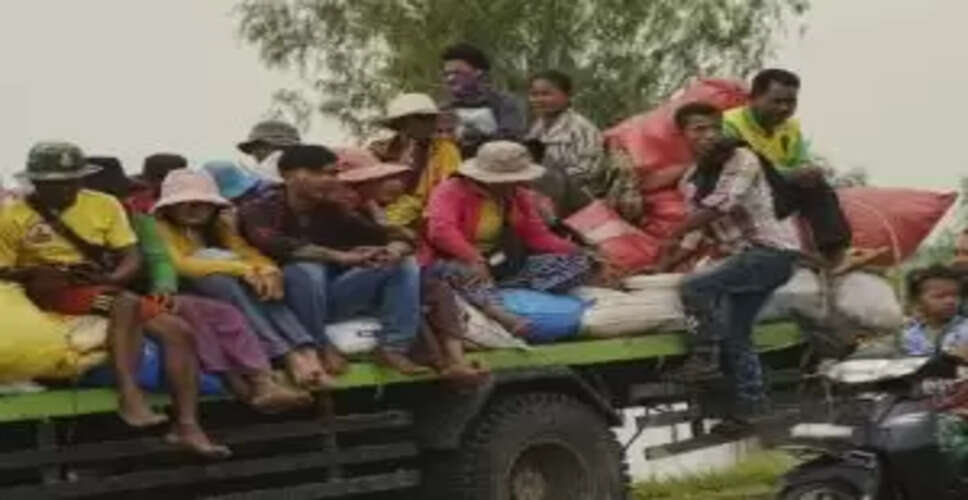
Some villagers had dug makeshift underground bunkers to protect themselves from shelling, while families were seen loading belongings onto homemade tractors to flee, although some men chose to stay behind.
A remote Buddhist temple surrounded by rice fields provided shelter for several hundred evacuees, where women rested in hammocks and children played. Makeshift plastic tents were being erected under trees.
Veng Chin, 74, expressed a plea for both governments to negotiate a resolution so he could return to his farm.
ASEAN's Role and Calls for Peace
This conflict represents a rare instance of armed confrontation among ASEAN member states, although Thailand has previously faced tensions with Cambodia and sporadic skirmishes with Myanmar.
Malaysian Prime Minister Anwar Ibrahim announced that both Thailand and Cambodia had agreed to a ceasefire and troop withdrawal, although they requested additional time before implementation.
Anwar stated he had communicated with both Cambodian leader Hun Manet and Thailand's Phumtham, urging them to create space for peaceful dialogue and offering Malaysia's assistance in facilitating discussions.
UN Secretary-General Antonio Guterres also called for restraint and encouraged both nations to resolve their disputes through dialogue.
Longstanding Border Tensions
The 800-kilometer (500-mile) border between Thailand and Cambodia has been a point of contention for decades, with previous confrontations being brief. The last significant conflict in 2011 resulted in 20 fatalities.
The current tensions escalated in May following the death of a Cambodian soldier, which strained diplomatic relations and stirred political unrest in Thailand.
The situation worsened when a landmine injured five Thai soldiers on Wednesday, prompting Bangkok to close the border and expel the Cambodian ambassador.