
Escalating Tensions: Iran's Drone Strikes and U.S. Military Response in the Gulf

Iran's Aggressive Actions in the Gulf
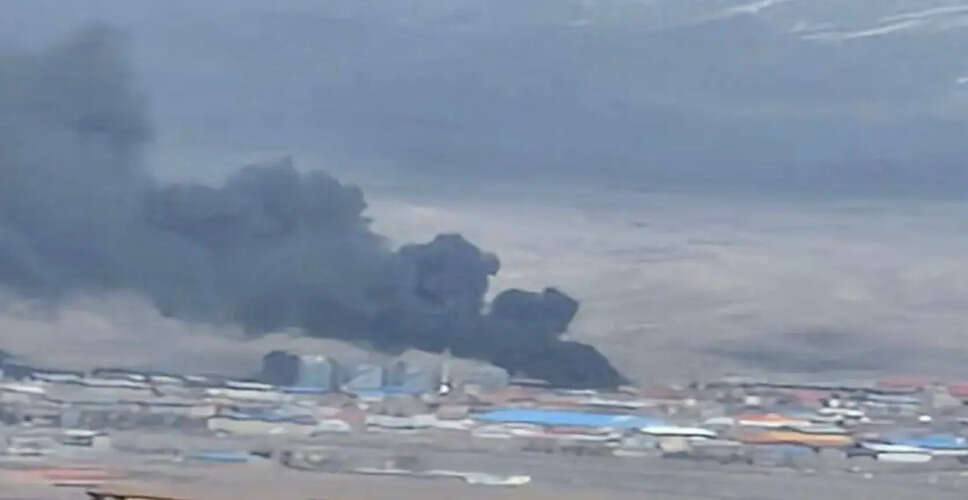
Dubai: In a significant escalation, Iran has launched drone and missile strikes targeting Bahrain and Kuwait, following recent U.S. airstrikes against its forces. Iranian officials have warned that continued U.S. military actions could lead to a complete cessation of negotiations aimed at resolving the ongoing conflict.
The situation in the Strait of Hormuz has become increasingly tense, with a multinational maritime coalition led by the U.S. Navy announcing plans to enhance shipping routes near Oman. Iranian Foreign Minister Abbas Araghchi emphasized that Tehran must maintain control over this vital waterway, which is crucial for global oil and gas transport.
Araghchi stated, "Any attempts to create new arrangements outside of Iran's oversight will only complicate matters further and delay the reopening of the Strait of Hormuz, escalating tensions in the region."
Despite being situated within Iranian and Omani territorial waters, the strait is recognized as an international passage. Recently, Iranian forces have targeted vessels navigating close to the Omani coast.
Pakistan, acting as a mediator, has announced that discussions between the U.S. and Iran regarding their interim agreement will resume on Tuesday. The Trump administration confirmed that no negotiations have been canceled and that technical discussions are proceeding as planned.
These negotiations encompass critical issues such as the management of the strait, the lifting of U.S. sanctions on Iranian ports, and the future of Iran's enriched uranium stockpile. The parties have a 60-day window to finalize the details following the signing of a memorandum of understanding earlier this month.
Ongoing violence in Lebanon poses a threat to the agreement, which stipulates that hostilities must cease before certain topics can be addressed.
Iran's Attacks on Gulf States
Strikes Targeting U.S. Military Bases
The Iranian Revolutionary Guard has claimed responsibility for the recent strikes in Bahrain and Kuwait. Kuwait's air defenses successfully intercepted Iranian drones and missiles shortly after the U.S. conducted its airstrikes in Iran, with no reported injuries or damage.
In Bahrain, an Iranian attack caused damage to a residential building near the international airport, although no fatalities were reported. Bahrain hosts the U.S. Navy's 5th Fleet, and the damaged structure was not in proximity to its headquarters.
Bahrain's Foreign Ministry condemned the strikes, labeling them as a dangerous escalation and indicative of a systematic pattern of aggression from Tehran.
Additionally, Qatar reported that a civilian was killed and another injured due to shrapnel from military operations in the vicinity after a vessel failed to return as scheduled.
U.S. Military Response and Political Reactions
Trump's Accusations Against Iran
The U.S. military has targeted Iranian military infrastructure, including surveillance systems and drone storage facilities, in retaliation for an attack on a merchant vessel. The Panamanian-flagged tanker Kiku was reportedly carrying crude oil for Qatar's state-run energy company.
President Donald Trump took to social media to accuse Iran of breaching the ceasefire agreement, warning that the U.S. might be compelled to take military action. He stated, "If that happens, the Islamic Republic of Iran will no longer exist!"
The exchange of hostilities began when an Iranian drone struck a merchant ship off the coast of Oman, prompting a U.S. military response.
Despite the heightened threat level, ship traffic through the strait has increased over the past three days, with the multinational maritime coalition reporting that U.S.-assisted commercial transits continued without interruption.
Ongoing Conflicts in Lebanon and Syria
Iran's Call for Conflict Control
In a related development, Israel and Lebanon recently signed a framework agreement aimed at ending hostilities between Israel and Hezbollah, which escalated shortly after the onset of the Iran conflict. Israel has stated it will not withdraw until Hezbollah is disarmed.
The agreement does not involve Iran or Hezbollah, both of which have criticized it and rejected disarmament demands.
Iran's foreign minister reiterated that the U.S. must compel Israel to cease its attacks and withdraw from Lebanese territory.
Sporadic clashes continue, with Hezbollah's leader asserting that the group will persist in its fight until Israel exits Lebanon.
Iran's parliament speaker has called for a meeting of a newly established "conflict control unit" involving Iran, the U.S., and Lebanon to convene promptly.
On Sunday, two strikes were reported in southern Lebanon, with no immediate reports of casualties. Additionally, Hezbollah militants reportedly killed an Israeli soldier in southern Lebanon, although Hezbollah has not commented on this incident.
Israeli Military Actions in Syria
Israel's military has targeted the village of Abdin in southern Syria's Daraa province with artillery fire, according to Syrian state media. There were no immediate reports of casualties.
Earlier reports indicated that residents had blocked access to the village to prevent Israeli forces from re-entering after a previous incursion.
The Israeli military has claimed to have killed several armed individuals in southern Syria, but no further details have been provided.