
Escalating Tensions: Iran Strikes Back as US Prepares for Major Bombing Campaign
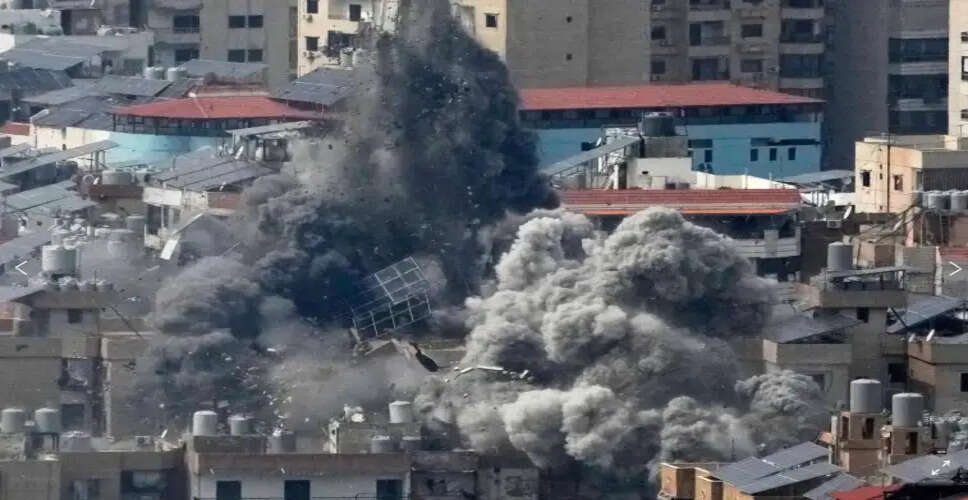
Intensifying Conflict in the Middle East
Dubai: Early Saturday, explosions erupted in Tehran, sending thick plumes of smoke into the sky as Iran retaliated against Israel by launching missiles. The United States has cautioned that a significant bombing campaign is imminent, which officials claim will be the most severe yet in the ongoing conflict.
The violence shows no signs of abating. The Trump administration has authorized a new arms sale to Israel worth USD 151 million, following Trump's declaration that he would not engage in negotiations with Iran unless it surrenders unconditionally. Iran's ambassador to the UN stated that the nation would take all necessary actions to protect itself.
Footage from the Associated Press captured explosions and smoke billowing over western Tehran as Israel announced the initiation of extensive airstrikes. Concurrently, the Israeli military reported efforts to intercept a fresh barrage of missiles launched from Iran.
The conflict's expansion was evident as sirens blared in Bahrain due to an Iranian assault on the island nation. Additionally, Saudi Arabia reported intercepting drones aimed at its Shaybah oil field and downing a ballistic missile targeting Prince Sultan Air Base, which accommodates US troops.
The US and Israel have relentlessly targeted Iran's military infrastructure, leadership, and nuclear initiatives. The objectives and timelines of the conflict have frequently shifted, with the US at times indicating a desire to overthrow Iran's government or promote new leadership from within.
In a concerning development, Russian officials have reportedly provided Iran with intelligence that could assist in targeting US military assets. Russian President Vladimir Putin expressed condolences to Iranian President Masoud Pezeshkian over the death of Iranian Supreme Leader Ayatollah Ali Khamenei during a recent phone call.
Emerging evidence suggests that a tragic explosion at a school, which resulted in numerous Iranian student fatalities, may have been caused by US airstrikes that also impacted a nearby Revolutionary Guard compound.
Qatar's energy minister, Saad al-Kaabi, warned in an interview that the ongoing war could devastate global economies, predicting a halt in Gulf energy exports that could drive oil prices to USD 150 per barrel.
On Friday, the price of benchmark US crude surpassed USD 90 for the first time in over two years.
Russia's Role in the Conflict
According to US intelligence sources, Russia has been supplying Iran with information that could enable Tehran to target American military vessels and aircraft in the region. However, these officials noted that there is no evidence suggesting that Russia is directing Iran's actions based on this intelligence.
This marks the first indication of Moscow's involvement in the conflict.
Trump's Stance on Iran's Leadership
In a social media post, Trump reiterated that there would be no agreement with Iran unless it surrenders unconditionally. He stated that following a surrender and the selection of acceptable leaders, the US and its allies would assist in rebuilding Iran, making it 'economically larger, better, and stronger than ever.'
These remarks have raised further questions regarding the war's ultimate objectives. The ongoing violence has claimed the lives of at least 1,230 individuals in Iran, over 200 in Lebanon, and around a dozen in Israel, with six US troops also reported dead.
Iranian President Masoud Pezeshkian mentioned on social media that some nations have initiated mediation efforts, though he did not provide further details.
Trump has also indicated that he should play a role in selecting a successor to Khamenei, who was killed in the initial strikes of the conflict. He dismissed Khamenei's son, Mojtaba Khamenei, a potential successor, labeling him 'a lightweight.'
Iran's UN ambassador, Amir Saeid Iravani, condemned Trump's comments, asserting that Iran will not permit any foreign interference in its internal matters.
Iranian state media reported that a leadership council has begun discussions on convening the Assembly of Experts to select a new supreme leader.
US Prepares for Major Bombing Campaign
US Treasury Secretary Scott Bessent stated in a television interview that the 'largest bombing campaign' of the conflict is still forthcoming. Israel has claimed to have heavily bombed an extensive underground bunker that Iranian leaders intended to utilize during the hostilities.
New information has surfaced indicating that a deadly explosion on February 28 at a school in Minab, located approximately 1,100 kilometers southeast of Tehran, was likely the result of US airstrikes. This information includes satellite imagery, expert analysis, and public data released by US and Israeli military forces.
Iranian state media reported that over 165 individuals, primarily children, lost their lives in the blast. Iran has attributed the explosion to Israel and the US, although neither country has accepted responsibility, with US Defense Secretary Pete Hegseth stating that an investigation is underway.
Clashes in Eastern Lebanon
Lebanon's state-run news agency reported clashes between local fighters and Israeli troops early Saturday near Nabi Chit, a Hezbollah stronghold in eastern Lebanon. There were no immediate reports of casualties, and the Israeli military did not respond to requests for comment.
Israel has conducted numerous airstrikes on southern Beirut, where Hezbollah maintains a significant presence, alongside a large civilian population.
According to Lebanon's Health Ministry, Israeli strikes have resulted in 217 fatalities and 798 injuries since Monday. Roads in Beirut were congested with evacuees as smoke billowed from the city's southern districts, prompting two hospitals to evacuate patients and staff.
"What can we do? We prayed here under the tree. During the night, we slept in the car because there is no place to stay," shared Jihan Shehadeh, one of the many displaced individuals.