
Escalating Border Clashes: Thailand and Cambodia in Deadly Conflict
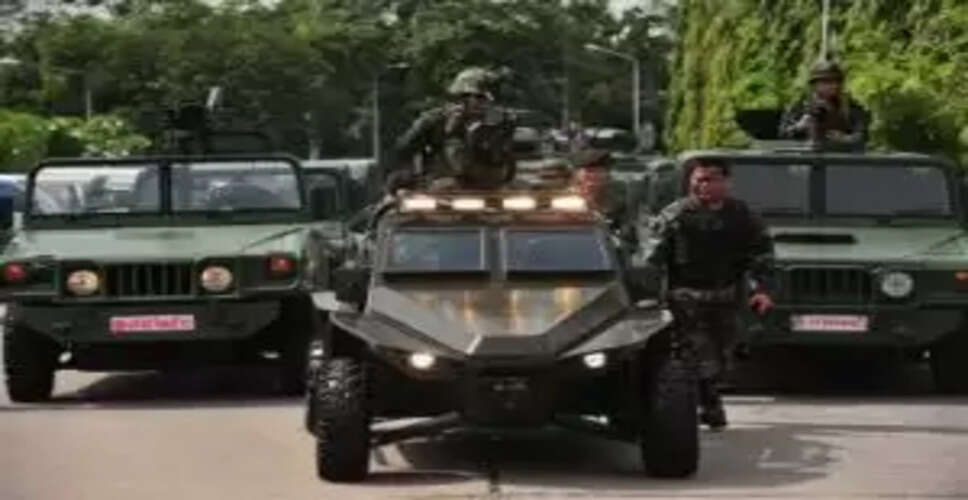
Intensifying Violence at the Thailand-Cambodia Border
Tensions along the Thailand-Cambodia border surged on Saturday as both nations accused each other of initiating new attacks, resulting in deadly confrontations for the third consecutive day. The ongoing violence has led to at least 33 fatalities and forced over 168,000 individuals to evacuate, prompting international allies to call for an immediate ceasefire.
Reports indicate artillery and small arms fire near various border villages, with the conflict escalating after a landmine explosion injured five Thai soldiers on Thursday. Officials from both countries have exchanged blame regarding the origins of the clashes.
In response to the escalating situation, both nations have recalled their ambassadors, and Thailand has shut down its border crossings with Cambodia.
Cambodian officials reported 12 additional deaths on Saturday, raising their total to 13, while the Thai military confirmed the death of a soldier, bringing their total to 20, predominantly civilians.
According to Cambodia's Information Minister Neth Pheaktra, the clashes have displaced 10,865 Cambodian families, totaling 37,635 individuals, across three border provinces. Thai authorities reported that more than 131,000 people have fled their villages near the border.
The 800-kilometer border between Thailand and Cambodia has been a point of contention for decades, although previous conflicts have typically been brief. The latest tensions began in May when a Cambodian soldier was killed, leading to a diplomatic rift and affecting Thailand's internal politics.
International Calls for Peace Amidst Ongoing Conflict
On Saturday, President Donald Trump announced on Truth Social that he had discussions with leaders from both Thailand and Cambodia, suggesting that he would refrain from finalizing a trade agreement with either nation if the hostilities persisted. He later indicated that both parties had agreed to meet for ceasefire negotiations.
However, officials from both countries have not confirmed any plans for a meeting.
Trump's remarks came amid increasing pressure on the Association of Southeast Asian Nations (ASEAN) to mediate the escalating tensions between its member states.
During an emergency session on Friday, the UN Security Council urged for de-escalation and called upon ASEAN to facilitate a peaceful resolution. Although no formal resolution was passed regarding the crisis, Thai Foreign Minister Maris Sangiampongsa stated that the council's 15 members advocated for restraint and an end to hostilities.
The current chair of ASEAN, Malaysia, has indicated that both Thailand and Cambodia are receptive to a ceasefire proposal. Malaysian media reported that Prime Minister Anwar Ibrahim has assigned the foreign minister to oversee peace talks, although no specific plans have been disclosed.
Maris mentioned earlier on Saturday that Thailand has tentatively agreed to ASEAN's ceasefire proposal but emphasized that Cambodia must first halt its military actions. He reiterated Thailand's commitment to resolving the conflict peacefully and in accordance with international law, urging Cambodia to engage sincerely in negotiations.
Accusations and Humanitarian Concerns Amidst the Conflict
Cambodia's Defence Ministry condemned what it termed an expanded offensive by Thailand, citing the firing of five heavy artillery shells into Pursat province as an 'unprovoked and premeditated act of aggression.'
Ministry spokesperson Lt Gen Maly Socheata expressed concerns about rising tensions in the coastal province of Koh Kong and the potential for maritime confrontations.
Reports indicate that seven Cambodian civilians and five soldiers have died in the recent fighting, with one individual reportedly killed when a pagoda sheltering him was struck by Thai rockets.
The Thai military has denied targeting civilians, accusing Phnom Penh of using 'human shields' by placing military assets near residential areas.
In a statement, Thailand's navy claimed that Cambodian forces initiated a new attack in Trat province, which borders Koh Kong, asserting that Thai forces successfully repelled the Cambodian incursion at three critical points. The navy warned that such aggression would not be tolerated.
Thai officials also alleged that several Cambodian artillery shells caused damage to properties in neighboring Laos, although Lao officials have not publicly responded to these claims.
Human Rights Concerns Amidst Military Actions
Human Rights Watch has called on the UN Security Council and other nations to urge both Thailand and Cambodia to adhere to international humanitarian law and take measures to protect civilians. The organization reported that children have been affected by the conflict, leading Thailand to close at least 852 schools and seven hospitals for safety reasons.
Both sides have utilized rockets and artillery, and after initially denying claims of using internationally banned cluster munitions, a Thai military spokesperson stated that such weapons could be deployed 'when necessary' to achieve military objectives. Human Rights Watch condemned the use of cluster munitions in populated areas.
Neither Thailand nor Cambodia is a signatory to the Convention on Cluster Munitions, which prohibits the use of such weapons. Thailand previously employed them during a border dispute with Cambodia in February 2011, resulting in 20 fatalities.
John Sifton, Asia advocacy director at Human Rights Watch, criticized both nations for neglecting international humanitarian law, which has severely impacted civilians. He emphasized that ongoing diplomatic efforts must prioritize the protection of civilians and civilian infrastructure.
Thai officials acknowledged the use of F-16 jets and drones for airstrikes during the conflict.