
Empowering Rural Livestock Farmers Through Scientific Practices

Innovative Farming Initiative in Mandi
Munish Sood
Mandi
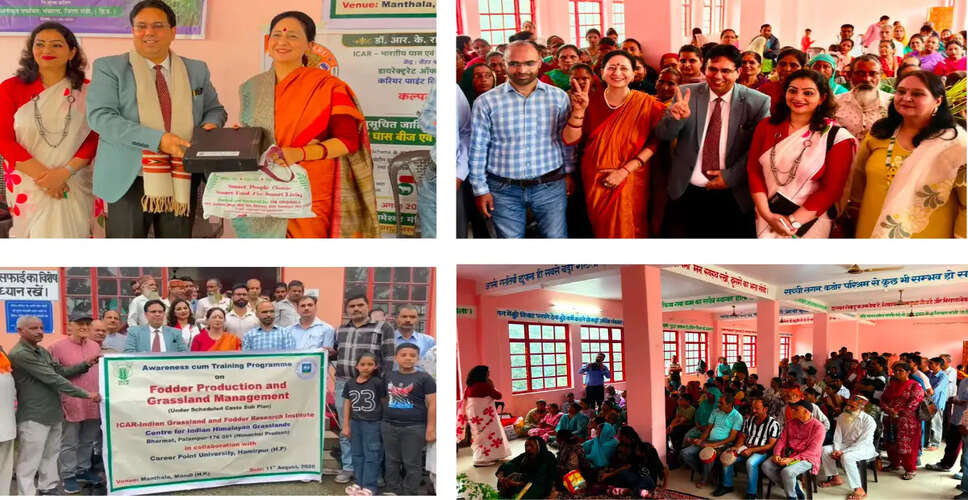
In a bid to enhance scientific farming and modern livestock techniques among rural communities, the Kalpataru Foundation, led by Prof. Anupama Singh, hosted a dedicated program for Scheduled Caste livestock farmers at Devdhar in Mandi on Tuesday. The focus was on advancing fodder production, optimizing animal nutrition, and boosting farm incomes.
The Advanced Fodder Grass Seed and Agricultural Equipment Distribution Programme took place at the Sat Bala Kameshwar Temple grounds, part of the SC-Sub Plan Scheme. This initiative was a collaborative effort involving the ICAR–Indian Grassland and Fodder Research Institute (IGFRI), the Centre for Indian Himalayan Grasslands, the Directorate of Community Services (DCS), Career Point University, Hamirpur, and the Kalpataru Foundation.
This event was held in loving memory of Dr. R.K. Raju, the father of Prof. Anupama Singh. Through this initiative, Prof. Singh and the Kalpataru Foundation aimed to link rural families with scientific insights, enhanced agricultural resources, and practical techniques that can foster sustainable livelihoods.
Over 150 farmers and livestock owners attended the event, with 100 selected Scheduled Caste livestock farmers from Manthla Panchayat receiving high-protein fodder grass seeds and root slips, including varieties like Setaria and Paspalum, along with essential agricultural tools such as spades and hoes.
Experts from ICAR–IGFRI, including Dr. Shiraz Bhatt, Surendra Paul, and Dr. Gulshan Kumar, provided education on scientific fodder cultivation, balanced animal nutrition, improved fodder varieties, and modern livestock management practices. They highlighted that access to nutritious fodder can enhance animal health and milk production, thereby increasing the income of livestock-rearing families.
During the event, Prof. Anupama Singh emphasized that rural development requires more than just financial assistance; farmers must also have access to knowledge, technology, resources, and markets to establish sustainable livelihoods.
She pointed out that quality fodder is essential for maintaining healthy livestock and improving milk production, which is crucial for the economic stability of farming families.
The program also showcased the broader mission of the Kalpataru Foundation, which aims to implement initiatives in education, healthcare, skill development, agriculture, and livelihood generation for rural communities.
Dr. Sanjeev Sharma, Vice-Chancellor of Career Point University, along with OSD Richa Sharma, Dr. Gulshan Kumar, and representatives from the university and ICAR–IGFRI, engaged with farmers to stress the importance of adopting scientific approaches in agriculture and animal husbandry.
Local leaders, including Manthla Panchayat Pradhan Praveen, Vice-Pradhan Mahesh, and members of the Sat Bala Kameshwar Temple Committee, such as President Mukesh, Prince, and Sen, were also present, providing support for the successful execution of the program.
The initiative conveyed a powerful message: “Quality Fodder, Healthy Livestock — Prosperous Farmers, Empowered Society.”
A community meal was organized for the participating farmers following the program.