
Election Commission Unveils Voting Schedule for Assembly Elections in Five States
Announcement of Voting Schedule
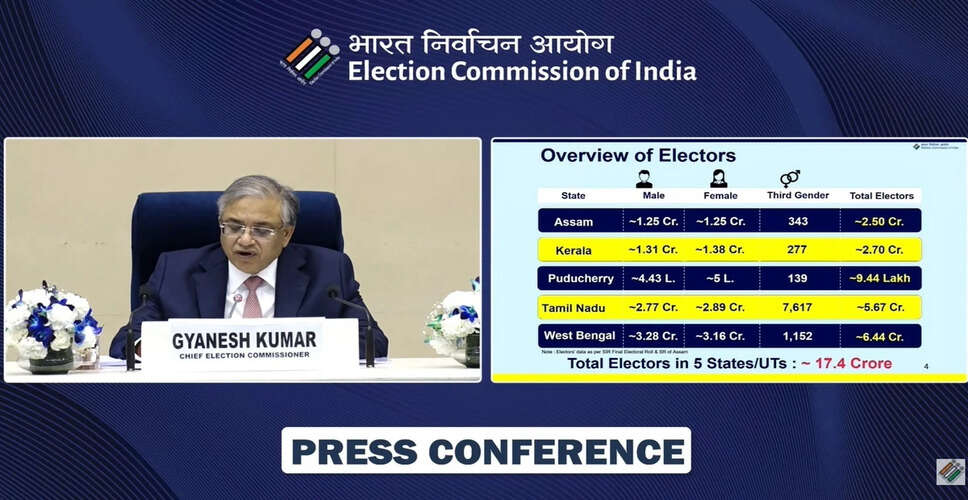
The Election Commission of India (ECI) held a press conference on March 15 (Sunday) at 4:00 PM to announce the voting schedule for assembly elections in Assam, West Bengal, Tamil Nadu, Kerala, and Puducherry. According to the announcement, voting will commence on April 9, with the counting of votes scheduled for May 4. The elections in Assam, Kerala, and the Union Territory of Puducherry will take place in a single phase on April 9, while Tamil Nadu will have its voting on April 23. In West Bengal, the elections will occur in two phases, with voting set for April 23 and April 29. The counting of votes across all states and the Union Territory will occur on May 4.
Detailed Election Schedule
Here is the complete election schedule: 1. Assam - Voting Date: April 9; Counting Date: May 4. 2. Tamil Nadu - Voting Date: April 23; Counting Date: May 4. 3. West Bengal - Voting Dates: April 23 (Phase 1), April 29 (Phase 2); Counting Date: May 4. 4. Kerala - Voting Date: April 9; Counting Date: May 4. 5. Puducherry - Voting Date: April 9; Counting Date: May 4.
Deployment of Election Officials
Additionally, the Election Commission revealed that approximately 2.5 million election officials will be deployed to conduct the assembly elections in Assam, Kerala, Tamil Nadu, West Bengal, and Puducherry. This workforce will include polling staff, security personnel, and administrative officers responsible for various aspects of the election process, ensuring that voting is conducted in a free and fair manner.
Voter Accessibility and Preparations
The Commission stated that over 219,000 polling stations will be established in the five states and the Union Territory. Officials have made extensive preparations to facilitate smooth and accessible voting for all voters. The large number of polling stations reflects the vast scale of this electoral process across diverse geographical areas. Chief Election Commissioner Gyanesh Kumar mentioned that to enhance transparency and monitoring in the voting process, 100% webcasting will be implemented at all polling stations during the 2026 assembly elections in four states and one Union Territory.
International Observers and Voter Diversity
Gyanesh Kumar also noted that representatives from over 20 countries' election commissions will observe the elections in the four states and one Union Territory. These representatives have been invited to witness the "festive, transparent, and efficient" conduct of elections in India. During a press briefing, Kumar highlighted the scale of the upcoming assembly elections, referring to the entire process as a "festival of elections." He stated that approximately 174 million voters will participate across 824 assembly constituencies, making it one of the largest electoral processes in the country.
Ensuring Accessibility and Transparency
In his address, Chief Election Commissioner Gyanesh Kumar emphasized that extensive arrangements will be made to ensure accessibility and transparency for all during the upcoming assembly elections. He also shed light on the diverse profile of voters. Kumar remarked, "To give you an idea of our voter demographics, we have centenarian voters in Assam, Kerala, Puducherry, Tamil Nadu, and West Bengal. There is also a significant number of voters aged over 85... In total, 218,000 polling stations will be established, mostly in rural areas. The average number of voters per polling station will range between 750 and 850, and will not exceed 900. Model polling stations will be set up across all states and Union Territories, with some specifically managed by women. All polling stations will feature 100% webcasting, and some will also be operated by our differently-abled citizens."