
Dubai's Stability Under Threat Amid Rising Tensions with Iran

The Fragile Reputation of Dubai
For decades, Dubai has cultivated a reputation centered on stability, which has become its most valuable asset. This reputation has overshadowed other sectors such as oil, real estate, and tourism. However, recent events have put this stability to the test. Currently, over 75% of the UAE's GDP is derived from non-oil industries. The World Bank projects a 5% growth for the UAE economy in 2026, with a slight increase to 5.1% in 2027, as noted in the Global Economic Prospects report from January 2026. Inflation rates are expected to remain low, with consumer prices estimated between 1.6% and 1.8% in 2026, according to a report by Crowe UAE. These positive indicators bolster the UAE's image as a thriving emerging market, driven by a diversified economy that no longer relies solely on oil.
Over the years, Dubai has strategically developed sectors such as tourism, trade, banking, real estate, technology, and logistics, which now serve as the primary engines of job creation and economic activity. While oil continues to play a role, it primarily acts as a financial cushion, ensuring stable government revenues and balanced budgets in line with OPEC+ production agreements. This dual-engine growth model allows Dubai to maintain a more resilient economic structure compared to many of its regional counterparts. The overarching strategy is to position Dubai as a secure haven in a tumultuous region, where financial safety, job security, and a high standard of living prevail, free from the threats that plague other areas.
To safeguard this model, the UAE has spent years fostering peace with Iran, its most formidable neighbor. Following a series of maritime attacks in 2019, the UAE opted for a peace agreement with Tehran, as reported by the Atlantic Council. However, this agreement has now been severely compromised. In the past 72 hours, Iran has launched aggressive attacks against the UAE, deploying nearly as many missiles and drones as it did against Israel during the initial hours of conflict. On Tuesday evening, loud explosions echoed across Dubai and Doha as Iran intensified its drone and missile strikes against US military presence in the region. Journalists reported hearing these explosions in both cities, while residents in Abu Dhabi also confirmed similar sounds. In response, the Dubai Media Office stated that the noises were due to successful interceptions by air defense systems, assuring the public that safety measures were being implemented and urging them to rely on official information sources.
Impact on Key Operations
Operations at Jebel Ali port, the largest container port in the Middle East, were temporarily halted after a fire broke out due to debris from an intercepted Iranian missile. This port, along with the adjacent free-trade zone, contributes significantly to Dubai's GDP, accounting for 36%. Additionally, numerous vessels near the Strait of Hormuz have been immobilized following Iranian threats to target any ships entering the strait. Fortunately, the UAE has an alternative: a pipeline from Habshan to Fujairah capable of transporting up to 1.5 million barrels of oil daily, circumventing the strait. However, this pipeline is limited to oil and cannot accommodate liquefied natural gas (LNG), which is also a vital export.
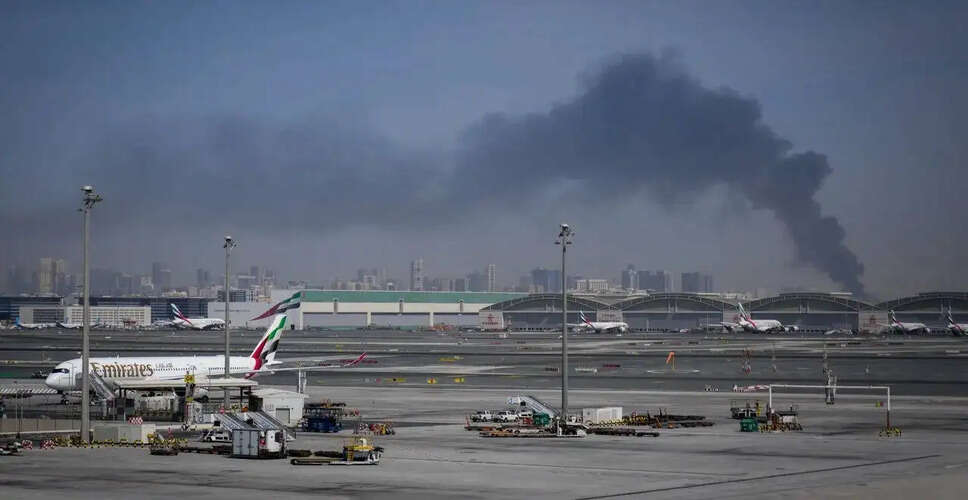
Moreover, a drone attack on Dubai International Airport, the busiest airport globally for international travel, has caused unprecedented disruptions in global travel since the COVID-19 pandemic. Airspace over Qatar, UAE, Bahrain, and Kuwait has been closed, leaving tens of thousands of passengers stranded. Dubai officials have previously warned that an unplanned airport shutdown could incur losses of $1 million per minute, with a full day of inactivity potentially exceeding $1 billion in damages across airlines, cargo, tourism, and local businesses.
Economic Resilience Amidst Crisis
Dubai has transitioned away from being an oil-dependent city, with over 95% of its GDP now stemming from non-oil sectors, as reported by the UAE government's Public Debt Management Office. The aviation sector alone contributes 27% to Dubai's GDP, valued at approximately $37.3 billion, according to a 2024 study by Oxford Economics commissioned by Emirates Group and Dubai Airports. Transportation and logistics add another 12.4% to the economy, as per official statistics. Together, Jebel Ali Port and Dubai International Airport form the backbone of an economy that has successfully evolved beyond its oil roots. The perception of safety in Dubai is crucial for these sectors, as it influences global confidence in flying into, shipping through, and investing in the city. A commentator noted that images of a five-star hotel ablaze on the Palm Jumeirah are circulating widely, impacting the perception of safety among expatriates who chose the UAE over other global cities like Singapore, London, or Zurich. This shift in perception could prove to be the most significant damage, overshadowing the physical destruction caused by the attacks.