
Discovery of Two New Snail Species in Meghalaya's Caves

New Species Uncovered in Meghalaya
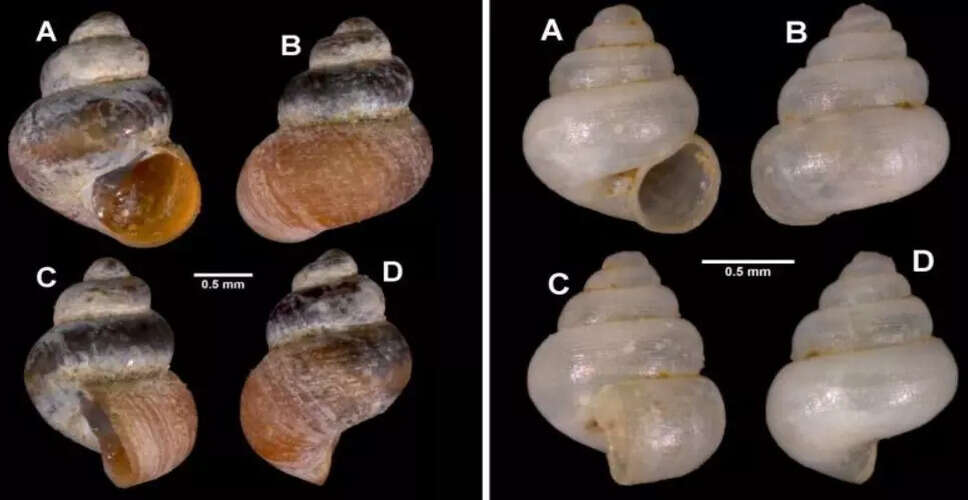
Two new microscopic snail species found in Meghalaya (Photo: Research Matters/website)
Shillong, Jun 24: In an exciting development for biodiversity in Northeast India, researchers have identified two new species of tiny, brightly colored snails residing in the limestone caves of Meghalaya.
This discovery highlights the largely uncharted underground ecosystems of the area, although experts express concerns regarding the impacts of mining and rising tourist activities, as reported on Wednesday.
The newly discovered molluscs are minuscule and often go unnoticed without the aid of a microscope.
The findings, which were published in the European Journal of Taxonomy, were made by scientists Nipu Kumar Das and Neelavar Ananthram Aravind from the Ashoka Trust for Research in Ecology and the Environment (ATREE). They named the species Georissa meghalayaensis and Acmella bensoni, based on their locations in the Krem Puri and Arwah cave systems, respectively.
Georissa meghalayaensis, located near the entrance of Krem Puri cave earlier this year, is notable for its orangish-red shell adorned with intricate mesh-like ridges, distinguishing it from similar species that typically have yellowish shells with spaced spiral lines.
This species is named after Meghalaya, where it is exclusively found.
Conversely, Acmella bensoni was discovered deeper within the Krem Puri and Arwah caves. It features a small, slightly translucent whitish shell with deeply impressed grooves and densely packed fine ribs, giving it a nearly smooth look.
This species is named in tribute to 19th-century naturalist William H Benson, a pioneer in the field of Indian malacology, which focuses on the study of molluscs.
Meghalaya is part of the Indo-Burma biodiversity hotspot, recognized as one of the richest ecological areas globally, and is home to over 1,200 limestone caves that serve as ideal habitats for shell-bearing organisms, according to the researchers.
Despite this richness, the cave-dwelling micro-fauna of the region remains poorly documented.
Alongside the two new species, the researchers also cataloged several other micro-snails from nearby Manipur and Mizoram, enhancing the understanding of these lesser-known organisms across Northeast India.
However, the scientists caution that increasing tourist activities in popular caves, such as heavy foot traffic, the installation of artificial lighting, and the construction of stairways, could disrupt these delicate subterranean ecosystems.
They also highlighted that limestone mining and habitat changes pose serious threats to these specialized species, emphasizing the urgent need for conservation efforts to safeguard the unique underground biodiversity of the region.