
Did Sonia Gandhi Really Object to Vande Mataram? BJP and Congress Clash Over Independence Day Event

Political Tensions Emerge Over National Song
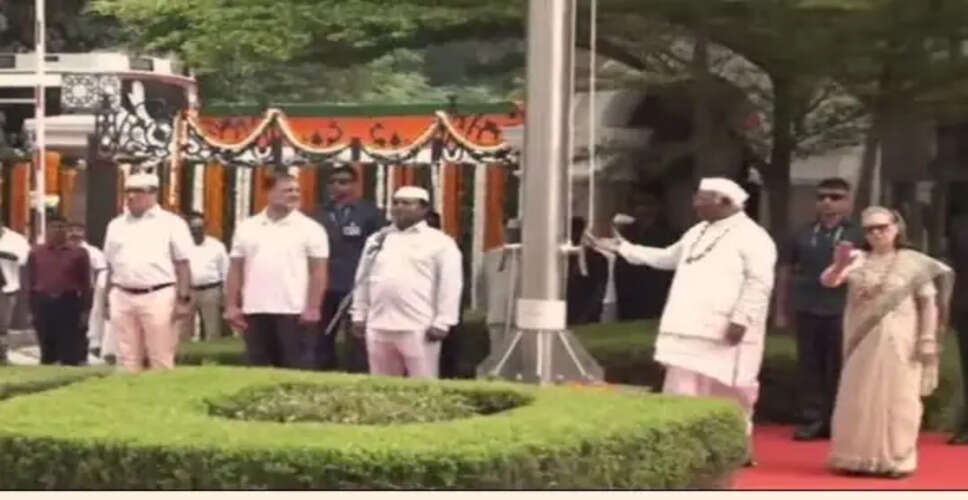
New Delhi: On Saturday, the BJP accused Congress leader Sonia Gandhi of trying to halt the full rendition of 'Vande Mataram' during the party's Independence Day celebration, a claim that the Congress party has firmly denied.
The Congress party clarified that there was no intention to prevent the full version of the national song from being sung, asserting that Gandhi was merely requesting a chair for party president Mallikarjun Kharge, who had been standing for an extended period.
BJP national general secretary B L Santhosh shared footage from the Congress event on social media, suggesting that Gandhi and her son appeared displeased with the full rendition of 'Vande Mataram'.
He remarked that certain attitudes have remained unchanged since before India's independence.
BJP spokesperson Gopal Krishna Agarwal expressed outrage over the incident, labeling it as disgraceful. He claimed that Gandhi's objections during the performance of 'Vande Mataram' reveal the Congress party's true mindset.
Agarwal emphasized that 'Vande Mataram' is not just a song but a significant emblem of India's struggle for freedom and national pride.
He questioned whether this was the same Congress that claims to uphold the legacy of the freedom movement, suggesting that their attitude towards 'Vande Mataram' reflects a bygone 'Emergency mindset'.
He concluded by stating that the citizens of India have rejected this mindset and will continue to do so.
In response, the Congress party reiterated that there was no effort to stop the full rendition of 'Vande Mataram', maintaining that Gandhi's request was solely for Kharge's comfort.
Congress general secretary Jairam Ramesh referenced a historical meeting from 1937, where it was decided that only the initial stanzas of 'Vande Mataram' would be sung at Congress sessions, following the advice of Rabindranath Tagore.
Ramesh asserted that the full version was indeed sung during the event and that there was no controversy surrounding it.
He mentioned that the matter had been thoroughly discussed in Parliament, where he provided context regarding the historical decision about the song.
Ramesh reiterated that the full version was performed at Indira Bhawan, dismissing any allegations of controversy.
BJP spokesperson Pradeep Bhandari accused Sonia and Rahul Gandhi of attempting to suppress the full rendition of 'Vande Mataram' for political gain.
He described the Congress party as suffering from a 'Dimagi Naxal mindset'.
BJP spokesperson R P Singh questioned Sonia Gandhi's apparent disdain for 'Vande Mataram', suggesting that her reaction during its performance indicated a deeper issue.
Recently, Parliament passed a bill making any insult to the national song a punishable offense, elevating 'Vande Mataram' to the same status as the national anthem, 'Jana Gana Mana'.
Amit Malviya, head of the BJP's IT department, claimed that for the first time, the entire 'Vande Mataram' was sung at the Congress headquarters on Independence Day.
He alleged that Gandhi became visibly upset during the performance and attempted to halt it, but was persuaded to allow it to continue.
Malviya stated that the new legal framework mandates respect for the complete national song, warning that any obstruction could lead to serious consequences.
He concluded by asserting that the Congress party has historically shown discomfort with a culturally confident India, a sentiment that was ironically highlighted on Independence Day.