
Delhi's Air Quality Improves Significantly After Heavy Rainfall

Impact of Recent Rainfall on Delhi's Air Quality
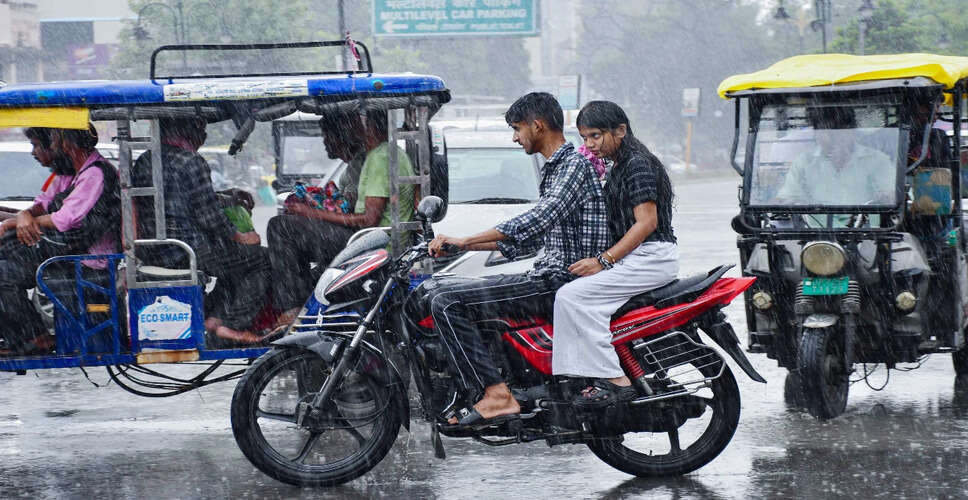
In the past two days, heavy rainfall in the Delhi-NCR region has not only slowed down daily activities but has also provided residents with a long-awaited gift: cleaner air. According to the Commission for Air Quality Management (CAQM), the air quality index (AQI) in Delhi recorded a remarkable 48 on July 9, marking it as the first 'Good Air Day' of 2026. This is a significant improvement, as the last occurrence of such clean air was on September 10, 2023.
The AQI translates various pollutants into a single number, with a range of 0 to 50 considered 'good'—the cleanest air level according to Indian standards. Such conditions are rare in Delhi. To illustrate this rarity, it's noteworthy that not a single day in 2026 has seen fine particulate matter levels within the World Health Organization's (WHO) safe limits.
In fact, the IQAir 'World Air Quality Report' indicates that Delhi was the most polluted capital globally in 2024, with an average level of fine particles at 108 micrograms per cubic meter—over 20 times the WHO's recommended limit of 5 micrograms. So, how did the city experience a day of clean air? Not through policy changes, but thanks to the heavy rains.
How Rain Cleans the Air
Scientists refer to this phenomenon as 'wet deposition,' but the process is quite straightforward. When raindrops fall, they act like tiny cleaners. They collide with airborne pollutants, particularly PM2.5 particles, which are so fine that they are about 30 times thinner than human hair and can penetrate deep into the lungs.
These raindrops capture these particles and bring them down to the ground. This process of collecting particles from the air is known as 'below-cloud scavenging.'
Rain also helps in two additional ways: it moistens roads and construction sites, effectively suppressing dust at its source, and the strong winds associated with the monsoon disperse remaining pollution instead of allowing it to accumulate over the city.
This week, all three factors came into play, with the Safdarjung weather station recording 72.6 mm of rainfall over 24 hours. However, light rain does not clean the air effectively.
Interestingly, light rain can worsen air quality. Research published in the Journal of Environmental Sciences found that heavy and prolonged rainfall significantly reduces pollution levels, while light rain can actually increase PM2.5 concentrations.
In humid air, fine particles swell and multiply, meaning that while light rain increases moisture, it does not clear the dirt. A separate study published in Environmental Monitoring and Assessment confirmed that only moderate to heavy rainfall can genuinely cleanse the air. The rainfall on Thursday was notably intense.
Will Delhi's Air Remain Clean?
Unfortunately, the answer is no. As the monsoon season ends, the calm winter winds and temperature inversion—a layer of warm air trapping cold, polluted air near the ground—will return. The pollution from traffic, industry, and burning materials in Delhi is not going anywhere. Rain is merely a temporary wash; it is not a permanent solution. Until pollution levels are reduced year-round, the city's good air days will rely solely on the mercy of the clouds, not on any solid plan.